Buying Guide
The best mini kitchen waste bins are not all designed for the same job. Some are countertop caddies for peels and coffee grounds, some hang from a cabinet door, and others are small floor bins for paper, wrappers, or light kitchen waste. This comparison uses supplied listing descriptions and specifications only. It is not a hands-on test and does not summarize customer opinions.
Start with the waste stream
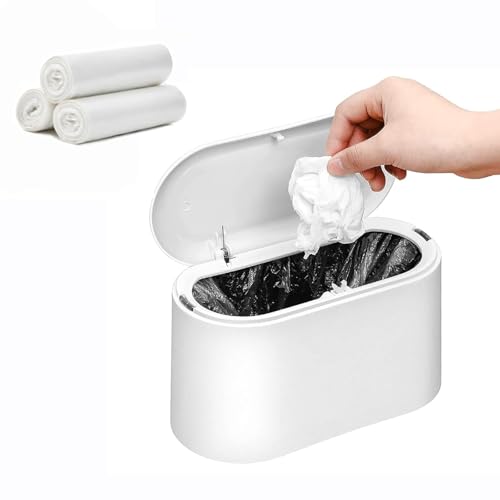
First decide what the bin will collect. A dedicated food-scrap caddy should have a lid and a location near food preparation. LALASTAR, EKO Puro, Dullrout, and Gleynest specifically discuss composting or food waste. A general desktop bin such as EKO Fandy, JILLICK, or SUBEKYU may be better for napkins, wrappers, coffee grounds, or other light refuse.
Capacity is the next choice. The smallest selected models hold 1.5 liters or 0.5 gallon, which preserves counter space but may need frequent emptying. LALASTAR and EKO Puro provide 3-liter capacities for compact collection. Glad Roomate reaches 7 liters, while Gleynest lists 2.6 gallons. Larger capacity can reduce trips to the main container, but it also makes cabinet clearance and filled-bin handling more important.
Measure the intended location
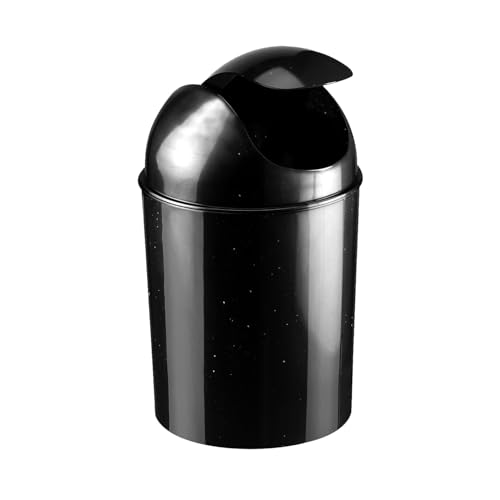
Do not rely on the word mini alone. Check width, depth, and height against the place where the bin will sit. EKO Fandy is 4.7 inches in diameter and 6.5 inches high, while JILLICK is 4.7 inches across and 5.3 inches high. These dimensions suit crowded surfaces. SUBEKYU is only 5.1 inches high but extends 8.6 inches in length, so it is low-profile rather than especially short from front to back.
For under-counter spaces, Glad Roomate measures 7 by 9.5 by 9.5 inches. Umbra is narrower at 7.5 inches but much taller at 12.5 inches. Gleynest is 9.4 inches high and 6.3 inches wide, with a listed length of 10.2 inches. Compare all three dimensions and account for cabinet doors, nearby plumbing, handles, and lid movement.
Choose a placement style
Countertop bins are simplest when a clear surface is available. Dullrout includes an anti-slip base, while the smaller EKO Fandy, JILLICK, and SUBEKYU are designed for tabletops and counters. A floor bin such as Umbra may be preferable when you want to keep food-preparation surfaces clear.
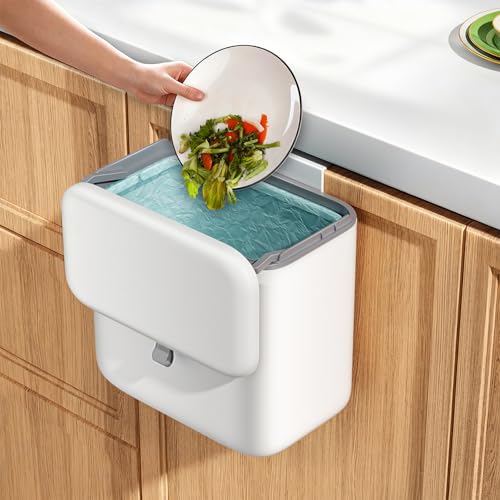
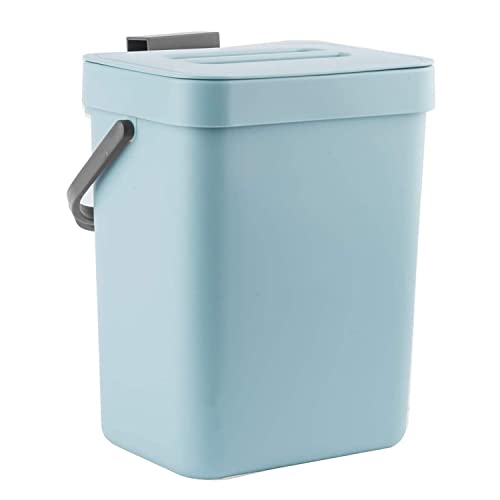
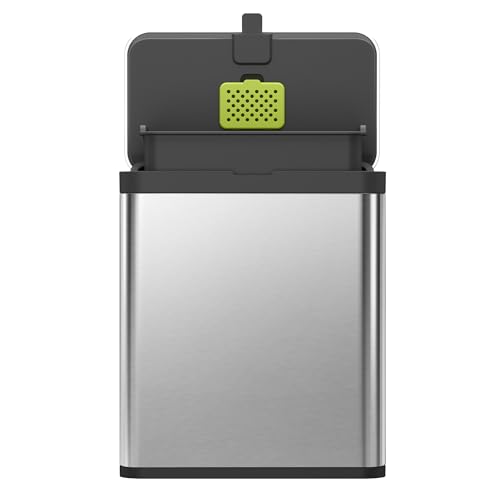
Hanging and mounted bins can save counter space. Glad Roomate can stand alone or hang with a plastic hook or adhesive hanger. EKO Puro documents countertop, cabinet-door, and wall placement. LALASTAR can hang on cabinet doors or mount with an adhesive pad. Gleynest supports hanging, adhesive mounting, and freestanding use. Verify that the cabinet-door thickness and surface are compatible with the supplied hardware; the Gleynest listing specifically notes a door-thickness limit for its hook.
Compare lid behavior
A lid can conceal waste and help contain odors, but the opening mechanism affects convenience. Swing lids on EKO Puro, Umbra, EKO Fandy, JILLICK, and SITAKE allow quick disposal without removing a full cover. Glad Roomate adds flip-back and slide-front modes, giving one approach for quick access and another for keeping the opening available during cleanup.
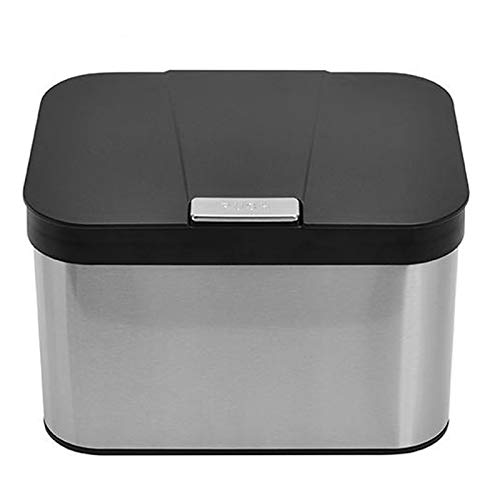
Dullrout documents an airtight flip lid and press-button opening. SUBEKYU describes a fingertip lid and hidden bag arrangement. A retaining ring, where provided on EKO Puro and Gleynest, is useful for keeping a liner from slipping into the bin.
Look at materials and maintenance
Plastic is common in this category because it keeps weight down and is generally easy to wipe. Glad lists plastic construction, LALASTAR uses plastic, and Gleynest specifies ABS plastic. SITAKE also lists plastic with a smooth inner surface. For a more finished appearance, Dullrout combines stainless steel and plastic, while EKO Fandy lists a stainless-steel base and PP body.
Cleaning claims should be read narrowly. Easy to clean generally means the listing describes a wipeable or smooth surface; it does not establish stain resistance after long-term use. Removable lids, smooth interiors, and accessible liner rings can make routine emptying more manageable. Dullrout’s anti-slip base and fingerprint-resistant exterior are documented design details, while Umbra’s removable lid supports access to the interior.
Consider bags and liner management
A small bin is easier to keep tidy when the liner stays in place and excess material is concealed. EKO Puro and Gleynest list liner rings. SUBEKYU describes a hidden trash-bag design, and SITAKE includes 120 bags with its two-bin package. Those details can matter if the bin will collect wet scraps or frequently handled waste.
Included bags do not establish that every future liner will fit. Check the bin’s opening and the dimensions of available bags before relying on a specific liner type. For food scraps, emptying frequency, leak prevention, and the ability to wipe the interior may matter more than the number of bags supplied.
Final recommendation
Glad Roomate Under Counter Waste Bin ranks first overall in this specification-based comparison under the published weighted criteria.
Among the best mini kitchen waste bins, Glad Roomate is the highest-scoring returned product and the first overall specification-based choice. Its 7-liter capacity, dual lid, compact dimensions, and freestanding or hanging setup make it the most balanced option here. For the top mini kitchen waste bins with wall or cabinet flexibility, EKO Puro is the most specification-aligned smaller alternative, while LALASTAR is a practical food-scrap caddy. Choose Gleynest for a larger hanging format, Dullrout for a sealed countertop compost design, or Umbra for a taller floor bin. EKO Fandy, JILLICK, SITAKE, and SUBEKYU are better matched to lighter waste and very small surfaces.
Frequently Asked Questions
How do I choose among the best mini kitchen waste bins for food scraps?
Look for a documented lid, suitable capacity, and placement near food preparation. LALASTAR and EKO Puro are explicitly presented for food scraps or composting and provide compact lidded designs. Dullrout offers a larger 1.13-gallon countertop format with an airtight lid. For greater capacity, Glad Roomate or Gleynest may reduce emptying frequency, provided the location can accommodate them.
Are cabinet-hanging mini bins better than countertop bins?
Neither style is universally better. Hanging models can preserve countertop space and keep the opening near a work area, while countertop models are simpler to place and remove. Glad Roomate, EKO Puro, LALASTAR, and Gleynest document hanging or mounting options. EKO Fandy, Dullrout, JILLICK, and SUBEKYU are primarily surface-oriented choices in the supplied evidence.
What capacity is practical for a small kitchen?
A practical capacity depends on how much waste you create and how often you empty the bin. A 1.5-liter bin suits light waste and takes little room. A 3-liter caddy provides more food-scrap room while remaining compact. Glad Roomate’s 7-liter capacity and Gleynest’s 2.6-gallon capacity are more suitable when fewer emptying trips are a priority, provided the location can accommodate them.
Do all mini waste bins include a liner holder?
No. EKO Puro and Gleynest specifically list liner rings, while SUBEKYU describes a hidden bag design. SITAKE includes bags with its two-bin package. For the other selected products, the supplied evidence does not establish a dedicated liner-retention feature, so check product details and intended bag fit before buying.
What should I measure before ordering?
Measure available width, depth, and height, then check lid clearance and cabinet-door thickness if mounting. Compare those measurements with the listed dimensions: EKO Fandy is compact and cylindrical, SUBEKYU is short but longer, Umbra is narrow but tall, and the hanging Glad Roomate, LALASTAR, and Gleynest models need room for their mounting arrangements. A precise fit check is especially important under counters and inside cabinets.