Buying Guide
Selecting the best diamond core drill bits starts with identifying the hole, the material, and the machine. A tile hole saw and a concrete coring bit both use diamond cutting surfaces, but their sizes, connections, depths, and operating requirements can be very different. The products above therefore fall into two practical groups: compact hole-saw sets for tile and stone, and dedicated core bits for deeper masonry penetrations.
Match the bit to the material
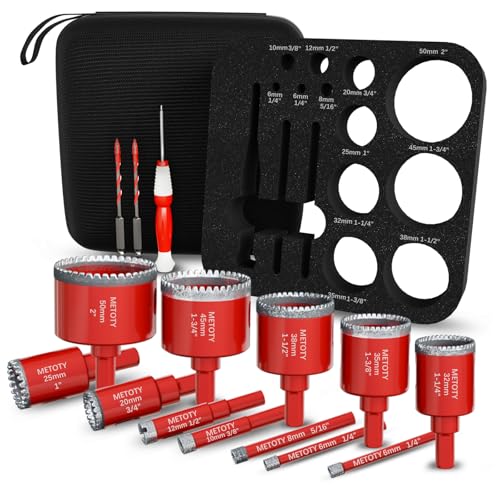
Tile-focused sets are the most flexible choice for ceramic, porcelain, glass, marble, granite, and ordinary stone. METOTY, ZNXIMER, DKIBBITH, DECKRKAT, and Hacaroa all document combinations of those surfaces. METOTY and ZNXIMER cover the widest hole-size ranges among the tile-oriented options, while DKIBBITH, DECKRKAT, and Hacaroa concentrate on smaller openings.
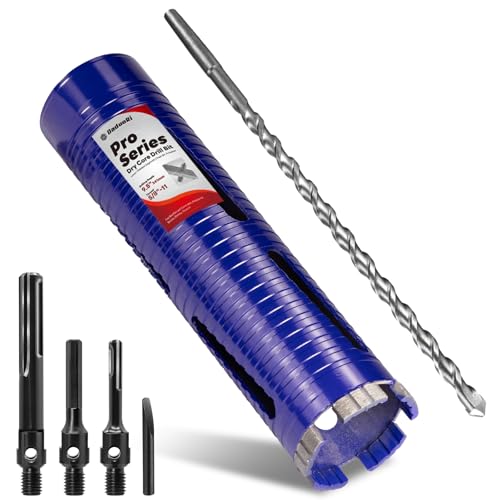
For concrete, brick, block, cement, or masonry, choose a product whose listing explicitly names those materials. SALI, DaduoRi, and SHDIATOOL are the stronger matches in this comparison. The 2-inch SALI bit is intended for concrete, red brick, cinder block, asphalt, rock, and related materials. The DaduoRi 2-1/2-inch set names low- to medium-reinforced concrete with rebar, while the SALI 1-inch bit lists reinforced concrete and a range of masonry surfaces.
Do not treat every diamond-coated bit as interchangeable. A product can be genuine without being suitable for every substrate or opening.
Choose the right diameter range
A broad set is useful when the final hole size is not yet fixed or when one project includes several fixtures. METOTY includes 15 listed sizes from 6 mm to 50 mm. ZNXIMER includes 11 sizes over the same broad endpoints. Those sets are better suited to varied tile installations than a one-size bit.
Compact sets can be more efficient for repeated small holes. DKIBBITH includes sizes from 3/16 inch to 5/8 inch, DECKRKAT covers 3/16 inch to 1/2 inch, and Hacaroa focuses on 1/4 inch, 5/16 inch, 3/8 inch, and 1/2 inch. Hacaroa supplies repeated pieces in those sizes, which may be useful when a job calls for several holes of the same diameter.
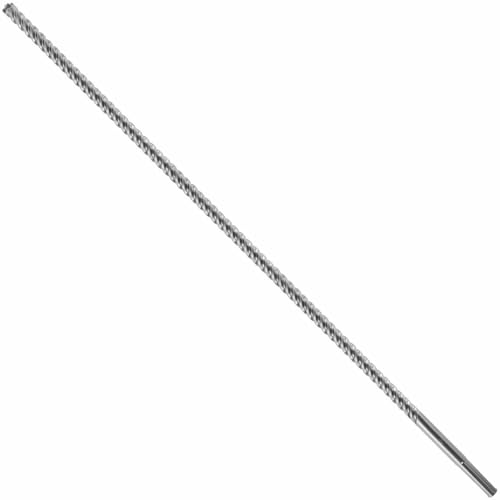
Dedicated masonry bits should be selected by both diameter and depth. The SALI 2-inch bit lists a 10-inch barrel depth, the SALI 1-inch bit lists 15 inches, DaduoRi’s 1-1/2-inch bit lists 14 inches, and the DaduoRi 2-1/2-inch bit lists 9.5 inches of depth. These specifications are not interchangeable: a larger diameter does not automatically mean a deeper bit.
Compare dry and wet drilling
Dry drilling is convenient where water cannot be used, but the supplied listings still emphasize cooling practices. DKIBBITH uses integrated wax lubricant and advises letting the bit cool after each hole. Hacaroa also uses wax filling and says water can be added after the wax runs out. These are compact, tile-oriented designs rather than a promise of unlimited dry operation.
METOTY, ZNXIMER, and ZNXIMER’s documented kit designs support dry and wet use. METOTY identifies heat resistance and self-cooling, while its listing says adding water can extend tool life and help prevent overheating. ZNXIMER similarly describes dry and wet cutting and recommends water for optimized performance and extended lifespan.
Dedicated masonry products may require a specific method. The SALI 1-inch bit is wet-only, so it suits users equipped to manage water during coring. SHDIATOOL allows dry or wet drilling and states that wet use can prolong segment life. The SALI 2-inch bit is described as best used dry. Follow the listed operating method rather than assuming that a wet-capable bit and a dry-only bit can be used in the same way.
Check the shank, thread, and machine
Tool connection is one of the most important specifications. DKIBBITH uses a round shank compatible with popular electric drills. DECKRKAT also lists a round shank for electric drills, angle grinders, and bench drills. Hacaroa uses a 1/4-inch hex shank and specifically lists ordinary electric and impact drills.
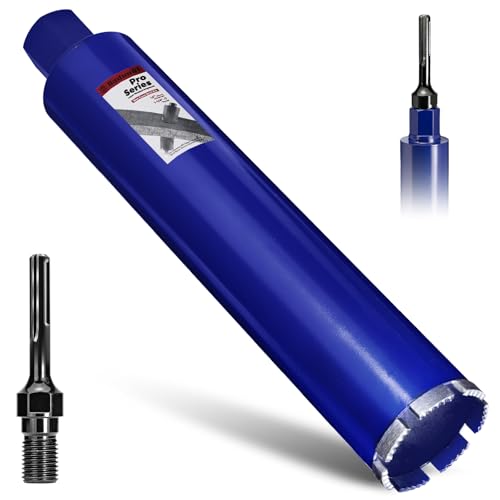
The 5/8-11 thread appears on several focused bits. SHDIATOOL lists that connection for angle-grinder use and notes that an adapter may be required for a drill or other machine. The DaduoRi 2-1/2-inch set includes adapters to SDS Plus, SDS Max, and 1/2-inch hex, while the SALI 2-inch bit includes two adapters. These accessories broaden compatibility, but they do not remove the need to verify the tool’s speed, mode, spindle, and mounting requirements.
The DaduoRi 1-1/2-inch bit uses a 1-1/4-7 thread and is specified for handheld core drills or dedicated core-drill rigs. It is not a general-purpose bit for a standard household drill. This distinction matters especially for deep concrete work, where the tool and support arrangement are part of the practical setup.
Look for positioning and debris control
Starting a hole accurately can be difficult, particularly on smooth tile. METOTY and ZNXIMER include EVA positioner guides. Their guides are intended to help hold the hole saw in position and reduce slipping at startup. Hacaroa, DKIBBITH, and the small SHDIATOOL set instead describe starting at an angle and gradually bringing the bit upright; those listings also mention wax cooling or depth details.
Debris removal is another useful design detail. METOTY and DECKRKAT list side flutes, while METOTY and ZNXIMER describe serrated or chip-clearing designs. The SALI bits identify chip-removal holes, and SHDIATOOL uses laser-welded segments. These features describe construction and intended operation, but they are not substitutes for correct pressure, alignment, cooling, or material selection.
Final recommendation
METOTY 15-Piece Diamond Core Bit Set ranks first overall in this specification-based comparison under the published weighted criteria.
The final choice among the best diamond core drill bits depends on the documented features that match your intended use.
METOTY 15-Piece Diamond Core Bit Set is the highest-scoring returned product and the first overall specification-based choice. Its 6 mm-to-50 mm range, dry/wet design, guide jig, storage case, and documented compatibility with several hard surfaces give it the broadest project coverage. Among the top diamond core drill bits, ZNXIMER is a close alternative when an 11-piece tile assortment and guided positioning are more important.
For smaller holes, DKIBBITH is the most balanced assorted set, DECKRKAT is a compact option, and Hacaroa is the clearest hex-shank choice. For masonry, select by the required opening and depth: SALI covers both a deep 1-inch wet bit and a 2-inch bit, DaduoRi offers 1-1/2-inch and 2-1/2-inch options, and SHDIATOOL provides a 35 mm dry/wet single-bit design. Verify the connection and operating method before ordering.
Frequently Asked Questions
Are the best diamond core drill bits suitable for both tile and concrete?
Not automatically. Tile-oriented sets such as METOTY and ZNXIMER document ceramic, porcelain, glass, granite, and marble, while dedicated products such as the SALI and DaduoRi bits document concrete, brick, block, or reinforced masonry. Match the substrate language in the listing to the material you will drill.
Should I choose a dry or wet diamond core bit?
Choose based on the work area and the product specification. Dry-capable sets such as DKIBBITH and Hacaroa use wax cooling, while METOTY, ZNXIMER, and SHDIATOOL document dry/wet flexibility. SALI’s 1-inch bit is wet-only, so it requires water management and suitable equipment.
What size range is best for tile installation?
A broad range is helpful when fixture sizes vary. METOTY spans 6 mm to 50 mm, and ZNXIMER covers the same endpoints with 11 listed sizes. For mostly small holes, DKIBBITH, DECKRKAT, or Hacaroa may be easier to organize and sufficient for the documented diameters.
Do these bits fit a standard electric drill?
Some do, but the connection must be checked. DKIBBITH and DECKRKAT list round shanks, and Hacaroa lists a 1/4-inch hex shank for electric drills. Many larger core bits use 5/8-11 or 1-1/4-7 threads and may require an angle grinder, handheld core drill, rig, or adapter.
What should I verify before buying a concrete core bit?
Confirm the hole diameter, stated drilling depth, material coverage, thread or shank, operating mode, and cooling requirement. For example, the SALI 1-inch bit is wet-only and lists 15 inches of depth, while DaduoRi’s 2-1/2-inch set is rotation-only and includes adapters. These details determine whether the bit matches the machine and job.