Buying Guide
The best elementary algebra books combine clear explanations, well-organized practice, and a structure that matches the learner’s starting point. This guide walks through the main buying considerations for anyone comparing the best elementary algebra books for self-study, tutoring, homeschool, or classroom support.
Match the Book to the Learner’s Starting Point
Beginners benefit from a title that introduces variables, expressions, and equations from scratch. A guided beginner path like Algebra I for Beginners (Effortless Math Education) explains each step in sequence, while a workbook such as Algebra for Beginners: With Answers (Libro Studio) adds a step-by-step answer key for independent checking. Learners refreshing old skills may prefer a review-focused book such as McGraw-Hill Education Algebra I Review and Workbook, which condenses Algebra I essentials into practice-friendly chapters.
Look for Strong Exercise Structure
Workbooks vary widely in how exercises are organized. The Beginning Algebra Skills Practice Workbook (Zishka Publishing) concentrates on a tight set of core operations such as factoring, distributing, FOIL, and combining like terms, which makes it a strong drill tool. By contrast, full textbooks such as Elementary Algebra (Master Books) and Elementary Algebra (Pearson) combine instruction with broader exercise sets across multiple chapters.
Consider Explanation Style and Clarity
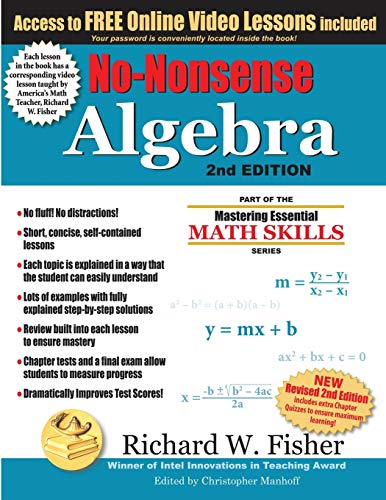
Some books lead with friendly, conversational explanation, as seen in the Algebra I Workbook For Dummies. Others use a more formal textbook voice, such as Elementary Algebra (Pearson) and Elementary Algebra (Chemeketa Press). No-Nonsense Algebra, 2nd Edition (Math Essentials) uses a stripped-down, step-by-step style intended to remove distractions and focus on essentials. Choosing the right tone can keep a learner engaged through challenging chapters.
Format influences how a book is used day to day. Paperback workbooks are lightweight and easy to write in, while hardcover textbooks like Elementary Algebra (Pearson) hold up better on a shelf or in a classroom. Color and illustration count: Elementary Algebra (Master Books) features vivid full-color images, McGraw-Hill Education Algebra I Review and Workbook includes fifty illustrations, and Elementary Algebra (Chemeketa Press) uses a multi-color interior. Learners who prefer plain, low-distraction pages may still prefer the more economical black-and-white workbooks.
Balance Coverage and Depth
If a learner needs a single volume to cover a full course, broader textbooks such as Elementary Algebra (Master Books), Elementary Algebra (Pearson), and Elementary Algebra (Chemeketa Press) offer wider topic sweeps. If the goal is to strengthen specific skills, a focused workbook such as the Beginning Algebra Skills Practice Workbook (Zishka Publishing) or the Essential Prealgebra Skills Practice Workbook (Zishka Publishing) can fill the gaps more efficiently. Pairing a textbook with a practice workbook is a common approach for serious learners.
Think About Progression and Pacing
Books that progress in small, manageable steps work well for nervous beginners and for tutors who want predictable pacing. No-Nonsense Algebra, 2nd Edition (Math Essentials) and Algebra for Beginners: With Answers (Libro Studio) both build skill sequences gradually, the latter through a daily 100-day practice structure. Faster-paced textbooks assume the learner can absorb larger concept blocks per chapter and may be better suited to classroom settings.
Final recommendation
Elementary Algebra (Master Books) ranks first overall in this specification-based comparison under the published weighted criteria.
For a single, specification-based choice that combines broad topic coverage, illustrated explanations, and adaptable curriculum design, Elementary Algebra (Master Books) stands out as the first overall specification-based choice among the best elementary algebra books in this category. Learners who want maximum drill time on core operations should pair it with a focused workbook such as the Beginning Algebra Skills Practice Workbook (Zishka Publishing), and those refreshing fundamentals can reinforce lessons with McGraw-Hill Education Algebra I Review and Workbook. Together, these selections illustrate why the top elementary algebra books work best when matched to the learner’s stage rather than treated as interchangeable.
Frequently Asked Questions
What should I look for when comparing the best elementary algebra books?
Focus on topic coverage, explanation clarity, exercise structure, and format. A book that pairs instruction with practice, such as Elementary Algebra (Master Books) or No-Nonsense Algebra, 2nd Edition (Math Essentials), tends to support a wider range of learners than a pure drill book.
Are workbooks enough, or do I need a full textbook?
Workbooks like the Beginning Algebra Skills Practice Workbook (Zishka Publishing) and Algebra for Beginners: With Answers (Libro Studio) are strong for skill reinforcement, especially when they include answer keys. A full textbook such as Elementary Algebra (Pearson) or Elementary Algebra (Chemeketa Press) is better when you need conceptual explanations and a complete course sequence.
Which book is best for a student returning to algebra after time away?
A review-focused workbook such as McGraw-Hill Education Algebra I Review and Workbook condenses key ideas into manageable chapters, making it a practical refresher. Combining it with a clear beginner text like Algebra I for Beginners (Effortless Math Education) can rebuild confidence.
How do I choose between a paperback workbook and a hardcover textbook?
Paperbacks are lighter and easier to write in, which suits daily practice with titles like the Algebra I Workbook For Dummies. Hardcovers like Elementary Algebra (Pearson) are more durable and may hold up better as long-term reference on a shelf.
Do illustrations and color really matter in an algebra book?
Color and illustrations, such as those in Elementary Algebra (Master Books), McGraw-Hill Education Algebra I Review and Workbook, and Elementary Algebra (Chemeketa Press), can make diagrams and worked examples easier to follow. Learners who prefer minimal visual styling can still succeed with a plain workbook such as the Essential Prealgebra Skills Practice Workbook (Zishka Publishing).