Buying Guide
The best ethernet network transceivers are selected by matching the host slot, Ethernet rate, cable medium, and required distance. A module can have the right connector yet still be unsuitable if the switch expects a different SFP generation, a coded vendor profile, or another fiber type. Treat product titles as starting points, then verify the compatibility notes before deployment.
Start with the host slot
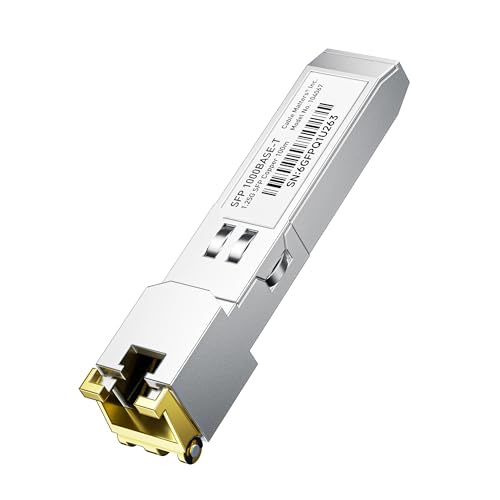
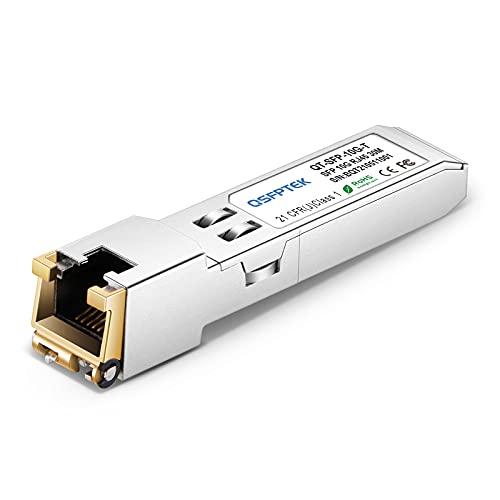
SFP and SFP+ are related but are not interchangeable in every device. The Cable Matters 1000BASE-T module is built around a 1G SFP connection, while the XZSNET, Wiitek, QSFPTEK, NataLink, QINIYEK, and 10Gtek products are SFP+ copper modules aimed at 10G-capable slots. Fiber products also use SFP or SFP+ form factors, but their host requirements follow the documented Ethernet standard.
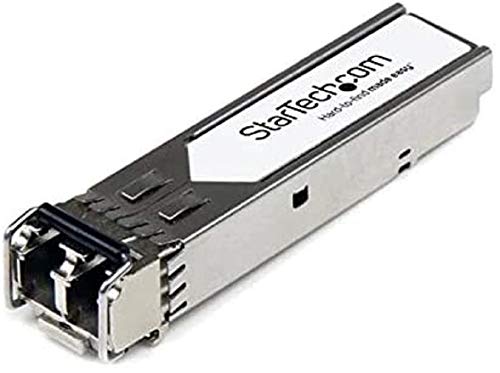
Check the switch, router, server, or NIC documentation for supported module speeds and coding. A module may follow the MSA specification without being supported by every host. Compatibility is especially important with specialized products: the StarTech.com Palo Alto Plus-LR is programmed for Palo Alto Networks Plus-LR equipment, and the QINIYEK listing identifies exclusions for some Cisco Nexus and Meraki series devices.
Choose copper or fiber
Copper SFP modules convert a host’s pluggable slot to an RJ45 connection. They are useful when installed cabling is twisted-pair Ethernet rather than optical fiber. The Cable Matters 1G unit supports Cat5e or higher cable and up to 100 meters. Most selected 10G copper modules specify Cat6a or Cat7 cable, with a 30-meter limit. Wiitek is the notable exception, documenting up to 100 meters with Cat6a/7 cable.
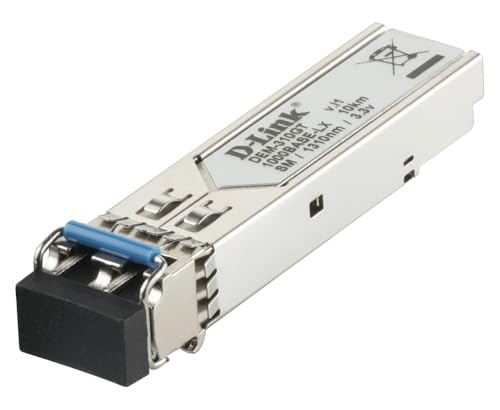
Fiber modules fit links that are already optical or require a distance beyond the selected copper modules’ documented limits. The StarTech.com Plus-LR uses single-mode fiber and reaches up to 10 kilometers. The D-Link DEM-310GT also uses single-mode fiber for up to 10 kilometers, but at 1G. The GESD pair is a short-range 10GBASE-SR option for 850nm multimode fiber and lists up to 400 meters.
Do not select by connector alone. Copper modules use RJ45, while the selected fiber modules use LC or LC/UPC interfaces. Fiber mode, wavelength, and transceiver standard must match at both ends. The GESD pair specifically names OM1, OM2, OM3, and OM4 multimode fiber. The LR and LX products document single-mode operation.
Match speed and negotiation
A fixed-rate module can be appropriate when both endpoints are known. The StarTech.com product is a 10GBASE-LR module, the GESD pair is 10GBASE-SR, and the D-Link module is 1000BASE-LX. These designs make the intended link standard easy to identify.
Multi-rate copper modules provide flexibility when a network includes different supported speeds. XZSNET, NataLink, and QINIYEK list 1G-class or 1.25G, 2.5G, 5G, and 10G auto-negotiation. Wiitek lists 1G/2.5G/5G/10GBASE-T support. This can help when the same physical port may connect to equipment with different supported copper capabilities, but the host still has to support the module and negotiated mode.
For a gigabit-only SFP slot, Cable Matters is the more directly aligned selection. It lists 1000BASE-T operation up to 1.25Gbps and backward compatibility with 10/100 Ethernet. Its standards references include IEEE 802.3ab and SFP MSA, which provide useful verification points for a compatible host.
Consider distance and thermal conditions
Distance is not an interchangeable specification. The 30-meter limit appearing on several 10G copper modules assumes the listed cable type, while Wiitek documents a 100-meter 10G copper link. Fiber reach depends on fiber mode and optical standard: the GESD SR pair lists 400 meters on multimode fiber, whereas the StarTech.com LR and D-Link LX modules list 10 kilometers on single-mode fiber.
Thermal information is also worth checking in dense switch installations. QSFPTEK lists a maximum power figure of 2.5W and a -20°C to 70°C working range. NataLink lists no more than 2.5W and 0°C to 70°C. Wiitek specifies 1.65W at 100 meters. By contrast, 10Gtek warns that its module may get hot and suggests ambient temperatures below 50°C. These details do not replace the host’s thermal guidance, but they help identify deployment constraints.
Look for installation and monitoring features
Hot-swapping appears across many selected products, including XZSNET, Cable Matters, QSFPTEK, QINIYEK, Wiitek, 10Gtek, StarTech.com, and D-Link. This can simplify insertion or replacement without shutting down the network device, provided the host supports that procedure. MSA references and plug-and-play wording are useful evidence, but they do not replace host compatibility checks.
For monitoring, the StarTech.com Plus-LR and GESD SR modules list Digital Diagnostic Monitoring. The StarTech.com listing says DDM can report transceiver status to compatible SNMP management tools. That makes DDM relevant when link diagnostics are part of the network design. Copper alternatives in this comparison emphasize negotiation and physical connectivity instead.
Final recommendation
StarTech.com Palo Alto Plus-LR SFP+ ranks first overall in this specification-based comparison under the published weighted criteria.
The final choice among the best ethernet network transceivers depends on the documented features that match your intended use.
StarTech.com Palo Alto Plus-LR is the highest-scoring returned product and the first overall specification-based choice. Its 10GBASE-LR standard, single-mode fiber design, LC connector, DDM support, and documented 10-kilometer reach create the clearest long-distance 10G profile, provided the host is compatible with the Palo Alto Plus-LR programming.
For a longer copper run, choose Wiitek 10G SFP+ to RJ45 100m because its listing documents up to 100 meters and a 1.65W maximum figure at that distance. Cable Matters 1000BASE-T SFP to RJ45 is the clearer fit for a standard gigabit SFP port and a 100-meter Cat5e-or-higher copper run.
For short-range fiber, choose the GESD 10GBASE-SR LC Multimode Pair for a two-ended 10G multimode setup. D-Link DEM-310GT is a suitable documented alternative for 10-kilometer gigabit single-mode service. These are among the top ethernet network transceivers here because their media, standards, connector, and reach details are clearly stated.
Frequently Asked Questions
What should I verify before buying the best ethernet network transceivers?
Verify the host slot, supported speed, vendor coding requirements, cable medium, connector, and maximum link distance. For copper, confirm the cable category and whether the module is intended for SFP or SFP+. For fiber, match single-mode or multimode fiber, wavelength, and optical standard at both ends.
Are all SFP and SFP+ transceivers interchangeable?
No. The form factors are related, but host support varies by device and speed. A 1G SFP module such as Cable Matters 1000BASE-T is not the same deployment choice as a 10G SFP+ copper module. Vendor-specific programming can also matter, as shown by StarTech.com Palo Alto Plus-LR.
When should I choose a copper RJ45 module?
Choose a copper module when the host has a compatible SFP or SFP+ slot and the installed cabling terminates in RJ45. Copper options include the Cable Matters 1G module and multi-rate 10G products from XZSNET, Wiitek, NataLink, QINIYEK, QSFPTEK, and 10Gtek. Check the documented cable category and distance before deployment.
When is single-mode fiber preferable to multimode fiber?
Single-mode fiber is the documented choice for the longest links in this comparison: both StarTech.com LR and D-Link LX list up to 10 kilometers. The GESD 10GBASE-SR pair is designed for shorter multimode links and lists up to 400 meters. Select according to the existing fiber plant and required Ethernet standard.
Do both ends of a fiber link need matching transceivers?
The two ends must be compatible in Ethernet rate, fiber mode, wavelength, connector arrangement, and host requirements. The GESD product is supplied as a pair, while StarTech.com, D-Link, and the copper modules are listed as individual modules. Confirm the complete endpoint combination before installation.