Buying Guide
A car cigarette lighter inverter is a small DC-to-AC converter that draws power from a vehicle’s standard 12V accessory socket. The selected models also add USB charging, so one unit can serve a laptop, phone, tablet, camera, or other small electronics while traveling. The best car cigarette lighter power inverters are not necessarily the units with the biggest headline wattage. Socket limits, total shared output, charging-port ratings, cooling, and the type of AC waveform all affect whether a model fits your use.
Start with the vehicle socket and total load
First confirm that your vehicle has a standard 12V accessory socket and that the inverter is intended for a 12V system. A product labeled 300W or 400W does not mean every vehicle socket can safely deliver that amount through the lighter plug.
The Pro Chaser listing gives a particularly useful warning: using the USB-C PD port together with an AC socket may exceed the vehicle socket’s limit. Treat the inverter’s continuous rating as an upper product limit, not a promise that the car socket can always provide the full figure. Check the vehicle manual and the inverter instructions before connecting demanding equipment.
Choose continuous AC output carefully
Continuous output is the most important specification for equipment connected to an AC outlet. The selected range runs from 150W on the compact BESTEK model to 400W on the FSATBTNE, EPANEE, Pro Chaser, and vansoet models. A 150W or 200W unit can be appropriate for a laptop, small charger, or several low-demand electronics. A 300W or 400W model gives more documented headroom, but it still should not be treated as a household outlet or used automatically with heating appliances.
Look for continuous output rather than relying only on peak or surge output. Peak figures describe brief startup or transient capacity and are not a substitute for a sustained rating. The FSATBTNE and EPANEE listings, for example, state both continuous and peak figures; the continuous number is the practical comparison point. Also remember that total power is shared across AC outlets and USB ports. Connecting several devices requires adding their expected draw and leaving some margin.
Most supplied listings identify a 110V AC output but do not specify the waveform. This distinction matters when a device’s power supply or motor is sensitive to waveform quality. A pure sine wave design is the more clearly documented choice for equipment that requires careful protection or has unusual power requirements.
For ordinary phone chargers, tablets, and many laptop power supplies, the listing may be enough to establish basic compatibility, but the evidence here does not include hands-on tests. Do not infer real-world performance, noise, or device compatibility beyond the supplied specifications. If a device manufacturer requires pure sine wave AC, the BESTEK pure sine model is the only selected product with that feature explicitly documented.
Match USB-C output to the device
USB port count and USB output are separate considerations. The BMK has two USB-C ports listed at up to 36W each, while the vansoet 300W, FSATBTNE, EPANEE, and Pro Chaser models document 65W USB-C PD. A 65W PD port is more suitable for compatible laptops than a basic USB port, but actual charging depends on the device, cable, and combined inverter load. USB-A QC ports can be useful for phones and accessories, while additional standard USB ports help when several passengers need power.
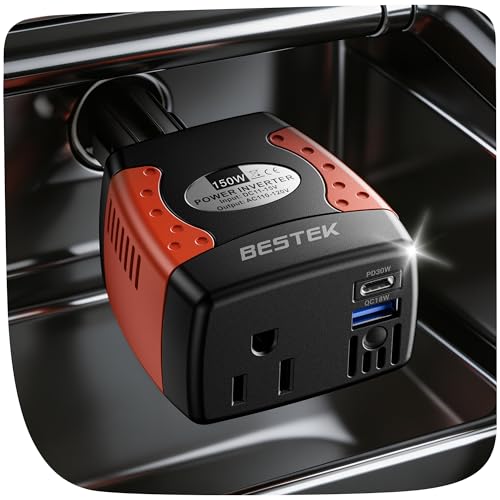
The vansoet 400W model emphasizes port quantity, with two AC outlets, two USB-C ports, and two USB-A ports. That layout can suit a family or work vehicle, although its documented USB-C outputs are lower than the 65W options. The BESTEK 150W model takes a different approach by documenting independent 30W USB-C PD and 18W USB-A QC charging. It may be more suitable when two fast-charge connections matter more than maximum AC output.
Review protection and cooling features
The selected listings commonly document protection against combinations of overvoltage, undervoltage, overload, overheating, and short circuit. These features are useful safeguards, but they do not make an inverter suitable for every device or eliminate the need to observe the load limit. A built-in fuse is another practical feature. BMK documents two replaceable 15A fuses, while the BESTEK pure sine model lists a 40A fuse.
Cooling design is also relevant because power conversion creates heat. Several selected models use temperature-controlled or intelligent fans that adjust with load or temperature. The EPANEE and Pro Chaser listings specify a fan activation threshold, and the FSATBTNE and BESTEK pure sine models describe automatic or smart cooling. Fan behavior can vary with the connected load, so a listing description alone cannot establish how quiet a unit will be in every situation.
Think about placement and controls
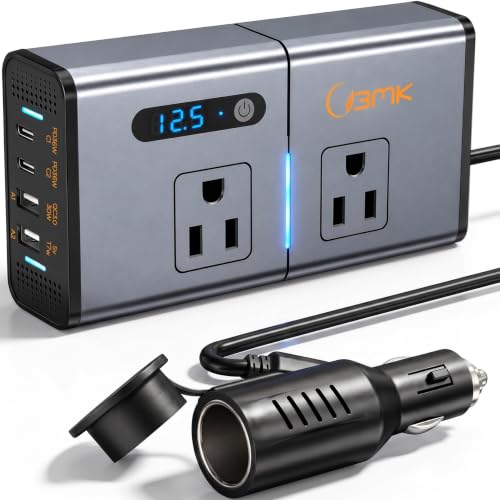
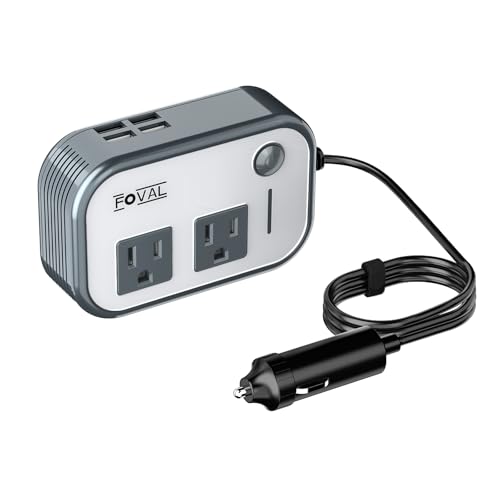
Compact dimensions help when the inverter must fit in a glove box, door pocket, or crowded center console. The FOVAL 200W model is among the smallest selected choices, while the BESTEK pure sine model is notably longer. A longer cable can matter just as much as the enclosure size: Pro Chaser documents a 30-inch cable, and BMK includes a pass-through 12V socket so the original accessory connection remains available.
A separate AC switch is useful when you want to stop AC conversion without disconnecting USB charging. BMK and the 400W vansoet model document this control. Voltage or fault displays can also improve visibility. BMK provides an input-voltage display, and the vansoet 400W model uses LED status indications for normal and fault conditions. These controls are convenience and monitoring features, not substitutes for checking the vehicle and load requirements.
How this comparison was scored
The ranking uses only supplied listing features and specifications. Continuous AC output carries 30% because it determines how much sustained AC capacity the product documents. Charging-port versatility carries 25%, vehicle input practicality 15%, protection and cooling 20%, and portability and control 10%. No editorial score uses customer ratings, current listing information, purchase activity, marketplace labels, or hands-on testing. The result is a specification-based comparison, so buyers should verify the current listing, vehicle limits, device requirements, and included cable or fuse details before use.
Final Recommendation
vansoet 400W Multi-Port Inverter ranks first overall in this specification-based comparison under the published weighted criteria.
The final choice among the best car cigarette lighter power inverters depends on the documented features that match your intended use.
BESTEK 300W Pure Sine Wave Inverter is the highest-scoring returned product and the first overall specification-based choice. It combines documented pure sine wave AC, 300W continuous output, two AC outlets, two USB ports, broad protection, and 11–17V compatibility. For buyers focused on fast laptop charging, the vansoet 300W PD65W model is a strong alternative because its USB-C port is specified at up to 65W and its compact body is easier to place. The FSATBTNE and EPANEE are logical upgrades when 400W continuous AC output is the priority.
Among the top car cigarette lighter power inverters, BMK is especially flexible for mixed charging because it adds a pass-through socket, two USB-C ports, two USB-A ports, an AC switch, and a voltage display. The vansoet 400W model is another strong multi-device choice because it documents five USB ports. For smaller everyday loads, FOVAL’s 200W design and BESTEK’s 150W fast-charge model avoid the bulk of higher-output units. Regardless of selection, keep total connected power within both the inverter rating and the vehicle socket’s limit.
Frequently Asked Questions
Among the best car cigarette lighter power inverters, what should I plug into a car cigarette lighter inverter?
These selected inverters are intended for small electronics such as laptops, phones, tablets, cameras, string lights, and similar devices, subject to the stated output limits. The listings do not support treating any model as a general-purpose source for high-power heaters, hair dryers, or other demanding appliances. Check the device’s wattage and power-supply requirements before connecting it.
Is pure sine wave output necessary for a laptop?
The supplied evidence does not establish a universal rule for every laptop. The BESTEK 300W Pure Sine Wave Inverter explicitly documents pure sine output and is the clearest choice when a device requires that waveform. Other selected products specify AC voltage and wattage but do not identify their waveform, so consult the laptop or power-supply documentation rather than assuming equivalence.
Can I use a 400W inverter at the full rating through a cigarette lighter socket?
Not necessarily. The product’s continuous rating and the vehicle socket’s fuse or wiring capacity are separate limits. Pro Chaser specifically warns that certain combined USB-C and AC loads may exceed the socket limit, and other listings caution that lighter sockets may support less than the inverter’s maximum. Follow the vehicle manual and product instructions, and reduce the load if the documentation requires it.
Which selected model offers the most charging connections?
The BMK 200W 7-in-1 model documents two AC outlets, two USB-C ports, two USB-A ports, and a pass-through 12V socket. The vansoet 400W model documents two AC outlets, two USB-C ports, and two USB-A ports. Port count does not remove the shared output limit, so calculate the combined demand of all connected devices.
Is a compact inverter always the better choice?
No. Compact models such as FOVAL 200W can fit more easily in small storage spaces, while larger models may provide higher AC output, more ports, longer cables, or additional controls. Choose based on the devices you need to power, the available socket capacity, cable reach, and whether features such as a display, AC switch, or pure sine wave output matter to your setup.