Buying Guide
The best expandable flatware organizers are chosen by fit first, not by slot count alone. A tray with many compartments can still be unsuitable if the drawer is too shallow, too narrow, or too short inside. Compare the organizer’s folded footprint with the drawer interior, then confirm the expanded width and any required height clearance.
Measure the drawer interior
Measure usable width, depth, and height inside the drawer rather than relying on the cabinet’s outside dimensions. Leave enough room for the drawer to close without pressing against the organizer. This matters especially for the Umilife 13–20-Inch Bamboo Organizer, which is listed at 2.5 inches high, and for the TIOPGHAD Bamboo Tray with Knife Rack, which lists a 2.13-inch height.
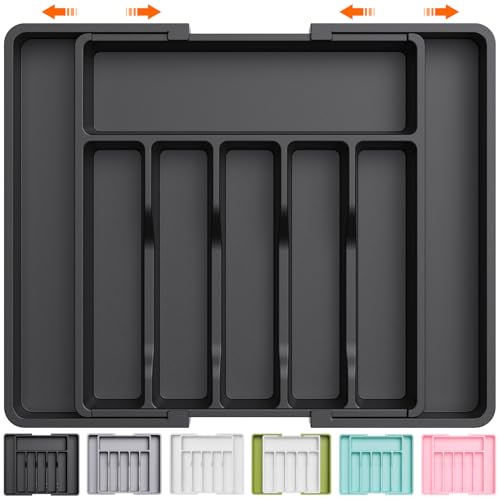
Two-way adjustment can help when both dimensions are difficult. The Homecor Expandable Organizer adjusts in width and depth, while the Lifewit Two-Way Adjustable Tray and Vtopmart Two-Way Silverware Organizer also document adjustment in both directions. Spaclear provides another two-direction option with a more compact width range. A one-direction tray may still be the better choice when your drawer has a predictable rectangular footprint and you prefer a simpler layout.
Match compartments to your flatware
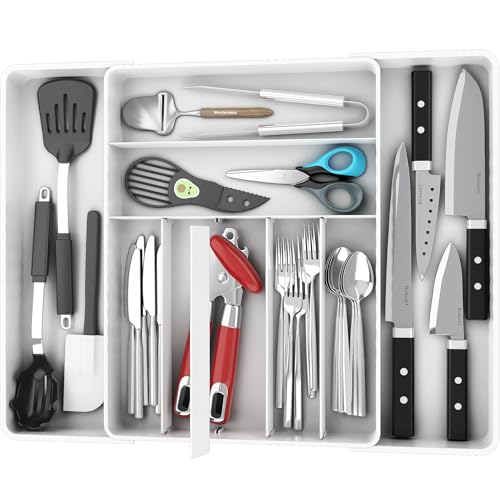
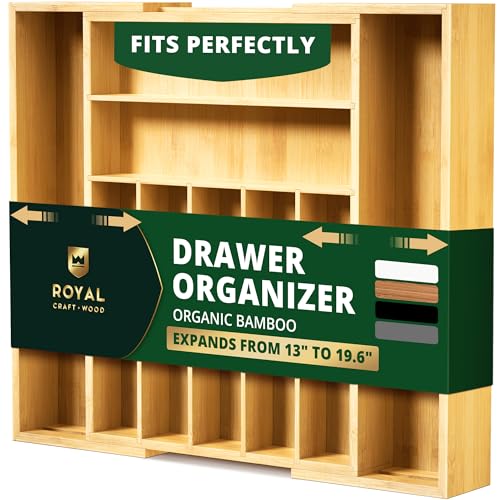
Count the types of items you actually store. Forks, tablespoons, teaspoons, butter knives, steak knives, serving pieces, and cooking tools may each need a separate area. The Homecor Expandable Organizer has up to nine compartments plus two removable knife inserts, making it suitable for a mixed cutlery collection. The Purawood 7–9 Slot Bamboo Organizer also increases from seven to nine slots as it expands.
Fewer compartments can be preferable for oversized tools. A utensil section that is too narrow may force spatulas or tongs into neighboring spaces. The TIOPGHAD Bamboo Tray with Knife Rack specifically mentions larger utensils, while the Spaclear Width-and-Depth Tray documents expandable compartments for selected larger tools. Check the stated compartment dimensions when available; otherwise, compare the product’s overall depth and the wording used for larger utensils.
Choose plastic or bamboo based on care needs
BPA-free PP plastic is represented by Homecor, Lifewit, Vtopmart, and Spaclear. These listings describe rinse cleaning or water cleaning, but several explicitly say not to use a dishwasher. Plastic is therefore convenient for wiping or rinsing, but care instructions still matter.
Bamboo models include the Umilife 13–20-Inch Bamboo Organizer, Purawood, Pipishell, and TIOPGHAD. Their listings describe damp-cloth or warm-water cleaning, with air-drying guidance appearing for some products. Bamboo can provide a natural appearance, but it should not be treated as dishwasher-safe unless the listing explicitly says so. The right material depends on whether appearance, rinse cleaning, or a particular maintenance routine matters most to you.
Look for stability and access features
An expandable tray should remain aligned when the drawer opens and closes. Homecor documents non-slip feet on all four corners; Umilife lists eight silicone feet; Vtopmart and Spaclear also specify anti-slip feet or pads. These details are useful because an adjustable tray may otherwise shift at its edges.
Access features can be just as important as stability. Curved grooves appear on the Umilife and Lifewit designs, while Spaclear describes grooves intended to make flatware easier to pick up. Buckle systems are documented on several plastic trays to help the adjustment stay in position. These features do not replace accurate measuring, but they can make the selected layout more practical.
Consider knife storage separately
Knife storage changes the buying decision. Homecor includes two removable knife inserts with protected slots for eight blades, while TIOPGHAD includes a detachable rack that can hold up to seven knives. These designs may reduce the need to mix sharp items with forks and spoons. If a listing does not specify a knife rack, do not assume that a narrow compartment is intended for blades.
Compare capacity with drawer size
Extra-large trays are not automatically better. The Simple Houseware 9-Compartment Tray expands to 24.75 inches wide, and the Lifewit Extra-Large 8-Compartment Tray expands to 22.4 inches. Those ranges may suit broad drawers but can overwhelm a smaller one. Conversely, the Spaclear Width-and-Depth Tray begins at 9.5 inches wide, which may be more appropriate for compact spaces.
Capacity should also include depth and vertical clearance. A 15- to 19-inch-deep tray can use more of a drawer, but only when the drawer has that usable depth. Treat every stated dimension as a requirement to verify, not as a promise that the product will fit a particular cabinet.
How this comparison was made
This is a specification-based comparison using public listing titles, features, and technical fields. The editorial criteria emphasize fit flexibility, organization, material and cleaning information, stability and access, and capacity. No hands-on testing, customer-opinion summary, volatile marketplace label, or rating-based criterion was used. Products were selected from semantically eligible expandable flatware organizers, with identical non-empty parent groups treated as one product.
Final Recommendation
Homecor Expandable Organizer ranks first overall in this specification-based comparison under the published weighted criteria.
Homecor Expandable Organizer is the highest-scoring returned product under the published weighted criteria.
Homecor Expandable Organizer is the best expandable flatware organizers choice when two-way fit adjustment and dedicated knife storage are priorities. Its combination of width and depth adjustment, up to nine compartments, removable knife blocks, and non-slip feet gives it substantial documented utility in this comparison.
For a drawer with unusual dimensions, the Lifewit Two-Way Adjustable Tray is a close alternative. Vtopmart is useful when labels and two-way adjustment matter, while Umilife is better suited to drawers with enough height for its extra-high bamboo body. Among the top expandable flatware organizers, Simple Houseware is notable for its removable middle tray, Purawood and Pipishell for bamboo layouts, and Spaclear for a smaller two-way footprint.
Before buying, measure the drawer’s interior width, depth, and height at the point where the tray will sit. Then compare the folded and expanded dimensions, confirm whether knife storage is included, and follow the stated cleaning instructions. That process is more dependable than choosing by appearance or compartment count alone.
Frequently Asked Questions
What should I measure before choosing the best expandable flatware organizers?
Measure the drawer’s usable interior width, depth, and height. Compare those measurements with the organizer’s minimum and maximum dimensions, including any stated clearance requirement. Also check whether handles, hinges, or drawer slides reduce the usable space.
Are bamboo or plastic expandable organizers easier to clean?
The answer depends on the care instructions for the specific product. The selected plastic models commonly describe rinsing or water cleaning, but some say not to use a dishwasher. Bamboo listings generally describe wiping with a damp cloth or washing with warm water followed by air drying. Neither material should be assumed dishwasher-safe without explicit documentation.
Do all expandable flatware organizers include knife storage?
No. Homecor includes two removable knife inserts, and TIOPGHAD lists a detachable knife rack. Other selected products focus on general compartments for forks, spoons, knives, or cooking utensils without documenting a dedicated blade rack. If protected knife storage is important, choose a model that specifically lists it.
Is a two-way adjustable tray worth choosing?
Two-way adjustment can be useful when a drawer has an unusual depth or when both dimensions need fine tuning. Homecor, Lifewit, Vtopmart, and Spaclear document width-and-depth adjustment. For a conventional drawer with predictable dimensions, a width-only bamboo or plastic tray may provide enough flexibility with a simpler layout.
How many compartments do I need?
Use separate sections for the flatware categories you regularly keep in the drawer, then allow room for larger serving or cooking utensils if needed. Six to nine compartments cover many mixed flatware layouts, but a three- to five-section design may be more practical when the drawer contains bulky spatulas, ladles, or tongs. Compartment count should follow your items and drawer dimensions, not the other way around.