Buying Guide
The best knife holders and flatware organizers differ mainly in how they store blades, how much drawer space they use, and whether they are meant for general silverware or mixed kitchen tools. Start by identifying the available drawer width, depth, and height. Then decide whether you need individual knife slots, broad compartments for forks and spoons, or both in one organizer.
Choose a dedicated knife holder when blade separation matters
A dedicated knife block is the clearest choice when knives are the main storage problem. The Bambüsi model uses 16 individual slots and stores knives blade-down, with separate slot widths for different blade types. That layout is more specific than a general flatware tray and may help keep knife edges from contacting one another, according to the listing. Its 17-inch length and 2-inch height still require a careful drawer measurement.
The Joseph Joseph DrawerStore takes a more compact approach. Its two-tier structure places smaller knives above larger knives, holds up to nine knives, and accepts blades up to 9 inches. The 15.5 x 5.5 x 3-inch footprint is narrower than many expandable flatware organizers, but the drawer must provide at least 3 inches of height. This format suits kitchens that want dedicated knife storage without using a countertop block.
Use combined storage for knives and everyday flatware
If one drawer must hold knives, forks, spoons, and cooking utensils, a combined organizer can be more efficient. Homecor documents nine compartments and two removable knife-block inserts, with expansion from 14.5 x 13.2 inches to 19 x 22 inches. This is one of the broadest layouts in the comparison, so it is better suited to a large drawer than a narrow one.
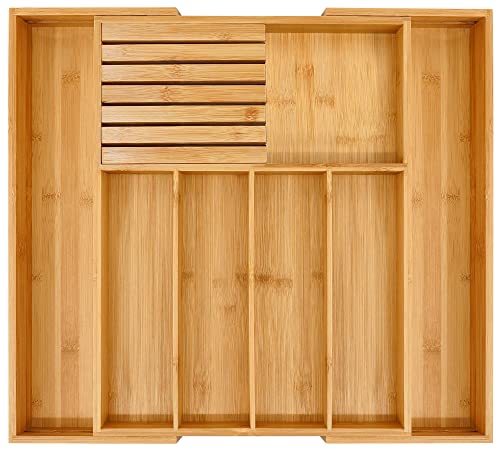
The VaeFae tray also combines general compartments with removable knife storage. It has five to seven compartments and a block for six knives, while its width expands from 12.6 to 21.65 inches. The removable design gives you the option to reclaim space if your knife collection changes. Measure the drawer carefully because the listing recommends more than 14 by 18 inches for proper fit.
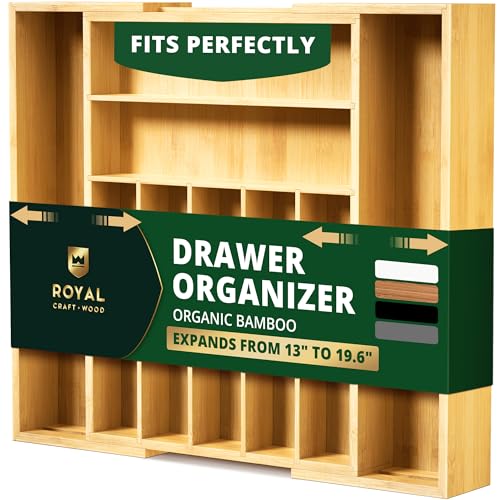
Expandable organizers without dedicated knife blocks are better for flexible flatware sorting. The Pipishell model expands from 13 to 19.6 inches and provides six to eight compartments. Bellsal offers a smaller 10- to 15-inch range with five to seven compartments. Both are bamboo trays, but neither listing specifies individual knife slots, so they should not be treated as substitutes for a dedicated knife block.
Match the organizer to drawer size
Small drawers benefit from compact, fixed trays or narrow adjustable models. Lifewit’s expandable seven-compartment organizer adjusts from 8 to 13.8 inches wide and is intended for everyday forks, spoons, and knives. It is not designed for oversized utensils, making the size guidance especially important. The separate Lifewit covered tray measures 12.6 by 11.8 by 2.1 inches and may fit a different type of drawer because it does not expand.
For a fixed bamboo layout, the Umilife seven-slot tray measures 17 by 13 by 2.5 inches. Its two larger compartments are intended for items such as spatulas, tongs, and ladles, so it is useful when a drawer contains more than tableware. The extra depth can increase usable compartment space, but it also reduces compatibility with shallow drawers.
Large drawers can take advantage of the Homecor or Ukeetap formats. Ukeetap expands from 12.4 to 21 inches and provides seven to nine compartments, while Homecor expands in both dimensions and adds removable knife inserts. Wide expansion is useful only when the drawer has enough clear space for the organizer to open without interference.
Compare materials and stability features
Bamboo trays provide a natural wood appearance and generally require wiping rather than machine washing in the supplied listings. Bambüsi, Pipishell, Umilife, Bellsal, and VaeFae all document bamboo construction. Umilife adds six silicone feet, while the dedicated Bambüsi block is described as a solid 2.5-pound piece. These details are relevant when drawer movement is a concern, but they do not replace measuring the drawer or checking whether the base sits flat.
Plastic organizers are often easier to rinse and may offer adjustment mechanisms. Homecor uses BPA-free PP and lists four anti-slip corners. Lifewit uses BPA-free PP in both selected models, with a buckle design on the expandable version and a removable lid on the covered version. Ukeetap also documents BPA-free, waterproof plastic. Follow each model’s care instructions: some plastic products recommend hand washing, and bamboo products should not be placed in a dishwasher.
Think about covered versus open storage
Open trays offer quick visibility and access, while the covered Lifewit model adds a see-through removable lid intended to protect silverware from dust, dirt, and moisture. The lid can be useful for countertop storage, portable use, or drawers where extra covering is desirable. However, it adds another piece to remove during access and does not provide width adjustment.
Measure before ordering
Record the drawer’s internal width, front-to-back depth, and usable height, including clearance above handles. Compare those measurements with the organizer’s stated dimensions in its intended configuration. Expandable products should be checked both folded and expanded. Also consider the size of your largest knife, ladle, or serving utensil. A tray that fits the drawer may still have compartments too short or narrow for the items you want to store.
Final Recommendation
Homecor Adjustable Flatware Organizer with Knife Blocks ranks first overall in this specification-based comparison under the published weighted criteria.
Bambüsi 16-Slot Knife Drawer Organizer is the first overall specification-based choice among these best knife holders and flatware organizers because it combines dedicated blade-down storage, 16 separated slots, broad knife compatibility, and a stable bamboo construction. Choose Joseph Joseph DrawerStore when the drawer is narrower and a two-tier knife design is more useful than maximum capacity.
For a combined knife-and-flatware setup, Homecor is the most flexible documented option because it pairs nine compartments with two removable knife inserts and expands in both dimensions. VaeFae is a strong alternative when bamboo construction and a removable six-knife block are priorities. Ukeetap and Pipishell are better for broad adjustable flatware storage when individual knife slots are not essential.
For smaller spaces, Lifewit’s expandable seven-compartment tray has the clearest compact-width range, while the covered Lifewit organizer is the better fit when protected storage matters. Umilife, Bellsal, and the remaining bamboo trays are sensible fixed or moderately adjustable choices, provided their dimensions match the drawer.
Overall, the top knife holders and flatware organizers are not interchangeable: dedicated blocks prioritize blade separation, expandable trays prioritize fit, and covered trays prioritize protection. Use the stated dimensions and care requirements as the final decision points rather than relying on general appearance alone.
Frequently Asked Questions
What should I measure before buying the best knife holders and flatware organizers?
Measure the drawer’s usable width, depth, and height, then compare those figures with the organizer’s folded and expanded dimensions. Leave clearance for handles and check the height of the tallest stored utensil. A model can fit the drawer footprint but fail if the drawer is too shallow or if the organizer cannot expand without contacting the sides.
Are dedicated knife blocks better than general flatware trays?
They are more appropriate when blade separation and knife capacity are the main priorities. Bambüsi and Joseph Joseph document dedicated knife-storage layouts, while several bamboo and plastic trays provide general compartments without individual knife slots. A general tray may work for everyday table knives, but the supplied evidence does not establish the same dedicated blade organization.
Is bamboo or plastic easier to maintain?
The selected bamboo products generally call for wiping with a damp cloth and specifically caution against dishwasher use. The plastic products commonly describe rinsing or hand washing, although Lifewit’s expandable model warns that high heat may warp the plastic. Check the individual care instructions rather than assuming either material is universally dishwasher safe.
When is a covered organizer useful?
A covered tray can be useful when flatware is stored on a countertop, transported, or kept where dust and moisture are concerns. The selected Lifewit covered model has a removable see-through lid and six compartments, including two long sections for knives or larger utensils. Its fixed dimensions should be checked before purchase.
Which design is best for a changing drawer layout?
An expandable organizer is the most adaptable documented design. Homecor expands in width and depth, Ukeetap expands from 12.4 to 21 inches, and VaeFae expands from 12.6 to 21.65 inches while adding a removable knife block. The right option depends on available drawer space and whether dedicated knife storage is needed.