Buying Guide
Choosing the best exterior door thresholds is mainly a measurement and application decision. A threshold sits between the exterior exposure and the interior floor, so the correct model must match the opening width, jamb depth, door swing, bottom gap, and desired transition height. The products above are compared from public listing evidence, not hands-on testing. That means the scores reflect documented specifications and stated design features rather than observed installation results.
Measure the opening before comparing models
Start with the clear distance between the jambs at the bottom of the doorway. Many selected products are listed at 36 inches, while the M-D Building Products 08003 is listed for a 32-inch doorway. A longer threshold may be cut when the listing expressly supports trimming, but do not assume every aluminum sill can be shortened without affecting its seal or end profile.
Width matters just as much as length. The Trademark Hardware adjustable threshold and the Barzen adjustable aluminum threshold are both listed at 5.75 inches wide. The M-D Building Products 08003 is narrower at 3.75 inches, while the Barzen outswing model is listed at 4.56 inches. Measure the existing sill, jamb, and floor transition rather than choosing by the nominal door width alone. A sill that is too narrow may leave part of the opening unsupported; one that is too wide may interfere with trim or flooring.
Height is the next critical measurement. Fixed models such as the Frost King TS36SP and the Barzen outswing threshold require the existing door-bottom gap to be compatible with their listed profiles. Adjustable models provide more latitude. The Trademark Hardware and M-D Building Products adjustable models document a riser range from 1-1/8 to 1-3/8 inches, while the Barzen adjustable model documents 0.25-inch adjustment. That extra control can be useful when a door bottom or sub-sill is uneven, but it does not replace careful leveling.
Match the threshold to door swing
Door swing changes the useful shape of the sill. The Tandefio threshold is specifically described for outswing doors and uses a 5-degree incline, high dam, and V-notch foam strip. The Barzen outswing threshold likewise documents an aluminum slope and compression seal for pre-hung outswing doors. These designs should be considered when the door opens toward the exterior and the threshold must meet the bottom edge at the appropriate angle.
It should therefore not be treated as a recommendation here. Among the selected products, the adjustable and general exterior models are the more relevant choices when the door swing is not covered by a dedicated fixed outswing design. Verify the manufacturer’s fit information against the actual door system before ordering.
Compare sealing features, not just material
Aluminum is common across this category because it forms the exposed top surface of many exterior sills. However, the sealing system often determines how the threshold meets the door. The Trademark Hardware model describes protection from drafts, moisture, dust, and pests, while the M-D Building Products 78600 lists similar environmental protection and an adjustable oak riser. The Barzen adjustable model documents an integrated rubber weather and moisture seal.
Fixed designs use different approaches. The Tandefio model lists a V-notch foam weather strip and a high dam. The Barzen outswing model includes a Q-Lon foam seal that compresses against the door bottom. The M-D Building Products 08003 uses flexible vinyl. These features are not interchangeable: foam compression, vinyl inserts, rubber seals, and adjustable risers each depend on the door bottom and installation geometry. Treat the listing language as a design description, not a guarantee of a leak-free result.
Choose the right base material
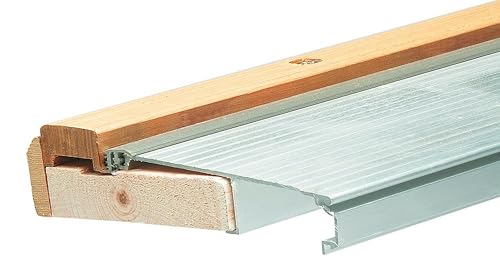
The selected products represent several construction approaches. Aluminum-and-oak thresholds, including the Trademark Hardware, Barzen adjustable, Frost King TAOC36SP, and M-D Building Products 78600 models, combine a metal exterior with a wood interior or riser. This can provide a traditional entryway appearance while retaining an aluminum walking surface. The trade-off is that the wood portion deserves careful attention to exposure and fit.
The Tandefio threshold uses a composite base with an aluminum slope, and the Frost King models emphasize heavy-gauge aluminum. A composite base may appeal where resistance to rot is a priority in the documented design, while a full or primarily aluminum construction may suit a commercial or frequently used opening. The listing evidence does not establish a universal best material; the installation environment should decide.
Consider transition and accessibility needs
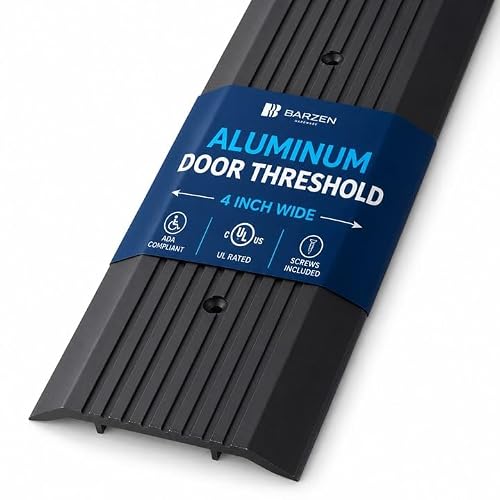
A high sill can help close a larger gap, but it can also create a more noticeable transition. The Frost King TS36SP is described as low-rug and fixed, while the M-D Building Products commercial threshold is described as flat profile, non-skid, low profile, and wheelchair accessible. These attributes make the latter a logical model to investigate for commercial or accessibility-sensitive projects.
Do not interpret a product description as automatic compliance for a specific building project. Door clearances, local codes, fire-door assemblies, and accessibility requirements may involve more than the threshold alone. The M-D Building Products commercial listing mentions fire-rated doors and ADA standards, but project documentation should still be checked independently.
Review installation details and included parts
Installation practicality varies. The M-D Building Products 78600 lists fasteners, bolts, nuts, cap, and screws. The M-D Building Products 08003 lists screws and says the aluminum can be cut with a hacksaw and the vinyl insert with scissors. The Tandefio listing describes installation without drilling or screws, while also mentioning optional concrete anchoring with recommended expansion anchors.
Adjustable thresholds generally require more careful setup than fixed replacement sills because the riser must be positioned to meet the door bottom without creating excessive friction. Fixed thresholds may be simpler when the existing measurements already match. In every case, confirm the substrate, fastener requirements, end cuts, and seal contact before removing the old sill.
How this comparison was scored
The editorial criteria are specific to exterior door thresholds: weather-sealing design, fit and adjustability, construction materials, doorway application fit, and installation practicality. Each product receives a 0.0-to-10.0 score for every criterion, weighted to a 100-point editorial framework. The comparison does not score ratings, reviews, purchase activity, marketplace labels, or customer sentiment. Products were selected only when their titles, features, and specifications identified them as exterior door thresholds or closely related commercial entry thresholds.
Final Recommendation
M-D Building Adjustable Aluminum & Hardwood Threshold ranks first overall in this specification-based comparison under the published weighted criteria.
Trademark Hardware Adjustable Aluminum & Oak Threshold is the highest-scoring returned product and the first overall specification-based choice. Its 36-by-5.75-inch size, adjustable 1-1/8-to-1-3/8-inch riser, aluminum-and-oak construction, and documented exterior sealing use give it the broadest fit profile in this comparison. It is especially suitable for a pre-hung exterior doorway where the bottom gap needs measured adjustment.
The top exterior door thresholds are not interchangeable. Choose the KC Hardware model when a black finish and hidden-screw appearance matter, the Frost King TAOC36SP when an extra-wide adjustable sill is needed, and the Tandefio or Barzen outswing models when the door geometry specifically calls for an outswing slope and compression seal. For a low-profile commercial transition, the M-D Building Products flat-profile threshold is the focused option. For a smaller 32-inch replacement opening, the M-D Building Products 08003 offers the clearest documented fit and included screws.
Before purchase, measure the opening, width, door-bottom gap, swing direction, and substrate. Then verify that the selected seal, riser, or slope will meet the door without restricting movement. This process is more reliable than choosing solely by finish or nominal length and is the best way to narrow the best exterior door thresholds for a particular entry.
Frequently Asked Questions
What should I measure before buying the best exterior door thresholds?
Measure the clear opening length, existing threshold width, threshold height, door-bottom gap, jamb depth, and floor transition. Also identify whether the door swings inward or outward. The selected products vary from 32-inch to 36-inch nominal lengths and from narrow 3.75-inch widths to wider 6.125-inch listed widths, so the existing opening should guide the choice.
Are adjustable thresholds better than fixed thresholds?
Adjustable thresholds are useful when the door bottom or sub-sill is uneven and the documented adjustment range matches the gap. Trademark Hardware, Barzen, and M-D Building Products offer selected adjustable designs. Fixed thresholds such as Frost King TS36SP may be preferable when the opening is already measured and level, because there is no riser to set. Neither type is automatically superior for every doorway.
Which top exterior door thresholds are designed for outswing doors?
The Tandefio fixed outswing threshold and the Barzen outswing threshold are the clearest selected choices. Tandefio documents a 5-degree incline, high dam, and V-notch foam strip. Barzen documents a 5-degree aluminum slope, fixed 0.75-inch height, and Q-Lon foam seal. Confirm the door’s swing and bottom profile before selecting either design.
Do aluminum thresholds include weather seals?
Some do, but the seal type varies. The M-D Building Products 08003 lists a flexible vinyl insert, the Barzen adjustable model lists an integrated rubber seal, and the Barzen outswing model includes Q-Lon foam. Other models emphasize an adjustable riser or a thermo-barrier. Check the individual listing for the included seal rather than assuming that an aluminum top alone provides the complete seal.
Can a 36-inch threshold be cut to fit?
Only rely on trimming when the supplied evidence supports it. The Barzen outswing listing says it can be cut to length, and the M-D Building Products 08003 listing provides cutting instructions. For other products, confirm the manufacturer’s installation directions before cutting, because shortening can affect end caps, screw locations, or the seal. A precise measurement remains important even when trimming is documented.