Buying Guide
Choosing among the best 1-inch thresholds starts with the actual obstruction, not the product title. Measure the vertical distance from the lower floor surface to the top of the sill at several points. A listed 1-inch rise is appropriate only when the transition is close to that height and the ramp can sit level on a firm base. The Nuvium adjustable aluminum model documents a 0.76-to-1.24-inch fit range, while the EZ-ACCESS model adds a pivoting flap and modular sections. Those designs can be more forgiving when the threshold is not exactly uniform.
Match the ramp type to the doorway
Most selected products are rubber ramps. Rubber models generally use a one-piece, beveled or sloped profile and are often positioned directly on the floor. Silver Spring, Ruedamann, GANSNAY, FACHNUO TOOL, and the two Nuvium rubber designs document 1-inch rise formats, textured or grooved surfaces, and compatibility with mobility aids. Several can be cut to fit or joined side by side. That flexibility is useful when the opening is narrower or wider than the listed dimensions.
Aluminum models work differently. The EZ-ACCESS Transitions Modular Entry Ramp uses a modular format with removable sections and extensions, and the Nuvium aluminum ramp uses a removable flap for fine adjustment. Aluminum may be preferable when you want a structured, portable ramp or a closer fit to a measured threshold. The trade-off is that modular parts can require more careful configuration than a one-piece rubber ramp.
Check width, depth, and approach space
A 1-inch rise does not describe the whole transition. Width determines how much of the doorway is covered, while depth affects the approach angle and available rolling surface. The Silver Spring ramp is listed at 43.5 inches long and 8 inches deep. The VEVOR option is 44.5 inches long and 9.5 inches wide, making it one of the broadest selected designs. Ruedamann also documents a 43.5-inch width. These choices may suit wide openings, garages, or approaches involving carts and equipment.
More compact designs can work where floor space is limited. FACHNUO TOOL and GANSNAY list approximately 35-inch lengths, and the standard Nuvium rubber model lists a 35.5-inch width with a 5.3-inch depth. ROBLOCK is different again: its two-piece system can be assembled at either 16 or 32 inches wide. Before ordering, compare the product’s listed dimensions with the clear opening, door swing, nearby trim, and the amount of flat floor available on both sides.
Compare surfaces and traction features
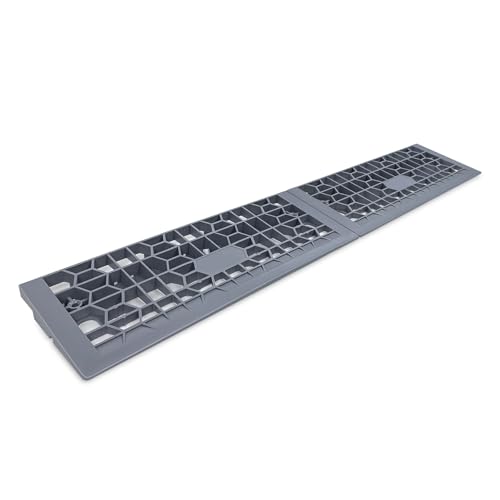
Surface design is an important specification for a threshold transition. Grooves, textured patterns, drain channels, raised crossbars, and anti-slip strips appear across the selected products. The Silver Spring model lists molded drain channels, while GANSNAY and both Nuvium ramps describe grooved surfaces. VEVOR lists a textured surface and a grid underside. The Nuvium aluminum ramp lists raised crossbars and anti-slip strips, and ROBLOCK lists a honeycomb anti-slip pattern.
These descriptions identify design features, but they do not replace site preparation. The aluminum Nuvium listing specifically says to use the ramp on a dry, firm, level surface and to avoid wet or icy conditions. For any design, remove loose debris, confirm that the ramp lies flat, and check that the transition does not rock before use. A textured surface cannot compensate for an unstable base or a height mismatch.
Review materials and capacity carefully
Rubber is prominent in this category because it can form a sloped, one-piece transition. The listings describe natural, recycled, solid, flexible, or odor-free rubber depending on the model. Some natural-rubber products note that an initial smell may require ventilation. If the ramp will be used indoors, the odorless LIEKUMM model or plastic ROBLOCK system may be more appealing based on the supplied descriptions.
The selected listings state capacities ranging from the current price to substantially higher figures. Treat those numbers as product-listing specifications, not as a substitute for checking the combined load of the user and mobility device. VEVOR, GANSNAY, LIEKUMM, FACHNUO TOOL, and ROBLOCK list especially high capacities, while the aluminum models list the current price. Keep the intended device, traffic pattern, and surface condition in mind rather than selecting solely by the largest number.
Decide how the ramp will stay in place
Installation varies from simply positioning a one-piece ramp to configuring modules or adding anchors. The EZ-ACCESS model is self-supporting and modular. Nuvium’s aluminum ramp includes pre-drilled points for optional anchoring, and VEVOR lists screw grooves and expansion screws. Rubber options may be lay-flat, adhesive-backed, cuttable, or modular. Nuvium’s rubber model includes adhesive strips for clean, dry, smooth surfaces, while GANSNAY and FACHNUO TOOL emphasize placement and trimming.
Adhesive can be convenient, but the evidence ties it to particular floor conditions. If the surface is rough, dusty, damp, or frequently exposed to changing conditions, verify whether the selected product offers a suitable mechanical fixing method. Do not assume that every 1-inch ramp includes screws, tape, or permanent hardware. The product listing should explicitly document the installation approach you need.
Consider special features
Several selected designs add features beyond the basic slope. ROBLOCK includes a cable channel and supports adhesive or bolt installation. LIEKUMM lists a built-in cable groove and the ability to combine ramps for wider access. VEVOR adds a reflective strip and a grid underside. These details may matter in garages, workshops, stores, or entryways with cables and hoses, but they should not distract from the fundamental checks: rise, width, depth, surface, and stability.
Final Recommendation
VEVOR 1-inch Natural Rubber Curb Ramp ranks first overall in this specification-based comparison under the published weighted criteria.
EZ-ACCESS Transitions Modular Entry Ramp is the highest-scoring returned product and the first overall specification-based choice. Its combination of modular aluminum construction, a pivoting flap, removable sections, and additional height adjustability gives it the most documented fitting flexibility in this comparison. For a threshold that is close to but not exactly 1 inch, Nuvium Adjustable Aluminum Threshold Ramp is the more specifically documented match because its listing states a 0.76-to-1.24-inch range.
If broad rubber coverage is the priority, Silver Spring, VEVOR, and Ruedamann provide wide listed dimensions. GANSNAY, LIEKUMM, and FACHNUO TOOL are stronger choices when cuttable rubber, capacity, or indoor material considerations matter. Nuvium’s rubber model balances adhesive placement with side-by-side flexibility, while ROBLOCK stands out for its detachable width options and cable channel. These are among the top 1-inch thresholds only after confirming the measured rise, available floor area, and intended load.
The best 1-inch thresholds are not interchangeable. A wide rubber ramp may be practical for a garage but cumbersome in a narrow hall. A modular aluminum option may offer closer fitting but require more setup. Use the specifications to select the design that matches the doorway and the way the space will be used.
Frequently Asked Questions
How do I measure for the best 1-inch thresholds?
Measure the vertical rise from the lower floor to the top of the threshold, preferably at several points across the opening. Then measure the clear doorway width and the available approach depth. The ramp should sit on a firm, level surface and cover the intended path without interfering with the door swing. Do not rely on a nominal 1-inch label when the actual sill is significantly higher or lower.
Are rubber or aluminum 1-inch ramps better?
Neither material is automatically better for every doorway. Rubber models in this comparison offer one-piece formats, grooved surfaces, cuttable sizing, and indoor/outdoor descriptions. Aluminum models such as EZ-ACCESS and Nuvium document modular construction, portability, corrosion resistance, or fine adjustment. Choose based on fit, floor conditions, securing method, weight, and whether you need a temporary or more structured installation.
Can a 1-inch threshold ramp be cut to width?
Only when the listing says it can. GANSNAY, FACHNUO TOOL, Ruedamann, and the Nuvium rubber models document cuttable or adaptable designs. EZ-ACCESS uses removable and extension sections instead. Cutting an unsupported product could change its stability or usable surface, so follow the supplied product instructions and do not assume that a ramp can be modified simply because it is rubber.
Do these ramps need to be secured?
The answer depends on the model and surface. Nuvium rubber lists adhesive strips for clean, dry, smooth surfaces. VEVOR and the adjustable Nuvium aluminum model document options for screws or anchoring, while ROBLOCK lists adhesive or bolt installation. Other products emphasize lay-flat or ready-to-use placement. Inspect the ramp after positioning and use only the securing method documented for that product and installation surface.
What capacity should I choose?
Use the combined weight of the person, wheelchair, scooter, walker, cart, or other equipment as a starting point, then compare it with the product’s stated capacity. The selected listings provide different capacity figures, so do not infer that all 1-inch ramps support the same load. Also consider how the load is distributed and whether the ramp remains stable on the intended surface. Capacity alone does not confirm fit or safe installation.