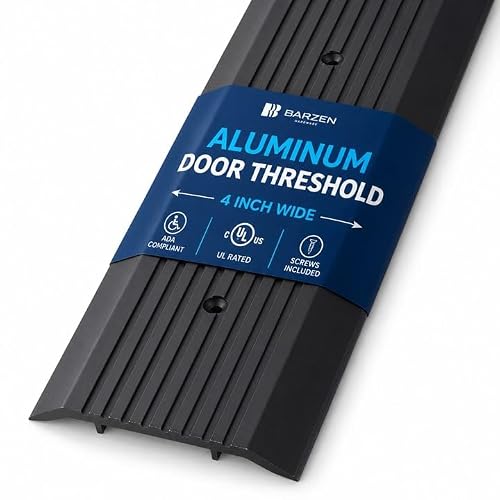
Buying Guide
A threshold is a transition component, so the right choice depends less on appearance alone than on the opening width, floor-height difference, door clearance, and installation surface. The best hardwood thresholds in this comparison range from simple unfinished oak strips to mixed hardwood-and-aluminum exterior assemblies. Start by measuring the opening and the area that must be covered before comparing profiles.
Match the threshold to the transition
For a typical interior doorway between similar floor surfaces, a fixed strip such as the M-D Building Hardwood Low-Profile Threshold or Hartford Style 3 provides a conventional wood transition. The M-D Building model is 36 inches long and 3-1/2 inches wide, while Hartford Style 3 is listed at 72 inches long and approximately 2-1/4 inches wide. A longer piece can be useful across a broad opening, but it still needs to be trimmed or fitted to the actual doorway.
When the floors differ in height, profile matters. The Randall 3-1/2-Inch Unfinished Oak Half Threshold is specifically described for reducer and butt-up applications and stands 5/8 inch high. Hartford Style D and Style F offer much wider red oak surfaces for deeper transition areas. Style D is listed at 6-1/2 inches wide and 60 inches long; Style F has the same listed width but is only 24 inches long and can be paired back to back. These are specialized choices, so verify that the added width will not interfere with adjacent flooring or door trim.
Consider carpet-specific designs
A carpet edge usually needs a profile that can cover or secure the carpet side rather than a generic flat seam cover. The Randall 2-Inch Red Oak Carpet Bar is explicitly intended for carpet-to-hardwood, tile, laminate, and other interior transitions. The M-D Building Hardwood Carpet Trim is another focused option: its listing says to position the shorter leg on the carpet side and includes mounting screws.
These designs are not interchangeable with every doorway. Check which side of the transition receives carpet, whether the hard floor is level, and how much width is available beneath the closed door. A narrower carpet trim may be preferable where a broad saddle would crowd the opening.
Choose unfinished or finished wood
Most selected products use unfinished oak or red oak. That finish is useful when the threshold must coordinate with existing hardwood because it can generally be stained, sealed, painted, or otherwise finished according to the listing. The 6-Foot Unfinished Red Oak Threshold is especially flexible because its 72-inch length and 2-1/2-inch width give installers room to cut a broad piece for a longer opening.
Unfinished wood does require a finishing decision. Match the stain or paint only after comparing it with the installed floor and trim, and follow the finish manufacturer’s preparation instructions. The supplied evidence does not establish how any finish will look in a particular room, so color matching remains a project-specific step.
Measure width, height, and clearance
Do not rely on a product title alone for dimensions. The candidates vary from slim 3/8-inch-thick strips to profiles around 3/4 inch high, as well as much wider pieces intended to cover substantial floor changes. Measure the gap from floor edge to floor edge, the vertical difference between surfaces, and the clearance beneath the door.
The fixed 3/8-inch profile of the 6-Foot Unfinished Red Oak Threshold may suit a modest interior transition, while the 3/4-inch M-D Building model addresses a different dimensional situation. Hartford Style F is only 24 inches long but 6-1/2 inches wide, which may work for a deep localized transition but not a standard long opening. Cutting is documented for several products, but cutting does not make an unsuitable height or width automatically compatible.
When to choose an adjustable exterior threshold
Exterior doors introduce sealing concerns that interior transition strips do not address. The Inbar Hardware Adjustable Hardwood Threshold combines solid oak and aluminum, offers a 72-inch size, and lists an adjustment range from 1/3 to 5/8 inch. Its hidden screws and included hardware support a cleaner exterior installation. The M-D Building Adjustable Aluminum and Hardwood Threshold is a shorter 36-inch option with an adjustable riser listed from 1-1/8 to 1-3/8 inches.
These mixed-material products are the most relevant choices when the threshold must help address air, moisture, dust, or insect entry. Confirm the actual door type, sill configuration, and opening dimensions before ordering. The M-D Building Outswing Door Threshold is another selected option for outswing doors, but its flexible vinyl component means it is not an all-wood interior transition strip.
Review the installation provisions
Installation details differ considerably. The Randall half threshold has pre-drilled holes and included nails. The M-D Building Hardwood Carpet Trim includes 1-1/2-inch 10-gauge screws, while the Randall carpet bar documents countersunk holes but does not state that fasteners are included. Several unfinished strips are simply described as cuttable, leaving the installer to select the appropriate fastening method.
For concrete floors, the M-D Building Hardwood Reducer Threshold listing specifies drilling 3/16-inch pilot holes and using anchors, although that product is not among the final ten because the comparison prioritizes stronger overall evidence and application fit. In every case, check the substrate and use hardware suitable for it. A countersunk hole can help a fastener sit flush, but it does not by itself confirm compatibility with a particular floor.
Final recommendation
Inbar Hardware Adjustable Hardwood Threshold, 72 in ranks first overall in this specification-based comparison under the published weighted criteria.
Inbar Hardware Adjustable Hardwood Threshold, 72 in is the first overall specification-based choice among these best hardwood thresholds. Its combination of solid oak, commercial-grade aluminum, hidden screws, included hardware, long available sizing, and adjustable height gives it the widest documented range of exterior and high-traffic applications. For an uneven 36-inch exterior opening, the M-D Building Adjustable Aluminum and Hardwood Threshold is the more compact alternative.
For interior projects, choose according to the transition rather than treating one design as universal. The 6-Foot Unfinished Red Oak Threshold is the most specification-aligned long-opening option, Randall’s half threshold is better aligned with butt-up and reducer work, and the Randall 2-Inch Red Oak Carpet Bar is the clearest carpet-to-hardwood choice. Hartford Style D or Style F makes more sense when the transition needs unusual width. These top hardwood thresholds should still be checked against the measured opening, door swing, floor heights, and chosen fastening method.
Frequently Asked Questions
How do I measure for the best hardwood thresholds?
Measure the opening length, the horizontal area that needs coverage, and the height difference between the adjoining floors. Also check the gap beneath the closed door and the direction of the door swing. A threshold can be cut shorter, but an incorrect profile or insufficient width may remain unsuitable after trimming.
Are unfinished oak thresholds ready to install?
They are generally ready to cut and fasten according to the supplied product details, but unfinished wood is not factory-finished. Products such as the Randall 6-Foot Unfinished Red Oak Threshold, Hartford Style 3, and M-D Building Hardwood Low-Profile Threshold are listed as stainable or paintable. Choose and apply the finish appropriate for the installation after fitting the piece.
Which selected threshold is best for carpet?
The Randall 2-Inch Red Oak Carpet Bar and M-D Building Hardwood Carpet Trim are the most directly documented carpet options. The Randall model is described for carpet-to-hardwood and other interior floor transitions, while the M-D Building trim specifies positioning its shorter leg on the carpet side. Confirm the carpet edge and floor-height relationship before choosing between them.
Should I use an adjustable threshold outside?
An adjustable design is worth considering when an exterior door has an uneven or unusual gap. The Inbar Hardware model and M-D Building Adjustable Aluminum and Hardwood Threshold both document adjustable components and sealing-related applications. Check the door type and sill dimensions first; an adjustable feature does not remove the need for correct overall sizing.
Can a wide hardwood threshold be used in any doorway?
No. Hartford Style D and Style F are unusually wide, at a listed 6-1/2 inches, and are intended for deeper transition areas. Measure the available floor surface and confirm that the profile will not obstruct the door, trim, or adjacent flooring. A narrower threshold is usually more appropriate when only a small seam or carpet edge needs coverage.