Buying Guide
Choosing among the best home emergency first aid survival kits starts with the type of emergency you expect to manage. A household kit should make common supplies easy to identify, protect contents during storage, and include enough room for the number of people who may rely on it. The listings reviewed here provide specifications and feature claims only; this is not a hands-on test and does not summarize customer opinions.
Match capacity to your household
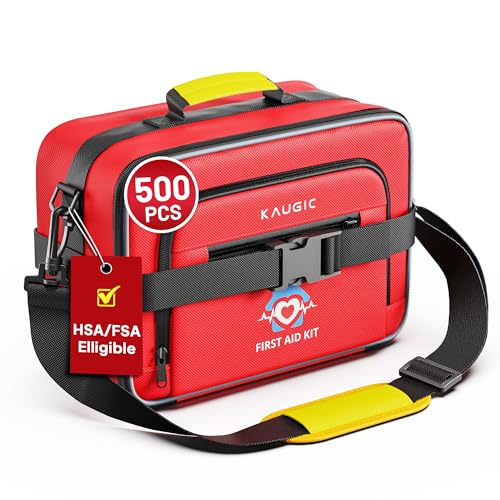
Piece counts provide a quick comparison, but they do not tell you how many of each item is included or whether every component suits your needs. Larger sets such as the KAUGIC 500-Piece First Aid Kit, Aidehelp 520-Piece Premium First Aid Kit, and Gevoke 410-Piece Waterproof Hard Shell First Aid Kit are aimed at broad coverage. Their listings describe supplies for wounds and minor injuries, with some adding emergency tools.
For a home with several occupants, a larger set can reduce the chance of using up basic dressings quickly. The Be Smart Get Prepared kit goes further by stating coverage for up to 100 people and including a refill order form. That positioning may suit a home office, workshop, or shared building better than a small personal pouch. By contrast, a 250- to 315-piece kit can be more manageable for a smaller household or a secondary location.
Prioritize organization and visibility
A kit is more useful when its contents can be located without emptying the entire bag. Look for labeled compartments, transparent sleeves, clear covers, or separate layers. Be Smart Get Prepared documents two layers and tilting shelves, while Gevoke lists five transparent compartments. Swiss Safe documents a two-way opening that allows access from the front and back.
Soft bags can also be well organized. Aidehelp, KAUGIC, and VRIEXSD each describe divided or labeled sections. These features are especially relevant when a kit will be stored in a closet, vehicle, or pack rather than left open on a shelf. Before buying, consider who will use it and whether the layout is understandable to someone who did not pack it.
Choose a case for the storage environment
Hard cases are a logical choice for garages, vehicles, or storage areas where the kit could be pressed against other equipment. Swiss Safe and Gevoke document hard-shell or hard-case construction, while First Aid Only and Be Smart Get Prepared use durable plastic cases. These designs may also be easier to wipe clean and stack, although the supplied listings do not establish a specific cleaning or impact-test result.
Soft cases can be preferable when the kit must be carried or attached. The Aidehelp and KAUGIC kits use 1680D polyester, VRIEXSD also documents 1680D polyester, and EVERLIT specifies 1000D water-resistant nylon. Protect Life uses ripstop casing. These fabric choices are useful signals for mobile storage, but water-resistance wording is not the same as a guarantee that a kit can be submerged.
Consider portability and placement
A home kit does not have to stay in one room. If you want a central cabinet kit plus a mobile option, Protect Life documents a two-in-one format with a separate compact safety kit. Swiss Safe includes a separate mini kit, which can be placed in a glove box or day bag while the larger case remains at home.
For users who attach equipment to a pack or vehicle, MOLLE compatibility is documented for Aidehelp, KAUGIC, and EVERLIT. Shoulder straps or handles appear on several selected kits, including Gevoke and KAUGIC. Measure the intended shelf, drawer, vehicle compartment, or wall area before choosing a larger model. Dimensions and weight vary enough that a high-capacity case may not fit the most convenient location.
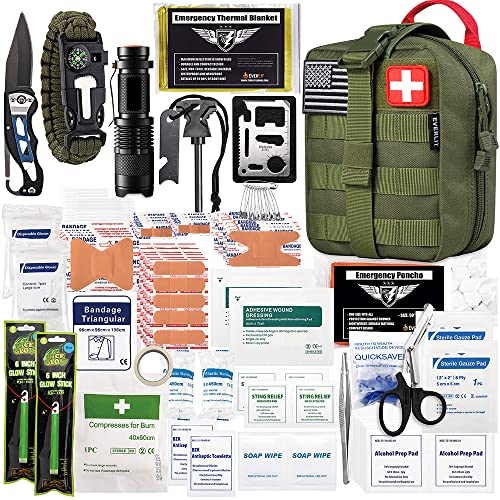
Some of the best home emergency first aid survival kits focus primarily on medical supplies. Others add tools intended for broader preparedness. EVERLIT lists a flashlight, emergency blanket, glow sticks, rain poncho, paracord bracelet, and other tools. KAUGIC lists a compass, blanket, whistle, CPR shield, and guide. Abpir documents blankets, a whistle, scissors, and a multifunction pocket card.
These additions can be useful during power outages, travel, or outdoor incidents, but they also take space that could otherwise hold medical items. A medical-first buyer may prefer Be Smart Get Prepared or First Aid Only. Someone building a general emergency tote may prefer EVERLIT or KAUGIC. Do not assume that a survival tool replaces specialized household supplies; compare the actual contents and supplement gaps separately.
Plan for replenishment and safe use
Inspect a kit after purchase and periodically afterward. Separate any items that are expired, damaged, opened, or unsuitable for your household. A refillable design, such as the one documented by Protect Life, can simplify maintenance. The Be Smart Get Prepared listing also mentions a refill order form.
Keep the kit accessible but away from conditions that could damage its contents. A dry, clearly labeled location is preferable to an inaccessible high shelf. If children may use the kit, store medicines and other age-sensitive products according to their labels and household safety needs. A first aid kit supports immediate care for minor injuries; it does not replace emergency services or professional medical advice.
How the ranking was calculated
The editorial score uses five category-specific criteria: contents breadth, organization and access, case protection and durability, portability and storage, and preparedness scope. The weights are 25%, 25%, 20%, 15%, and 15%, respectively. Scores are based on the supplied listing features and specifications. Price and marketplace signals were not used in the published criteria or described as evidence.
Final Recommendation
KAUGIC 500-Piece First Aid Kit ranks first overall in this specification-based comparison under the published weighted criteria.
Be Smart Get Prepared 326-Piece Hard Case Kit is the first overall specification-based choice among these best home emergency first aid survival kits because its listing combines large-group coverage, a durable organized case, wall-mounting, and refill planning. Gevoke is a strong alternative when a waterproof hard shell and transparent compartments matter most. KAUGIC and Aidehelp are better fits for buyers who want high capacity in a portable MOLLE-compatible bag, while Swiss Safe offers an especially distinctive dual-access format.
For broader non-medical readiness, EVERLIT provides the clearest documented survival-tool mix. Protect Life and Swiss Safe are useful when dividing supplies between home and travel is important. The top home emergency first aid survival kits are not identical: compare capacity, contents, access, and storage location before choosing one for your household.
Frequently Asked Questions
What should a home emergency first aid kit contain?
The selected kits commonly document bandages, gauze, wound-care items, gloves, scissors, tweezers, and supplies for minor cuts, burns, scrapes, or blisters. Some add emergency blankets, whistles, guides, CPR shields, or other survival tools. Review the individual contents rather than relying only on the advertised piece count, then add household-specific items if needed.
Is a hard case better than a soft first aid bag?
Neither format is universally better. Hard cases such as Gevoke, Swiss Safe, Be Smart Get Prepared, and First Aid Only may offer more structure and impact protection for a cabinet, garage, or vehicle. Soft bags such as Aidehelp, KAUGIC, VRIEXSD, and EVERLIT can be easier to carry or attach. Choose based on the storage environment and how often the kit will move.
How large should one of the best home emergency first aid survival kits be?
Capacity depends on household size, storage space, and whether the kit is a primary or secondary station. Larger 400- to 520-piece kits provide broad documented coverage, while a 250- to 315-piece kit may be easier to store and carry. A two-kit design can also work when you want one supply set at home and another in a vehicle or travel bag.
They can, especially for power outages, outdoor travel, or evacuation planning. EVERLIT and KAUGIC document several survival tools, while other selected products focus more directly on medical supplies. Survival tools should complement, not replace, the wound-care supplies your household is most likely to need.
How should a first aid kit be maintained?
Keep it in a dry, accessible location and check it periodically for opened, damaged, or expired supplies. Replace used items and confirm that the contents still match your household needs. A refillable format can make this routine easier, but always follow product labels and seek professional care for serious injuries.