Buying Guide
The best medium-base incandescent bulbs are easiest to compare by separating socket compatibility from appearance and lighting purpose. Every selected product here uses an E26 medium screw base according to its listing, but that does not mean every bulb fits every fixture. Shape, diameter, length, wattage limit, enclosure, and intended application still matter. This guide uses public product titles, features, and specifications; it is not a hands-on test and does not assess customer opinion.
Confirm the socket and fixture limits
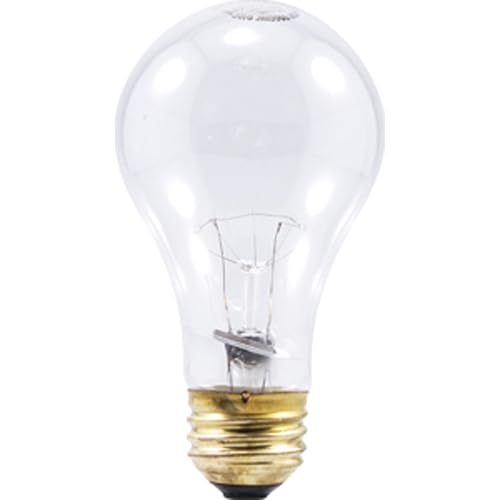
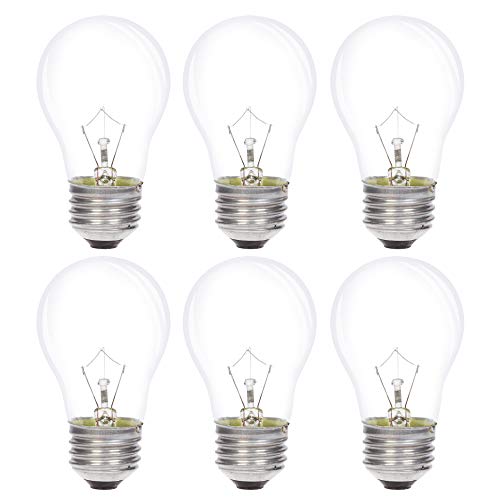
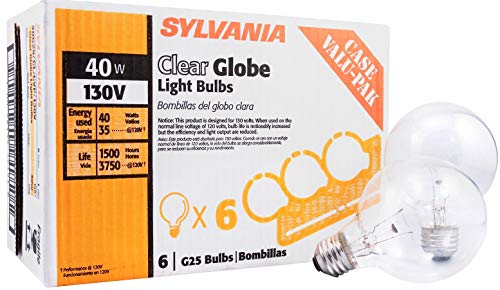
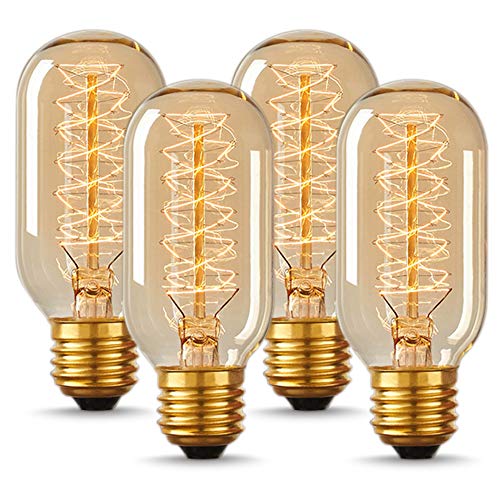
E26 is the standard medium screw base used by the products in this comparison. Before choosing a bulb, check that the fixture calls for E26 rather than a candelabra base, and verify the maximum wattage printed on the fixture. A 100-watt bulb should not be installed in a socket rated for less. Also compare the bulb’s shape and dimensions with the available space. A19 bulbs are common general-purpose choices, while A15 bulbs are smaller and often used in appliances, ceiling fans, and compact lamps. G25 globes and T45 Edison bulbs need more visual and physical clearance.
The listing for Simba Lighting specifically advises checking an appliance’s required bulb type before ordering. That is useful guidance for refrigerators, ovens, and microwaves, where the socket, heat environment, and appliance instructions may impose additional requirements. A normal household A19 is not automatically an appliance bulb simply because its base matches.
Match wattage and brightness
Wattage indicates electrical power, not brightness by itself, so use listed lumens when available. Xtricity documents 1,020 lumens from a 100-watt A19, making it the brightest clearly quantified general-format selection here. The Sylvania rough-service traffic bulb lists 595 lumens at 60 watts. Lower-output choices include the Sylvania 25-watt A19 at 160 lumens and the Sylvania 15-watt A15 at 65 lumens.
For a main room or work area, look first at the available lumen figure and then confirm the fixture’s wattage allowance. For bedside, accent, or decorative lighting, a lower-output bulb can be more appropriate. The 25-watt and 15-watt Sylvania options are designed around that gentler role. Simba Lighting’s 40-watt A15 provides 310 lumens, placing it between low-level accent bulbs and brighter household A19 options.
Do not infer brightness from a product’s marketing language when a lumen value is absent. Philips identifies its bulb as a 100-watt frosted A19 but the supplied listing does not provide a lumen figure. That makes it possible to confirm the format and finish, but not to make a precise brightness comparison with the quantified products.
Choose the light color and finish
Incandescent bulbs generally suit buyers who want warm light, but the selected products still vary. Sevici lists 2200K amber light, which is the warmest documented option and is aimed at vintage ambiance. Xtricity and YXQZH list 2700K warm or soft white light. Simba Lighting lists 2700K, while the Sylvania A19, A15, and G25 products list 2850K.
Clear glass can emphasize a decorative filament or produce a direct-looking appearance, while frosted finishes are commonly chosen for a softer visual effect. Philips is explicitly frosted, as are the two lower-wattage Sylvania choices. Sevici and DORESshop use amber-colored glass for their Edison styling. The right choice depends on whether the bulb is exposed and decorative or hidden behind a shade.
Color rendering is another useful specification when supplied. YXQZH lists CRI 90-plus, while Sylvania’s 25-watt A19, 15-watt A15, G25 globe, and Simba Lighting A15 list CRI 100. These figures can be useful for vanity, accent, and everyday spaces where natural-looking color matters. They do not replace checking the fixture and desired brightness.
Decide whether dimming matters
Dimming is documented for most of the selected products, including Xtricity, Sevici, YXQZH, the Sylvania low-wattage and globe models, Simba Lighting, and DORESshop. A dimmable bulb still needs a compatible dimmer and fixture. If you plan to adjust brightness regularly, confirm the dimmer’s requirements rather than assuming any incandescent dimmer will work identically with every installation.
A 360-degree or omnidirectional description can help when you want broad distribution. Xtricity lists a 360-degree beam, and YXQZH also lists a 360-degree beam angle. Decorative Edison bulbs may be selected more for their visible filament and glow than for evenly lighting an entire room. Their listed lumen levels reinforce that distinction: Sevici provides 280 lumens and DORESshop 240 lumens.
Consider rough-service construction and life
Rough-service bulbs are designed for applications where vibration or repeated service demands are relevant, but the exact construction varies. Xtricity describes an additional wire and reinforced filament, while the Sylvania traffic bulb lists shock-resistant construction, vibration resistance, and an 8,000-hour rated life. Those features explain why they rank strongly for utility or demanding fixtures.
Rated life is supplied for several other products: Sevici lists more than 2,500 hours, Sylvania’s 25-watt and 15-watt bulbs list 2,500 hours, Sylvania’s G25 lists 1,500 hours, and Simba Lighting lists 1,000 hours. These are product specifications, not guarantees of actual service in every fixture.
Pick the right design type
Choose an A19 when you want a familiar household silhouette for lamps and standard fixtures. Choose an A15 when the fixture is compact or the application is an appliance or ceiling fan. A G25 globe is purposefully shaped for vanity and decorative installations. T45 and A19 Edison designs are most useful when the bulb remains visible and contributes to the room’s appearance.
The top medium-base incandescent bulbs are therefore not interchangeable winners for every room. A rough-service traffic bulb can be the most specification-aligned specification-based utility choice but a poor vanity choice. Conversely, a 15-watt A15 may be ideal for a small accent lamp but insufficient for a kitchen. Treat the ranking as a comparison of documented strengths, then select by fixture and lighting task.
Final Recommendation
Among the top medium-base incandescent bulbs, the ranked products differ under documented medium-base and form-factor fit, documented light output and color, dimming and light-control features, fixture and application versatility, and construction and rated service life.
Xtricity A19 Clear 100W Rough Service Bulb ranks first overall in this specification-based comparison under the published weighted criteria.
Sylvania A19 60W Rough Service Traffic Signal Bulbs are the first overall specification-based choice among these selections because they combine E26 fit, useful 60-watt output, dimmability, enclosed-outdoor suitability, and the longest documented rated life. Their specialty design is especially relevant for traffic signals, sign boxes, utility lamps, and vibration-prone fixtures.
For a more conventional household A19, Xtricity is the stronger broad-use pick because it lists 1,020 lumens, 2700K light, dimming, omnidirectional coverage, and rough-service filament support. YXQZH is a sensible alternative when 75 watts and CRI 90-plus are a better match. Philips is the simpler frosted 100-watt format when the supplied core specifications are enough for your decision.
For decorative fixtures, Sevici offers the warmest documented amber tone, while DORESshop provides a 2700K T45 Edison appearance. For lower light levels, the Sylvania 25-watt A19 and 15-watt A15 are more appropriate than high-output bulbs. The Sylvania G25 is the focused vanity option, and Simba Lighting is the appliance-oriented A15 choice. In short, the best medium-base incandescent bulbs depend on the socket, wattage limit, required brightness, and whether the bulb is functional, decorative, or built for rough service.
Frequently Asked Questions
Among the best medium-base incandescent bulbs, what does an E26 medium base mean?
An E26 medium base is a standard screw-in socket format with a nominal 26-millimeter diameter. All ten selected products identify an E26 or medium screw base in their supplied title or features. The base alone does not confirm that the bulb’s shape, wattage, or application is suitable for a particular fixture, so those details should be checked separately.
Which of these bulbs is best for a standard lamp?
An A19 model is generally the most conventional shape for a standard lamp among the selected products. Xtricity, YXQZH, Philips, and the Sylvania 25-watt A19 use that format. Choose among them by wattage allowance, desired brightness, finish, and whether you need rough-service construction. The Philips listing confirms a frosted 100-watt A19, but does not state lumens or rated life.
Are medium-base incandescent bulbs dimmable?
Many of the selected products are listed as dimmable, including Xtricity, Sevici, YXQZH, the Sylvania A19 and A15 models, the Sylvania G25 globe, Simba Lighting, and DORESshop. Use a compatible dimmer and follow the fixture instructions. Dimmability does not mean every bulb will provide the same usable range in every installation.
Which bulb is suitable for an appliance?
Simba Lighting’s 40-watt A15 is explicitly positioned for refrigerators and certain ovens and microwaves, as well as other small fixtures. The listing says to verify the appliance’s required bulb type before ordering. That check is important because an E26 socket does not by itself establish heat, enclosure, or appliance compatibility.
What should I choose for a warm decorative glow?
Sevici is the warmest documented decorative choice at 2200K with amber glass and an A19 Edison design. DORESshop is another decorative option with amber glass, a T45 profile, and 2700K light. Both are dimmable according to their listings, but their documented lumen outputs are more suited to ambiance than bright general-purpose illumination.