Buying Guide
The best floor thresholds are chosen by matching the transition’s measured height, width, flooring materials, and installation conditions. A threshold that looks suitable in a product image may still be too narrow, too tall, or too dependent on adhesive for the location. The products above cover four main formats: solid wood interior thresholds, aluminum profiles, rubber ramps, and flexible PVC or vinyl strips.
Measure the transition first
Measure the height difference between the two finished floor surfaces, not just the visible gap. Also measure the doorway or seam length and the width of the area that needs covering. Jiekayi documents support for differences up to 1 inch, while Gaahing is intended for approximately 0.2 to 0.5 inches. The Maxiroc rubber ramp is specified for a 1/2- to current listing information-inch transition, and the other adhesive products are generally aimed at lower transitions.
A low, nearly level seam may suit Greymond, Maxiroc, or MYFAMIREA. A larger difference needs a defined ramp or bridge profile rather than a flat decorative cover. BNELL’s specification is for height differences under 7 mm, and the 40-inch Maxiroc strip is specified for uneven floor heights within 5 mm. These limits should be treated as compatibility guidance, not as a substitute for measuring the installed floors.
Choose a material for the location
Wood thresholds provide a traditional interior appearance. Kigley uses red oak and Frost King uses clear oak. Both can suit interior doorways where the threshold should coordinate with wood trim or flooring. Frost King is particularly wide at 5 inches and is described as paintable and stainable, while Kigley’s approximately 3.5-inch width offers a more moderate wood profile.
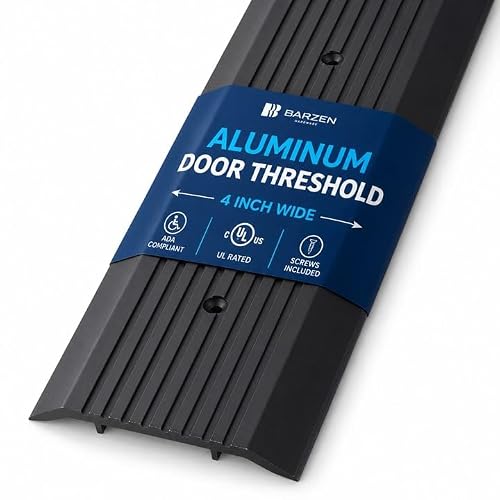
Aluminum is a useful choice when a metal finish and a more structured profile are wanted. Jiekayi is described as weatherproof and rust-resistant, with indoor and outdoor use, while Gaahing uses Grade 6063 aluminum alloy with an oxidized surface described as waterproof, anti-corrosion, and anti-rust. The supplied evidence supports considering these products for moisture exposure, but it does not provide independent testing results.
PVC and rubber strips are flexible alternatives for decorative coverage and low transitions. The selected vinyl products include scratch-, wear-, dirt-, or stain-resistant surface descriptions. Maxiroc uses rubber and is specifically positioned for rolling access, while the PVC choices focus on flexible, cut-to-length coverage. If the floor is uneven in multiple directions, check the listing carefully: some products explicitly say they are not suitable for uneven surfaces.
Compare installation methods
Adhesive thresholds are usually the simplest format on paper. MYFAMIREA, Greymond, BNELL, and Maxiroc describe peel-and-stick installation. Their instructions consistently emphasize cleaning and drying the floor first. Several also mention warming the material or adhesive with a hairdryer, especially after rolled packaging or in cooler conditions. This preparation is important because the supplied evidence does not establish that adhesive will bond equally well to every surface or remain secure under every use condition.
Mechanical installation offers a different trade-off. Jiekayi includes pre-drilled holes, screws, and expansion tubes, so it is the clearest selection when a fastened threshold is preferred. Gaahing supports construction adhesive, double-sided tape, glue, flooring nails, or staples. Frost King and Kigley are described as easy to install and cuttable, but the supplied details do not specify their complete fastening hardware. Plan the cut and fastening method around the flooring substrate and the threshold’s intended position.
Match width and length to the seam
Length determines whether one piece can span the doorway. Most selected products are approximately 3.3 to 4 feet long. Jiekayi and Gaahing are about 36 and 35.4 inches, respectively. The Maxiroc ramp, Maxiroc rubber strip, and wisleousda strip extend to 40 or 60 inches, while BNELL provides 9.84 feet for longer or multiple runs.
Width affects coverage and appearance. The 1.5-inch Maxiroc strip and 1.57-inch Greymond strip are relatively narrow. MYFAMIREA is 1.97 inches wide, and the Jiekayi aluminum profile is 2.4 inches wide. Frost King reaches 5 inches, and wisleousda reaches 3 inches. Wider choices can cover a larger seam, but they may stand out more on a narrow doorway. Compare the product width with the actual exposed flooring on both sides.
Consider appearance and maintenance
Color matters when the threshold crosses visible flooring. The selected finishes include black, matte silver, clear oak, red oak, walnut grain, gray wood, gray oak ash, and brown wood-grain options. Wood-grain PVC can coordinate with laminate or wood-look floors, but the supplied listings caution that screen and lighting conditions can affect perceived color. Where appearance is important, compare the physical finish with the flooring before installing.
Most selected PVC and aluminum listings describe smooth, wipe-clean, water-resistant, or moisture-resistant surfaces. These statements can help narrow choices for kitchens, bathrooms, or entry areas, but they do not establish waterproof installation in every application. Jiekayi is the selected product with explicit indoor/outdoor positioning and weatherproof wording. For any threshold near water, verify the substrate, adhesive suitability, and edge sealing separately.
Final recommendation
Jiekayi 36-Inch Aluminum Flat Threshold ranks first overall in this specification-based comparison under the published weighted criteria.
Jiekayi 36-Inch Aluminum Flat Threshold is the first overall specification-based choice.
Jiekayi is the highest-ranked returned product among the best floor thresholds. Its documented up-to-1-inch transition range, aluminum construction, included hardware, and broad flooring compatibility give it the most complete specification profile in this comparison. Choose Gaahing when the height difference is smaller and a slim silver aluminum finish is preferred. For mobility-focused access, the Maxiroc 40-inch rubber ramp is the more targeted option.
Kigley and Frost King are the leading wood choices for interior doorways, with Frost King favored for extra width and finishing flexibility. BNELL is the practical long-run option, while MYFAMIREA, Greymond, and Maxiroc’s 40-inch rubber strip suit lower adhesive transitions. wisleousda is worth considering when coverage width matters more than a precisely stated height range. These top floor thresholds are ranked from the supplied specifications only, so confirm dimensions and surface compatibility before purchase.
Frequently Asked Questions
What should I measure before choosing a floor threshold?
Measure the finished height difference, the doorway length, and the available coverage width. Compare those measurements with the product’s stated range. For example, Gaahing covers approximately 0.2 to 0.5 inches, while Jiekayi documents up to a 1-inch difference. Also check whether the threshold is intended for flat, smooth, or uneven surfaces.
Are adhesive floor thresholds suitable for every floor?
No. Adhesive products generally require a clean, dry, smooth surface, and some listings state that they are not suitable for uneven surfaces. Rolled PVC strips may need to be flattened or warmed before installation. The supplied evidence supports adhesive use for the named compatible surfaces, but it does not establish bonding on every substrate or under every moisture condition.
Which best floor thresholds are intended for interior doorways?
Frost King and Kigley are clearly positioned for interior doorways. Frost King is a 5-inch-wide clear oak threshold that can be painted or stained, while Kigley is a red oak threshold approximately 3.5 inches wide. Their wood profiles are best considered when interior appearance and seam coverage are more important than a flexible peel-and-stick format.
When is a rubber threshold ramp the better choice?
A rubber ramp may be preferable when a rolling transition is the main concern. The selected Maxiroc ramp is specifically described for wheelchairs, walkers, and strollers and covers a stated 1/2- to current listing information-inch difference. Confirm the measured height before ordering, because the ramp’s documented range is not unlimited.
Can these thresholds be cut to length?
Several listings state that the product can be cut. Jiekayi describes measuring and cutting before screw installation; Gaahing can be cut with a miter saw or hacksaw; adhesive PVC products such as MYFAMIREA and BNELL are described as cut-to-length. Use the appropriate tool and leave enough material for the complete seam without creating an unsupported edge.