Buying Guide
The best handheld marine two-way radios should be assessed as marine VHF tools, not ordinary land-based walkie-talkies. The selected products document features such as flotation, submersion protection, marine-channel access, weather reception, or adjustable VHF transmission. Because this is a specification-based comparison, the scores reflect listed capabilities rather than hands-on performance.
Start with water protection and retrieval
A radio carried on a boat, kayak, or fishing trip may encounter spray, rain, and accidental immersion. Look for both a stated ingress-protection rating and a recovery design. Floating construction can help keep a dropped radio on the surface. Several selected radios also use a flashing light or water-activated indicator to help locate the unit.
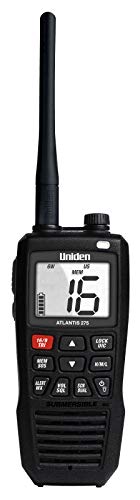
The Uniden Atlantis 275 and Atlantis 155 document IPX8/JIS8 protection and flotation. The Retevis RM15 lists IP68 protection, floating recovery, and corrosion-resistant charging contacts. IP67 models such as the Retevis RM40, RM22, RT55, and RM21 also document flotation. These ratings describe the supplied claims; they do not replace manufacturer care instructions.
Match transmit power to your use
Many marine handhelds let you select lower output for nearby communication and higher output when conditions or distance require it. The Retevis RM15 and RM22 list 6W transmission. The Atlantis 155 is a 3W model, while the RM21 offers up to 5W.
Higher listed wattage is only one part of a radio’s usefulness. Antenna position, obstructions, weather, battery condition, and the receiving station can affect communication. Adjustable settings may be practical because they let the operator avoid maximum output for every exchange. The ICOM IC-M73 01 is another 6W option, but its listing provides fewer details about output selection.
Check channel and watch functions
Channel coverage matters if you travel between regions or share waterways with different operators. The Atlantis 275, Atlantis 155, and HX210 explicitly list USA, Canadian, and international marine channels. NOAA access or alerts are listed for the Atlantis radios, RM22, RT55, RM21, and both Cobra models.
Watch modes help monitor important channels while another channel is in use. The RM40 lists dual- and tri-watch, the RM21 lists dual-watch, and the HX210 and Cobra BlueBound 350 provide related monitoring controls. Review the exact channel and watch requirements for your boating area before choosing.
Consider battery and charging logistics
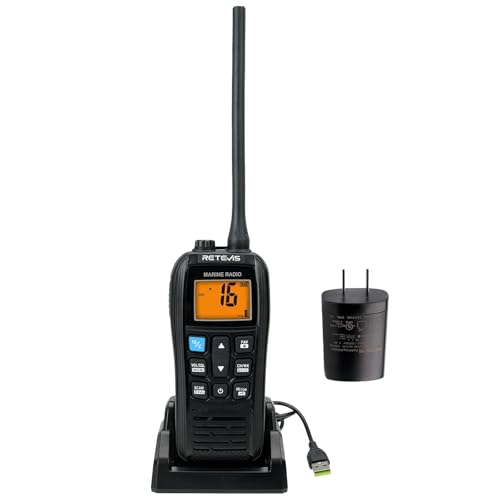
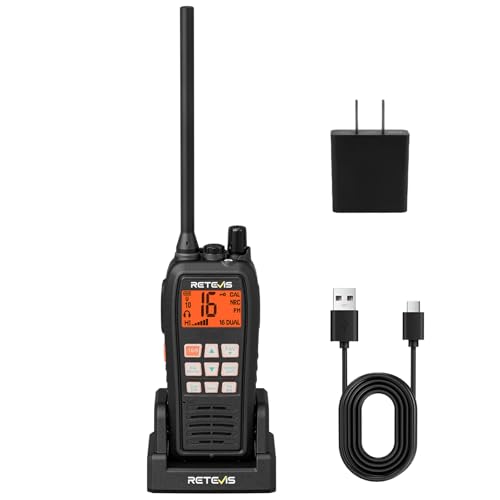
Charging convenience matters when a radio is used away from shore power. The RM15 lists USB-C ports on the radio and charger. The RM22 documents a 2200mAh battery and micro-USB charging, while the RM21 lists an 1800mAh lithium-ion battery and charging dock. The RT55 uses a 1200mAh rechargeable battery and desktop charger.
The Atlantis 275 includes a built-in lithium battery pack, AC and DC cables, and a charging cradle. The Atlantis 155 uses rechargeable AAA batteries with a DC cable. The HX210 includes a lithium-ion battery, rapid desktop charger, AC/DC cables, and cradle. The Cobra BlueBound listing does not provide battery-capacity or charging details, so buyers who need a documented charging plan may prefer a more fully specified option.
Prioritize visibility and audio controls
A readable display can make channel selection and status checks easier in changing light. The Atlantis radios use dual-color backlighting, the HX210 uses a high-resolution dot-matrix display, and the Cobra BlueBound 350 offers day/night display selection. The RM21 lists a seven-color backlit LCD, while the RT55 lists automatic brightness adjustment.
Audio controls are relevant around wind, engines, and waves. The RM15 lists dual-way noise reduction and a 1W speaker. The RM22 lists 900mW audio output and a noise-reduction microphone, while the RM21 lists intelligent noise cancellation. These are documented design features, not independent sound-quality test results.
Decide whether navigation features are necessary
Basic handhelds can be sufficient for routine channel communication and weather monitoring. A more specialized radio may be appropriate when location sharing and distress workflows are important. The Retevis RM40 is the selected model with the clearest documented navigation and emergency feature set: built-in GPS, DSC distress calling, position transmission, and a man-overboard function.
Those functions depend on correct setup, compatible receiving stations, and responsible operation. If you choose a radio with GPS or DSC, learn how the feature works before an emergency and follow applicable marine-radio rules.
How to use the ranking
The editorial criteria emphasize water protection, transmission controls, marine monitoring, charging, usability, and safety features. No score uses customer ratings, current listing information, purchase activity, or marketplace labels. A lower-ranked model may still be the better fit if its particular strength matches your use. For example, the RM40 suits GPS and DSC needs, while the RM21 emphasizes noise control and the Atlantis 155 favors compact lower-power use.
Final recommendation
Uniden Atlantis 275 ranks first overall in this specification-based comparison under the published weighted criteria.
Uniden Atlantis 275 is the first overall specification-based choice under the published weighted criteria.
The Uniden Atlantis 275 combines water protection, adjustable 6W output, marine-channel coverage, NOAA alerts, display visibility, and emergency-oriented lights. It is the most balanced pick for general boating when a floating, submersible handheld is wanted.
The Retevis RM40 is the specialist alternative for buyers who specifically need GPS, DSC, and man-overboard functions. For longer documented battery capacity, consider the Retevis RM22; for compact use with lower maximum output, the Uniden Atlantis 155 is a sensible fit. Together, these models represent several of the top handheld marine two-way radios without relying on customer-opinion claims.
Before purchase, verify channel requirements, charging compatibility, protection instructions, and local operating rules. The best handheld marine two-way radios are the ones whose documented features fit the water conditions, trip length, and emergency procedures you expect to use.
Frequently Asked Questions
Are the best handheld marine two-way radios waterproof?
The selected products list different protection levels rather than one universal standard. The Atlantis 275 and Atlantis 155 document IPX8/JIS8 protection, while the RM15 lists IP68. The HX210, RM22, RM40, RT55, RM21, and Cobra models list IPX7 or IP67 protection. Many also float, but users should follow each product’s care and immersion instructions.
Is 6W always better than 3W or 5W?
Not necessarily. Higher maximum output can be useful when longer communication range is needed, but actual results depend on conditions and equipment at the other end. Lower settings may suit nearby stations and can reduce power use. The Atlantis 155 lists 3W maximum, the RM21 lists 5W, and several selected models list 6W with adjustable lower settings.
Which selected radio has GPS and DSC?
The Retevis RM40 is the selected product whose listing explicitly documents built-in GPS, DSC distress calling, position transmission, and a man-overboard function. Buyers should understand setup and operating requirements before relying on these features.
What charging options are documented?
The selected range includes USB-C on the Retevis RM15, micro-USB on the RM22, charging docks for several Retevis models, AC/DC cables and a cradle for the Atlantis 275, and AC/DC charging accessories for the HX210. The Atlantis 155 uses rechargeable AAA batteries with a DC cable. Charging details for the Cobra BlueBound radios are not specified in the supplied evidence.
Several selected models list NOAA access or alerts, including the Atlantis 275, Atlantis 155, RM22, RT55, RM21, and both Cobra BlueBound radios. The presence and number of listed weather channels differ, so check the specific model’s documentation when weather monitoring is a priority.