Buying Guide
The best heavy-duty power strips are not defined by outlet count alone. A useful comparison should start with the equipment you plan to connect, the type of workspace involved, and the electrical limits of the circuit supplying the strip. The products in this guide are evaluated from public listing data, not from hands-on testing. Their specifications can help narrow the field, but they do not replace following local electrical guidance or the instructions supplied with connected equipment.
Match the strip to the workspace
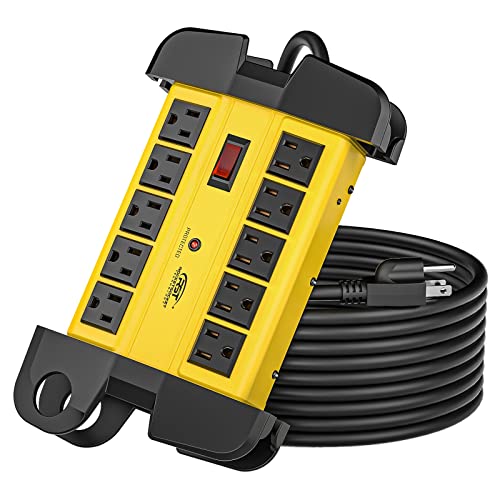
A garage, workshop, laboratory, and home office can all need a heavy-duty strip, but they do not necessarily need the same design. Metal housings appear across several selected models, including the HEZI, Plug’n, both CRST picks, Green Box Innovations, and Eaton Tripp Lite. That construction can be relevant where a rigid enclosure is preferred. The Eaton Tripp Lite 3SP is particularly focused on compact mounting, while the CRST 8-Outlet model documents compatibility with standard 16-inch stud spacing.
For a desk or shared electronics area, connection density may matter more than metal construction. The NANOLAKE has 18 AC outlets and four USB ports, while QINLIANF has 24 AC outlets and four USB ports. Belkin supplies 12 AC outlets in a slender design. These layouts may reduce the need for multiple strips, but a crowded strip still requires sensible load planning and clear access to switches and indicators.
Check electrical ratings carefully
A heavy-duty label does not mean every connected appliance can be used together without limitation. Several selected strips list a 15-amp, 125-volt, 1,875-watt maximum. The HEZI lists a 20-amp, 125-volt, 2,500-watt output rating, but its listing specifically says not to exceed 1,875 watts when used in a 15-amp system. CCCEI’s four-outlet model likewise lists 20-amp features while stating a 1,875-watt limit in its instructions.
Cord gauge is another useful specification. The HEZI and CCCEI four-outlet model list 12-gauge cords, while the NANOLAKE lists a thickened cord sheath and the 15-amp models commonly list 14-gauge cords. A higher gauge specification can be relevant for demanding setups, but it should be interpreted with the strip’s complete voltage, amperage, wattage, and circuit information rather than used as a standalone performance promise.
Compare surge protection and indicators
Joule ratings provide a documented way to compare the listed surge-protection capacity. The selected products range from 1,200 joules on the HEZI to 4,800 joules on NANOLAKE and the two CCCEI models. QINLIANF lists 4,100 joules, Belkin lists 3,780 joules, and the Green Box Innovations model lists 3,300 joules. These figures describe the advertised protection specification; they do not establish how a product will perform in every surge event.
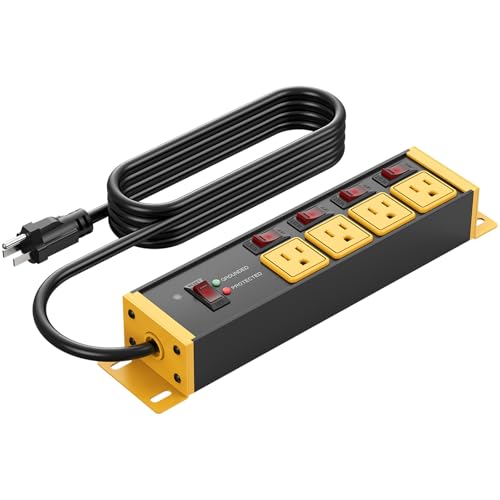
Indicators can make the status of the strip easier to check. NANOLAKE lists real-time grounded and protected LEDs. Belkin identifies a safety indicator light, and Eaton Tripp Lite includes diagnostic LEDs. Plug’n and QINLIANF also list protected indicators. A circuit breaker or overload feature is common across the comparison, but the exact design differs: Green Box Innovations uses a 15-amp breaker, the HEZI lists a 20-amp breaker, and CCCEI’s four-outlet model gives each outlet an independent breaker.
Count outlets, then examine spacing
The number of outlets is only useful if the plugs can be inserted without blocking one another. Wide spacing is documented on HEZI, Plug’n, CRST, Belkin, NANOLAKE, and QINLIANF. CRST’s 8-outlet model lists 1.7-inch center-to-center spacing, Plug’n lists 1.69-inch spacing, and HEZI lists 1.57-inch spacing. These details may help when using bulky adapters or power supplies.
Individual switches change the buying decision. Green Box Innovations has recessed switches for each outlet, while another selected design from the broader candidate pool is not used here because the ranking emphasizes the full balance of features. The CCCEI four-outlet model uses independent circuit breakers rather than merely individual on/off switches. Eaton Tripp Lite uses a guarded master switch, which may help prevent accidental shutoff in an active workspace.
Decide whether mounting is essential
Mounting can keep a strip accessible and reduce cable clutter. NANOLAKE documents side, top, and back mounting. Plug’n includes four mounting holes and screws, CRST documents hanging holes or stud-spacing support, and Green Box Innovations includes mounting holes and cord-management features. Belkin is wall-mountable, while Eaton Tripp Lite provides top, bottom, and rear mounting provisions.
A flat or angled plug is helpful when the wall receptacle sits behind furniture or near another outlet. NANOLAKE, HEZI, Plug’n, CRST, Green Box Innovations, Belkin, and QINLIANF list flat or angled plug designs. The cord length should be considered at the same time: CRST’s 15-foot cord is the reach leader, NANOLAKE reaches 10 feet, Belkin reaches eight feet, and most other selected models use six-foot cords.
Consider USB charging as a convenience feature
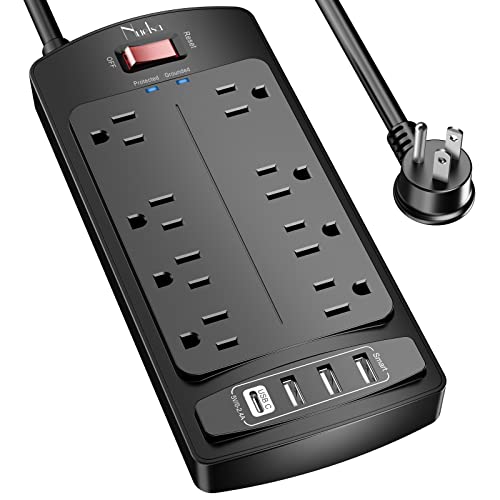
USB ports are useful when phones, tablets, or other USB-powered devices share the same area as AC equipment. NANOLAKE lists two USB-A and two USB-C ports, including USB-C PD20W. QINLIANF also lists four USB ports, with two USB-C ports and smart charging details. These ports can preserve AC outlets for larger plugs, but they do not replace the need to check the power requirements of each device.
Final Recommendation
NANOLAKE 18-Outlet Power Strip ranks first overall in this specification-based comparison under the published weighted criteria.
The final choice among the best heavy-duty power strips depends on the documented features that match your intended use.
NANOLAKE 18-Outlet Power Strip is the highest-scoring returned product and the first overall specification-based choice. It combines the largest well-documented outlet layout among the selected options with four USB ports, 4,800 joules of listed surge protection, a 10-foot cord, protected and grounded indicators, and three-way mounting. For a workshop that prioritizes metal construction and a simpler layout, the HEZI, Plug’n, CRST, or Green Box Innovations models offer more explicitly metal-oriented designs. For a long reach, CRST’s 10-outlet model is the clearest fit. For office equipment, Belkin provides a strong certified, wall-mountable alternative.
The top heavy-duty power strips therefore divide into practical use cases rather than one universal design. Choose NANOLAKE or QINLIANF when connection density and USB charging are central. Choose CCCEI’s four-outlet model when independent breaker control matters. Choose Eaton Tripp Lite when compact mounting and a guarded switch are more important than outlet count. Before purchase, confirm the connected load, receptacle compatibility, cord reach, mounting surface, and whether the listed safety features fit the environment.
Frequently Asked Questions
What makes the best heavy-duty power strips different from ordinary power strips?
The supplied listings commonly identify features such as metal or reinforced housings, heavier-gauge cords, circuit breakers, surge protection, wide outlet spacing, and wall-mounting provisions. No single feature proves that a strip is suitable for every demanding application. The best match depends on the equipment, the supply circuit, the environment, and the strip’s stated electrical limits.
Is a higher joule rating always the right choice?
A higher listed joule rating provides a larger published surge-protection figure, but it is not the only consideration. The comparison also includes circuit breakers, grounding or protected indicators, certifications, outlet layout, and electrical ratings. NANOLAKE and CCCEI list 4,800 joules, QINLIANF lists 4,100 joules, and Belkin lists 3,780 joules, but their physical designs and intended layouts differ.
A metal housing may be preferable when a rigid enclosure is desired, and several selected products document aluminum or metal construction. Plug’n, HEZI, CRST, Green Box Innovations, and Eaton Tripp Lite are examples in this comparison. However, the listings do not establish that any model is weatherproof or appropriate for direct outdoor exposure. Review the product’s environmental instructions and protect the strip from conditions it is not designed to handle.
How many outlets do I need?
Count the devices first, then allow room for bulky adapters and future additions. QINLIANF has 24 AC outlets, NANOLAKE has 18, Belkin has 12, and CRST’s long-reach model has 10. A smaller six- or eight-outlet strip may be easier to mount and manage in a workshop. Wide spacing can be more useful than a higher count if large plugs would otherwise block neighboring sockets.
Can a power strip safely run high-power equipment?
Use the strip’s stated amperage and wattage limits, and consider the rating of the wall circuit. The HEZI and CCCEI four-outlet model list 20-amp features but include a 1,875-watt limit for a 15-amp system. Many selected strips list 15 amps and 1,875 watts. Do not exceed the applicable limit, and do not assume that a heavy-duty label permits unlimited simultaneous loads.