Buying Guide
The best usb charging surge protectors are not defined by port count alone. A useful comparison should separate surge-energy capacity, USB arrangement, AC outlet layout, physical placement, and safety documentation. The models above are ranked from supplied listing evidence, so the scores describe documented specifications rather than test results.
Start with the devices you need to connect
Count both AC-powered equipment and USB-charged devices. A desk with monitors, a computer, speakers, lamps, and several phones may benefit from the 22 AC outlets on the SUPERDANNY 22-Outlet USB Power Strip or the 12 outlets on the okleeic 12-Outlet USB-C Charging Power Strip. These higher-capacity designs are intended for dense setups, but a larger body can be less convenient in a small space.
If the main requirement is charging phones, tablets, cameras, or other USB equipment, look at the USB mix rather than the total device count. The okleeic model has six USB ports, including three USB-C ports. Bawmwim provides four USB-A and two USB-C ports, while Beeiker lists four USB-A and two USB-C ports with 24-watt total USB output. A greater USB-C count can reduce the need for separate charging adapters, but the listing should still be checked for the stated output and whether that output is shared.
Compare surge-energy ratings carefully
Several selected products document their surge protection in joules. Nuetsa and ALESTOR list 2700 joules, while okleeic and SUPERDANNY list 2100 joules. Other selected models list 1850, 1680, 1080, or 980 joules. In this comparison, the stated joule figure is treated as a specification for relative comparison, not as a guarantee of protection in every electrical event.
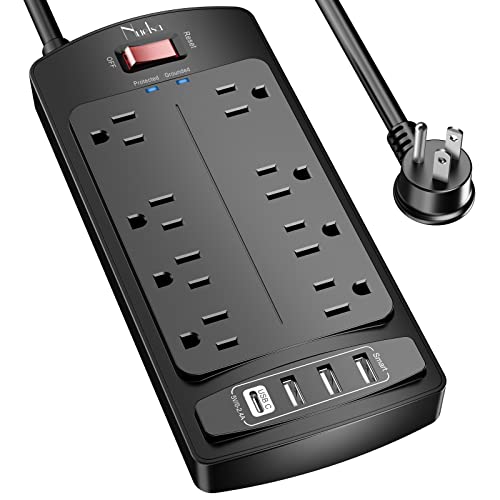
A surge rating should be considered alongside the unit’s other protection features. Nuetsa lists overload, short-circuit, and over-current protection. Mifaso lists overload, short-circuit, over-current, over-voltage, overheating protection, and an overload switch. Look for a protected indicator when you want a visible status signal; Nuetsa, Mifaso, Lvetek, QINLIANF, and ALESTOR document one.
Corded flat-plug strips are generally easier to position behind furniture than traditional bulky plugs. The Mifaso 6-Outlet USB-C Surge Protector with 10-Foot Cord is useful when the receptacle is far from the intended location. Its 10-foot braided cord can reach across a room or around furniture, though the extra length may need to be managed.
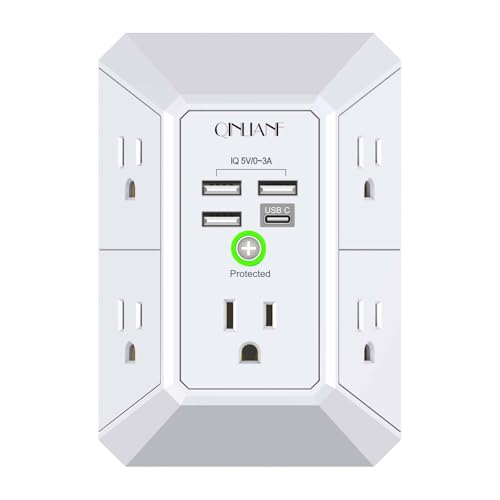
Wall extenders take a different approach. Lvetek and QINLIANF attach directly to a duplex wall receptacle and do not require a trailing extension cord. Their three-sided layouts and wide spacing are useful near a bedside table or in a dorm room. The trade-off is reduced placement flexibility: the unit stays at the wall outlet.
Mountable corded strips can provide a middle ground. okleeic, SUPERDANNY, Bawmwim, Mifaso, Beeiker, and YISHU document mounting holes. This can keep a charging station fixed to a desk, wall, workbench, or furniture panel, but installation requires a suitable surface and access to the listed mounting points.
Understand outlet spacing and orientation
Outlet geometry affects how many plugs can be used at once. SUPERDANNY documents widely spaced outlets, ALESTOR identifies two special wide-spacing outlets, and QINLIANF lists 2.1-inch spacing. YISHU lists 1.8-inch spacing, while Bawmwim lists 1.2-inch spacing. These measurements are more useful than a general claim that a strip is spacious.
Three-sided designs can also help. Instead of placing every plug in one row, they direct plugs across multiple faces. The okleeic, Lvetek, QINLIANF, and YISHU models document this type of layout. It may reduce adapter interference, although the result depends on the size and shape of each connected plug.
Check electrical and certification details
Do not treat a USB port as a replacement for every AC outlet. These electrical limits are product specifications, not invitations to exceed the rating. Check the equipment load and follow the product’s stated limits.
Certification information is another useful screening point. Nuetsa, Bawmwim, Mifaso, Lvetek, QINLIANF, Beeiker, and YISHU list ETL, FCC, or RoHS information in their supplied evidence. SUPERDANNY also describes UL-certified components and an FCC/RoHS certification statement. Certification references should be read as listing documentation and verified against the product packaging or current manufacturer information when that matters for your installation.
Match the strip to the room
For a large workstation, prioritize AC capacity, spacing, cord reach, and mounting. For a nightstand, a direct-wall extender may be neater. For a dorm or travel bag, consider physical size, a flat plug, and USB count. The Beeiker 4-Outlet Six-USB Travel Power Strip and Mifaso model both emphasize compact or flexible placement, while the SUPERDANNY 22-Outlet USB Power Strip is better suited to a much denser equipment area.
Remember that this is a specification-based guide. It does not confirm charging speed, heat behavior, durability, noise, or real-world surge performance through hands-on testing. Use the documented features to narrow the field, then confirm compatibility, electrical limits, and current availability before purchase.
Final Recommendation
okleeic 12-Outlet USB-C Charging Power Strip ranks first overall in this specification-based comparison under the published weighted criteria.
The final choice among the best usb charging surge protectors depends on the documented features that match your intended use.
The Nuetsa 8-Outlet USB-C Surge Protector is the highest-scoring returned product and the first overall specification-based choice. Its 2700-joule rating, ETL listing, eight AC outlets, four USB ports, six-foot cord, and flat-plug design create a balanced home-office profile. The top usb charging surge protectors also include stronger specialized alternatives: choose okleeic for the broadest port capacity, SUPERDANNY for a very large AC outlet array, Mifaso for a 10-foot reach, or Lvetek and QINLIANF for direct-wall installation.
For USB-C-heavy charging, Bawmwim or Beeiker document two USB-C ports, while okleeic documents three. For a dense stationary workspace, ALESTOR offers twelve AC outlets and a 2700-joule rating. YISHU is a practical choice when three-sided access and a six-foot cord matter more than a stated joule figure.
Frequently Asked Questions
What should I look for in the best usb charging surge protectors?
Start with the number and type of devices you will connect. Then compare the documented surge-energy rating, USB-A and USB-C mix, AC outlet spacing, cord length, mounting options, electrical limits, and certification information. A high port count is useful only when the layout fits your plugs and the total load stays within the listed rating.
Is a higher joule rating always the right choice?
Not necessarily. A higher documented joule rating is one useful comparison point, but physical layout, outlet count, USB capacity, safety features, and placement may matter more for a particular room. Nuetsa and ALESTOR list 2700 joules, while wall extenders such as Lvetek and QINLIANF may be preferable when direct-wall access and compact placement are the priority.
Are USB-C ports better than USB-A ports?
They serve different connector needs. USB-C can be more convenient for newer cables and devices, while USB-A remains common. Compare the number of each type and the stated output. Bawmwim and Beeiker list two USB-C ports, and okleeic lists three, but the supplied evidence does not establish identical charging performance across all devices.
When is a wall extender better than a power strip?
A wall extender can be preferable at a bedside table or dorm wall where you want to avoid a trailing cord. Lvetek and QINLIANF use direct-wall designs with securing hardware and four USB ports. A corded strip is usually more flexible when the charging station must sit away from the receptacle or be mounted on a desk.
How many outlets should a home office power strip have?
Count the equipment first, including monitors, computers, lamps, speakers, printers, and chargers. Eight to twelve AC outlets may suit many work areas, while the SUPERDANNY model documents 22 for especially dense setups. Also check outlet spacing and the product’s electrical limit rather than relying on the outlet count alone.