Buying Guide
The best steel utility carts are not all built for the same movement pattern. A three-tier service cart is useful for separating supplies, a platform cart is better for boxes and equipment, and a garden wagon is designed around loose or oversized outdoor loads. Start by identifying the load shape and route before comparing headline capacity.
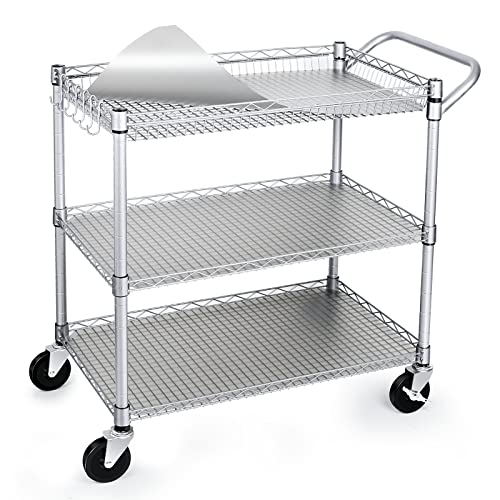
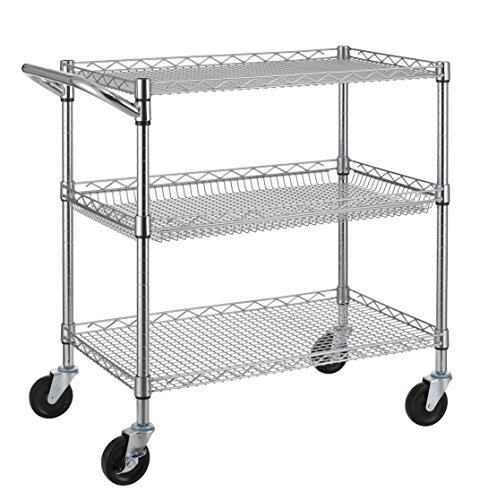
Tiered carts such as the Treshin, AQNIEGEP, Hally, WDT, and Finnhomy models keep supplies separated vertically. They are practical when a user needs multiple shelves, a push handle, and frequent access to smaller items. Guardrails on Treshin and Hally add a defined edge around each shelf, while WDT and Finnhomy document adjustable shelf positions. Wire shelves can also improve airflow around stored items, as described for Finnhomy.
Platform carts solve a different problem. The VEVOR two-tier platform model uses a fixed frame, a flip-up top shelf, and a bungee cord. That arrangement is useful for boxes, workshop equipment, or taller items that do not sit neatly in shallow baskets. A platform design may be easier to load from several sides, but it generally offers less containment than a deep mesh garden bed.
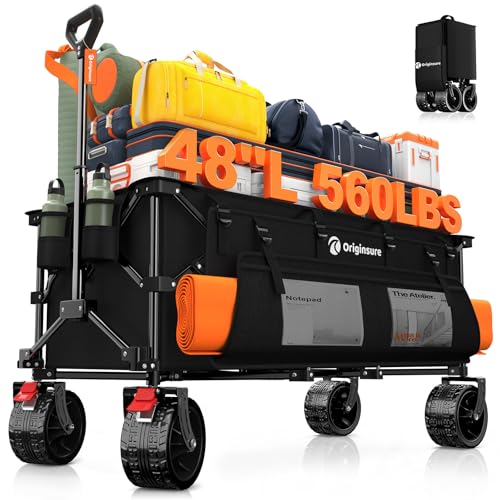
Garden carts are the better match for soil, stones, firewood, tools, and other outdoor materials. Sekey, VEVOR, and Gorilla Carts document large rubber or pneumatic tires, steel bodies, and convertible or removable sides. A fenced mode helps contain loose material; a flatbed mode makes room for long or bulky objects. Check the cart’s listed bed volume and overall length, not only its weight rating, because a high capacity does not guarantee enough space for a particular load.
Compare capacity carefully
Capacity is one of the clearest specification differences in this group, but it should be treated as a listed maximum rather than a promise about every surface or operating condition. EHONXI lists the current price, Sekey lists the current price, WDT lists the current price, and the VEVOR garden cart lists the current price. Gorilla Carts lists the current price, while the VEVOR platform cart lists the current price.
For shelf carts, consider how the load will be distributed across tiers. EHONXI documents three tiers and a surrounding safety fence. WDT offers three shelves and liners, while the stainless models provide shelf-based storage for commercial environments. A cart with a lower total capacity may still be a better fit if its shelves, footprint, and guardrails match the task.
Match wheels to the route
Wheel design should follow the floor. The outdoor models list 10-inch rubber or pneumatic tires and are described for grass, gravel, dirt, mud, rocks, or pavement. Those larger tires can be more appropriate for uneven ground than the smaller casters used on indoor service carts. Gorilla Carts specifically lists pneumatic tires, which may provide a different maintenance trade-off from solid or molded wheels.
Indoor carts generally emphasize turning and parking. Treshin, AQNIEGEP, Hally, WDT, and Finnhomy list swivel casters, and several document two brakes or locking wheels. The VEVOR stainless models also list four swivel casters with two locks. Brakes help hold a cart in place when parked, but they do not replace sensible load placement or a clear route.
The VEVOR platform model uses two swivel wheels and two fixed wheels, a layout intended to balance steering with directional stability. Before buying, measure doorways, aisles, elevator entrances, and storage spaces. A cart can have ample listed capacity yet be inconvenient if its length or width does not fit the route.
Evaluate steel type and finish
The supplied listings use several different levels of material detail. EHONXI identifies 14-gauge stainless steel, AQNIEGEP identifies 304 stainless steel, and Hally identifies 20-gauge 430 stainless steel. Other products describe steel, alloy steel, powder-coated steel, chrome-plated metal, or a rust-resistant finish without giving a gauge or grade.
A stated grade or gauge gives more useful comparison context than a generic heavy-duty label. Stainless surfaces can be attractive for kitchens, labs, clinics, and other areas where wipe-down cleaning matters. Hally also lists NSF certification. Powder-coated steel appears on the outdoor models and Gorilla Carts, where the listings describe resistance to rust, corrosion, wear, or outdoor conditions.
Finish is not the same as complete weatherproofing. The evidence supports comparing the stated surface treatment, but it does not establish long-term outdoor life or resistance under every climate. Follow the intended setting and inspect the product documentation for care instructions before leaving a cart outside.
Consider containment and organization
Deep mesh sides and removable panels are useful when a load needs containment and flexibility. Sekey, the VEVOR garden cart, and Gorilla Carts can convert or remove side structures for larger items. Shelf carts instead organize loads by level.
Guardrails are especially relevant for smooth-surface shelves. Treshin, Hally, the VEVOR stainless models, and EHONXI list some form of edge or fence. These features may reduce the chance of items sliding during movement, although the supplied evidence does not establish performance under a specific speed, slope, or load arrangement.
Check assembly and maintenance details
Many selected carts require assembly. The listings describe tool-free or straightforward setup for several models, including WDT, Finnhomy, AQNIEGEP, and the garden carts. That can reduce setup complexity, but assembly time and instructions should still be checked before purchase. Stainless and coated metal surfaces are generally described as easy to clean or resistant to corrosion, while pneumatic tires may require more attention than solid casters.
Final Recommendation
Sekey 1000lbs Steel Garden Cart ranks first overall in this specification-based comparison under the published weighted criteria.
EHONXI 14-Gauge Stainless Steel Utility Cart is the first overall specification-based choice among these best steel utility carts because it combines the highest listed capacity with specifically identified 14-gauge stainless steel, three tiers, safety fencing, and reinforced wheels. Its evidence best fits demanding indoor transport where load rating and steel detail take priority.
For outdoor work, Sekey is the more suitable choice because its removable sides, flatbed conversion, 10-inch tires, and rotating handle address bulky and uneven-terrain hauling. The VEVOR 900-pound garden cart is another strong option when a defined 3.45-cubic-foot bed and three base support beams are more important.
For commercial kitchens, labs, and clinics, compare AQNIEGEP, Treshin, and Hally. AQNIEGEP offers a listed 304 stainless construction and adjustable shelves; Treshin combines a 440-pound capacity with guardrails and two caster brakes; Hally adds a 430 stainless specification and NSF listing. WDT is a flexible alternative for users who want unusually high listed capacity, shelf adjustment, liners, and hooks.
These top steel utility carts should be judged by the route, load shape, capacity distribution, wheel arrangement, and available storage space. Measure the intended path and confirm the manufacturer’s current assembly and care instructions before ordering.
Frequently Asked Questions
What are the best steel utility carts for heavy loads?
EHONXI has the highest listed capacity in this comparison at the current price and specifies 14-gauge stainless steel. Sekey, WDT, the VEVOR garden cart, and Gorilla Carts also list high capacities, but their designs target different environments. Select by load shape and route as well as the maximum number.
Are stainless-steel carts better for kitchens and labs?
Stainless steel can be a practical material for areas where a smooth, cleanable surface is useful. AQNIEGEP lists 304 stainless steel, Treshin describes polished stainless steel, and Hally lists 430 stainless steel plus NSF certification. Those specifications support commercial-use comparison, but they do not replace the cleaning and operating guidance supplied with the cart.
Which selected cart is best for uneven outdoor ground?
Sekey, the VEVOR 900-pound garden cart, and Gorilla Carts list 10-inch rubber or pneumatic tires and describe use across outdoor surfaces. Their wagon formats are more appropriate for grass, gravel, dirt, or similar terrain than the small-caster service carts. Check the route and load before choosing between pneumatic and other tire types.
Do steel utility carts need locking wheels?
Locking wheels are useful when a cart must stay positioned while loading or unloading. Treshin, AQNIEGEP, Hally, WDT, Finnhomy, and the VEVOR stainless carts document two locking or braking casters. The outdoor wagons use different wheel and handle designs, so stability depends more on terrain, load placement, and the cart’s intended operating format.
How should I choose between a tiered cart and a garden wagon?
Choose a tiered cart when you need separated shelves for supplies, tools, or service items. Choose a garden wagon when you move loose materials or bulky objects and want removable sides or a flatbed mode. EHONXI, Treshin, and WDT illustrate tiered organization, while Sekey, the VEVOR garden cart, and Gorilla Carts document convertible outdoor hauling formats.