Buying Guide
Choosing among the best high-carbon martial arts swords requires more than looking at the steel number in a title. Public listings often combine practice, collection, display, cosplay, and cutting-oriented uses, so compare how clearly each sword documents its construction and role. This guide uses listing evidence only; it does not verify manufacturing claims, inspect the swords, or assess customer experience.
Start with the blade designation
The selected products include 1045, 1060, 1095, T10, and unspecified high-carbon steel. The number identifies an approximate carbon designation, but it does not by itself establish quality, edge retention, balance, or safety. Heat treatment, geometry, and assembly also matter. Wuder and HMDSWORDS provide process-oriented descriptions that include clay tempering and multiple forging or heat-treatment steps. Pnber states 1095 steel and a hardness figure, while Zhangswords documents 1095 steel, heat treatment, and polishing.
Treat hardness figures as listing specifications, not independent test results. A stated hardness value can help organize a comparison, but it should not be presented as proof of cutting performance. Seller phrases such as “battle ready” or “razor sharp” are also not substitutes for inspection or training.
Match edge condition to training
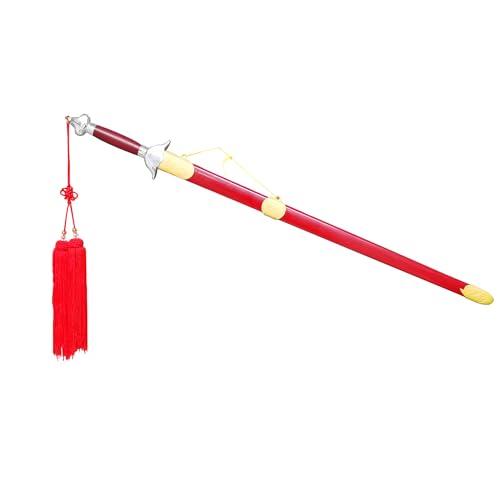
Edge condition is an important filter. YAXAZA explicitly describes an unsharpened high-carbon blade, and FixtureDisplays states that its Tai Chi blade is intentionally dull with smooth edges and corners. Those descriptions make them more clearly aligned with beginner practice or display-oriented handling, subject to appropriate supervision.
By contrast, MAKOTO Kaze, Lyuesword, and several full-size katana listings describe sharp or cutting-oriented blades. A sharp sword is not automatically appropriate for a beginner or choreographed practice. Confirm the seller’s current specifications, local laws, training requirements, and storage needs before purchase. Never assume that a scabbard or carrying bag makes a sword safe to handle.
Check tang and handle construction
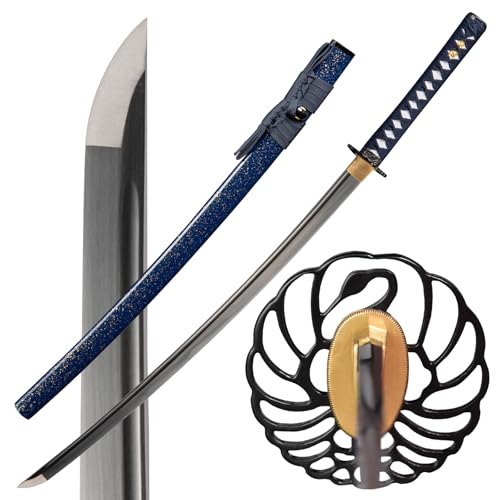
Full-tang construction is an important comparison point, but the term should be supported by the listing. Zhangswords states true full-tang construction extending through the handle and identifies two bamboo mekugi. Lyuesword also describes a full-length tang and two pegs. MAKOTO Kaze lists a full tang and double-pegged tsuka, while several other products mention handle nails or pegs without fully explaining the tang.
Grip materials help distinguish the documented designs but do not guarantee handling results. Zhangswords uses a hardwood handle with ito cord, Lyuesword lists genuine ray skin and silk, and Wuder describes a cotton wrap intended to absorb sweat. Pnber lists a wooden handle with cotton wrapping. These details do not replace inspection by a qualified practitioner.
Use dimensions to compare fit
Many selected katanas are close to a conventional full-size format, with overall lengths around 40 to 41 inches and blade lengths around 28 inches. Pnber, Wuder, Zhangswords, and both ATANAK listings provide useful measurements. Weight is also supplied for several models, generally around the 2.7- to 2.9-pound range in the listing data.
Do not treat similar measurements as proof that two swords handle identically. Balance, grip shape, blade profile, and assembly affect handling, and those factors are not independently tested here. FixtureDisplays is a different design: its Tai Chi sword has a slim flexible blade, a shorter handle, and an approximately two-pound total weight. That makes it a closer match for flowing forms than for the rigid katana format.
Consider the saya, bag, and display setup
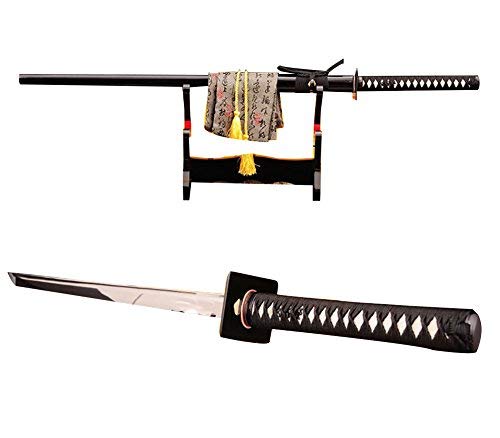
Storage features can be useful, but they are not substitutes for a secure storage plan. Zhangswords lists a wood saya and sword bag; Wuder lists a wooden lacquered sheath; and ATANAK includes a black sword bag. MAKOTO Kaze includes a wooden table stand along with a saya and bag. FixtureDisplays includes a scabbard, locking tab, carrying bag, and tassel.
Verify what is actually included. The selected listings vary between a sword bag, a stand, and other storage accessories. A stand shown in imagery may not be part of the package unless the listing says so. Keep any sword away from children, pets, damp locations, and unauthorized users.
Plan for high-carbon steel maintenance
High-carbon steel needs attention to moisture and storage conditions. Zhangswords specifically recommends light periodic oiling for long-term rust prevention. Pnber advises cleaning moisture from the blade and avoiding wet storage. Follow the current manufacturer’s instructions and use suitable supplies rather than improvising.
Final recommendation
Zhangswords 1095 High-carbon Katana ranks first overall in this specification-based comparison under the published weighted criteria.
Zhangswords 1095 High-carbon Katana is the highest-scoring returned product and the first overall specification-based choice.
Zhangswords 1095 High-carbon Katana is the first specification-based choice among these best high-carbon martial arts swords because its listing combines strong material, full-tang, handle, dimensional, saya, and maintenance documentation. Wuder is an alternative for clay-tempering and hardness detail, while Pnber suits buyers who prioritize measured dimensions. For unsharpened practice, YAXAZA and FixtureDisplays are the clearest fits. Among the top high-carbon martial arts swords compared here, the right choice depends chiefly on edge condition, documented construction, and the discipline in which the sword will be used.
Frequently Asked Questions
Are the best high-carbon martial arts swords suitable for beginners?
Not automatically. A sharp sword requires appropriate instruction, controlled surroundings, secure storage, and compliance with applicable laws. An unsharpened product such as YAXAZA or the FixtureDisplays Tai Chi set is more clearly aligned with beginner-oriented practice, but unsharpened does not mean risk-free. Training should be supervised by a qualified instructor.
Is 1095 steel always better than 1060 or 1045?
No. The steel designation is only one specification. Heat treatment, blade geometry, tang construction, assembly, and intended activity also matter. The selected 1095 listings offer useful material details, while 1060 and 1045 models may fit particular display or practice requirements. Do not infer performance solely from the number.
What is the difference between a katana and a Tai Chi sword?
The selected katana listings generally describe a curved Japanese-style sword with a longer grip and rigid blade. The FixtureDisplays sword is a Chinese Tai Chi design with a slim, flexible blade, shorter handle, and intentionally dull edge. These formats serve different movement traditions, so match the design to your instruction rather than choosing by appearance alone.
Do all full-tang listings provide the same construction evidence?
No. Some listings explicitly state full tang and identify pegs, such as Zhangswords, Lyuesword, and MAKOTO Kaze. Others describe handle nails or a sturdy structure without fully explaining the tang. Read the construction language carefully and avoid treating similar photos or titles as equivalent proof.
How should a high-carbon sword be stored?
Keep it dry, secured, and inaccessible to children or unauthorized users. Follow the manufacturer’s cleaning and oiling instructions; Zhangswords and Pnber specifically mention moisture control and maintenance. A saya, bag, stand, or wall hook may assist with storage, but each item should be checked for secure fit and included components before relying on it.