Buying Guide
Choosing among the best honda oxygen sensors starts with identification, not with the package quantity. Honda used different sensor designs across engines, model years, trims, and positions. A sensor for a 2.4L CR-V may not match a 1.8L Civic, even when both products are described as oxygen sensors. Use the vehicle year, exact model, engine, trim, transmission where relevant, connector, and original sensor number as the primary checks.
Match the vehicle and engine first
Fitment clarity is the most important criterion in this comparison. The Denso 234-4621 listing covers selected older Accord, Civic, and Prelude vehicles, while the MOTOKU set is specifically for the 2007-2008 Honda Fit 1.5L. Those focused listings can be easier to screen when the vehicle matches exactly.
For broader applications, read every qualification rather than relying on the model name alone. The QIYBONE V6 set covers several Accord, Odyssey, Pilot, Ridgeline, and Acura applications, but its Accord notes include transmission and California exclusions. The higherbro four-piece set also identifies an exception for 2011-2013 Odyssey Touring and Touring Elite models. These details can determine whether a connector and calibration match the vehicle.
Confirm upstream and downstream positions
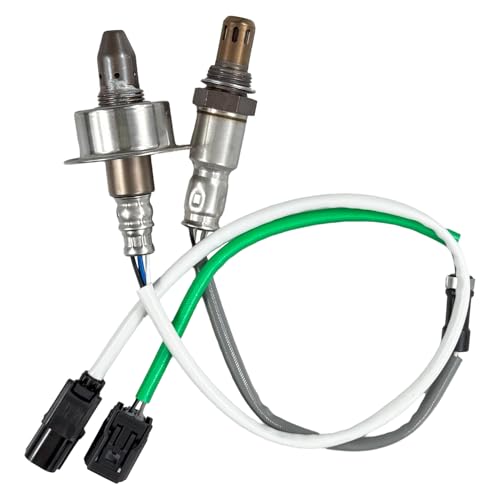
An upstream sensor is not automatically interchangeable with a downstream sensor. Several selections are paired sets that identify both locations, including the TAUTOY Accord 2.4L set, the SDYYDS Civic 1.8L set, and the HHGKPVX CR-V set. A paired product can be appropriate when both positions need replacement, but it is unnecessary for a repair requiring only one sensor.
The zubaydee 234-9131/234-4980 listing is presented as a single sensor for selected Accord and CR-V 2.4L vehicles. The Denso 234-4621 is also a one-sensor package. For either type, confirm whether the original part is upstream or downstream before ordering. The QIYBONE V6 and other four-piece products are intended for applications where multiple sensors are required, so quantity should be checked against the vehicle’s sensor layout.
Use OE and interchange numbers carefully
Reference numbers are useful because a model-year description may cover several configurations. Compare the original sensor’s number with the listing’s OE or interchange references. The QIYBONE Accord, CR-V, and TSX set lists 234-9091 for upstream and 234-4462 for downstream. TAUTOY lists 234-9040 and 234-4797 for its 2003-2007 Accord application. HHGKPVX provides separate 234-9062 and 234-4359 references for the 2007-2009 CR-V.
The Wobiwina V6 products use 234-5098 and 234-4461 references, but their vehicle notes still matter. A matching number without matching engine, year, connector, or position is not enough evidence of compatibility. The Wobiwina Civic and CR-V listing also warns that a CR-V can use different front-sensor harness lengths, so compare the connector and harness details shown for the original part.
Review construction and wiring details
Construction information helps distinguish how much technical evidence a listing provides. Denso documents a four-wire, 20.28-inch harness, corrosion-resistant stainless steel construction, a PTFE filter, and a zirconia element. Among the selected products, the QIYBONE sets describe stainless steel and high-temperature materials, while TAUTOY specifies a double laser-welded stainless steel body.
These details should be treated as specifications, not as proof of performance in a particular vehicle. A stainless housing does not resolve a wrong connector or incorrect sensor position. Wiring length and plug style are especially important when the vehicle has more than one possible front-sensor configuration.
Several listings describe direct replacement or plug-and-play installation. SDYYDS states a plug-and-play design for the Civic 1.8L, and the QIYBONE listings similarly describe plug-and-play construction. HHGKPVX adds pre-installed anti-seize brass fittings and a crush washer. These are documented installation features, but they do not eliminate the need to compare the old and new sensor before fitting.
The supplied listings vary in support terms, including one-year or two-year coverage on selected products. Such terms are product-specific and should be checked in the current listing. They should not replace fitment verification. Follow the vehicle’s service procedure, avoid forcing a mismatched connector, and inspect the threaded opening and wiring routing during installation.
Compare single sensors with multi-piece sets
A single sensor is appropriate when only one position is documented as needing replacement. A two-piece set may make sense when both upstream and downstream sensors use the supplied references. Four-piece sets such as the QIYBONE V6 and higherbro products are aimed at vehicles with several sensor locations, but the correct quantity depends on the specific engine and configuration.
The top honda oxygen sensors in this comparison are not universal parts. They are ranked by the quality and completeness of their supplied specifications, especially fitment, position coverage, reference numbers, construction details, and installation information. Confirming the vehicle and original part number remains the final selection step.
Final Recommendation
TAUTOY Accord 2.4L Upstream/Downstream Set ranks first overall in this specification-based comparison under the published weighted criteria.
Denso 234-4621 is the first overall specification-based choice among these best honda oxygen sensors because its listing combines clear older Honda and Acura applications with unusually detailed harness, filter, sensing-element, and housing information. It is a single narrow-band sensor, so confirm that the vehicle and sensor position require that design.
For a documented V6 multi-sensor application, the QIYBONE 4-Piece V6 Set provides broad Honda and Acura coverage, but its exclusions must be checked. For a two-position 2.4L repair, the QIYBONE Accord, CR-V, and TSX set gives detailed trim coverage and reference numbers. The TAUTOY Accord set is more focused on 2003-2007 2.4L models, while HHGKPVX is a practical CR-V-specific option with installation hardware. These top honda oxygen sensors each serve a different documented fitment need, so the correct choice is the one whose vehicle, engine, position, connector, and reference number all agree.
Frequently Asked Questions
How do I choose the best honda oxygen sensors for my Honda?
Start with the exact year, model, engine, trim, transmission when listed, and sensor position. Then compare the original part number and connector with the product listing. Do not choose only by the Honda model name because one model can use different engines and sensor configurations.
Are upstream and downstream Honda oxygen sensors interchangeable?
Not automatically. Upstream and downstream positions can use different replacement numbers and wiring. Products such as the TAUTOY Accord set, SDYYDS Civic set, and HHGKPVX CR-V set identify paired positions, but each application still needs to match the vehicle and original sensor.
Should I buy a one-piece or two-piece sensor set?
Choose a one-piece product when the documented repair requires one sensor, such as the Denso 234-4621 or zubaydee listing. Choose a two-piece set when both positions and both reference numbers match the vehicle. A four-piece set is relevant only when the specific Honda or Acura V6 application uses the documented quantity.
Why do some Honda listings show several OE numbers?
Manufacturers and suppliers may list OE, interchange, or replacement references for the same application family. Multiple numbers can help with cross-checking, but they do not override engine, year, trim, position, or connector requirements. Use the original sensor number and the full fitment notes together.
What should I verify before installing a replacement sensor?
Compare the old and new connector, harness length, threaded section, sensor position, and reference number. Also check the listing’s exclusions, such as the V6 Accord transmission or regional notes and the Odyssey trim exclusion described above. If any detail conflicts, stop and verify the application before installation.