Buying Guide
The best heavy-duty garment racks should be compared by more than the largest number in a listing. Capacity, frame layout, storage, movement, and available floor space all affect whether a rack is suitable for a bedroom, laundry room, boutique, or commercial back room. The selections above are ranked from public specifications, not from hands-on testing.
Start with the load rating
A stated maximum load is useful, but it does not always describe how that load is distributed. The Simple Houseware Commercial Grade Z-Base Double Rod Garment Rack lists a 600-pound maximum and identifies its solid-metal top rod. The HYSEYY 620-LB Double-Rod Rack goes further by allocating the current price to the double hanging rods and the current price to the bottom shelves. That breakdown can be easier to apply when you expect both clothing and stored items.
The FYBEE 960-LB Stainless Steel Three-Rod Rack and Ulif E12 Pro Six-Tier Clothes Rack both list 960-pound total capacities. Those figures should be treated as documented listing limits rather than a prediction of real-world performance. Avoid assuming that every rod or shelf can carry the total rating unless the listing specifically says so. Heavy coats, denim, uniforms, and packed hangers can create a different distribution from lightweight shirts.
Choose the right rod arrangement
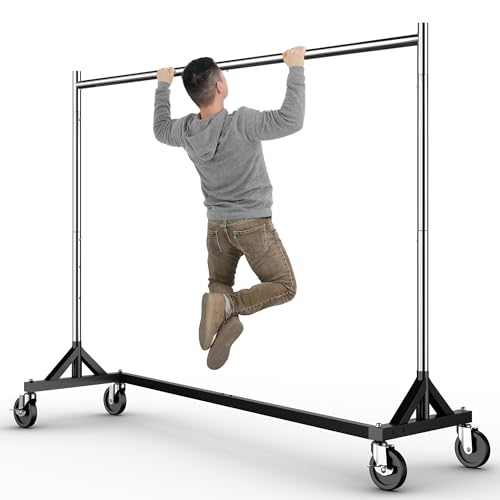
A single rod is straightforward and can leave more open space beneath the garments. The HOKEEPER Commercial Z-Base Rack is an example of this focused format. It is intended for hanging and offers three height settings, but the supplied evidence does not list shelves. This type can work well when the primary goal is a mobile display rail.
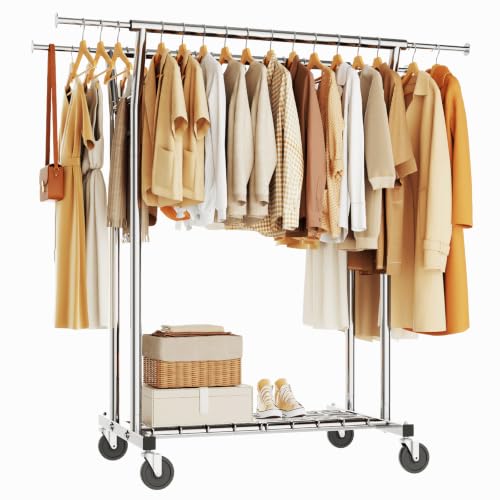
Double rods increase organization for shorter garments and can separate categories, sizes, or seasons. The HYSEYY 700-LB Dual-Rod Rolling Rack, Luxspire 600-LB Adjustable Double-Rod Rack, and EAGMAK 622-LB Double-Rod Rack all document two hanging levels. Before choosing one, check the clearance between rods and the overall height. A lower rod is useful for shirts and jackets, but it may not suit long dresses.
The Simple Houseware Commercial Grade Z-Base Double Rod Garment Rack uses a middle bar with four position options. That gives it more documented layout flexibility than a fixed two-level frame. FYBEE’s three-rod configuration provides another way to expand hanging space, although the listing does not provide a per-rod capacity.
Consider shelves and hooks
Shelves change a garment rack into a broader storage system. The Ulif E12 Pro has six adjustable shelves and four adjustable hanger rods, making it the most configurable shelf-and-rod design in this comparison. VIPEK R2 Plus also documents adjustable shelves, detachable hanging rods, and side hooks. These features can help organize folded clothing, shoes, bins, bags, or accessories alongside garments.
For a simpler shelf arrangement, WATIOWL’s two bottom mesh panels and Luxspire’s bottom shelves provide a place for shoes or containers without creating a tall enclosed closet. HYSEYY’s 620-pound design also documents bottom shelves and a capacity allocation for them. If you plan to store heavy boxes, look for a listing that specifies shelf capacity rather than relying on the rack’s total number.
Match the rack to available space
Measure width, depth, and height before ordering. Several selected products are approximately 63 inches wide, including the HOKEEPER, Simple Houseware, and HYSEYY 620-LB models. The Ulif E12 Pro is listed at about 70.8 inches wide, while the EAGMAK 622-LB model reaches 82.68 inches high. These dimensions can be helpful in a walk-in closet or retail area but may be unsuitable for a narrow bedroom.
Adjustable designs offer more placement flexibility. Luxspire adjusts from 64 to 73 inches high and includes telescoping side extensions. WATIOWL documents a rail that adjusts from 41 to 61 inches. HOKEEPER provides three fixed height settings, and FYBEE’s stainless steel three-rod model is listed as extendable. Adjustment is valuable, but it can also introduce more parts and more layout decisions, so prioritize it only when your clothing mix or room changes regularly.
Check caster and stability details
Rolling hardware is important when a loaded rack must move between rooms. The FYBEE model lists 4-inch industrial-grade wheels, while WATIOWL and HYSEYY 700-LB use 3-inch casters. Most selected rolling racks document four wheels with two locks. Those locks help keep the rack stationary, but they do not replace sensible loading and placement.
Frame geometry also matters in the supplied descriptions. WATIOWL lists a triangular base, HYSEYY 700-LB describes a gravity-centered base, and several models mention reinforced or triangular structures. The Ulif E12 Pro includes an anti-tip device. These are documented design features, not guarantees against tipping, so keep the rack on a suitable floor and distribute garments rather than concentrating weight at one point.
Review assembly and materials
Tool-free or snap-button assembly is documented for WATIOWL, HYSEYY 700-LB, and several other models. FYBEE includes tools and gloves, while HOKEEPER lists tools and instructions. VIPEK estimates 20–30 minutes, which is more specific than simply calling assembly easy. If you expect to move or store the rack often, also check whether the product description mentions disassembly; the WATIOWL listing does.
Material descriptions vary. FYBEE uses stainless steel, Ulif uses carbon steel with a coating, HYSEYY 620-LB describes chrome-plated stainless steel tubing, and HOKEEPER combines chrome-coated metal rods with a powder-coated Z base. These descriptions can inform finish and corrosion considerations, but they do not establish a particular service life. For damp laundry areas, a listed rust-resistant or rustproof finish may be relevant, while indoor use may make footprint and layout more important.
Final Recommendation
Ulif E12 Pro Six-Tier Clothes Rack ranks first overall in this specification-based comparison under the published weighted criteria.
The final choice among the best heavy-duty garment racks depends on the documented features that match your intended use.
Simple Houseware Commercial Grade Z-Base Double Rod Garment Rack is the highest-scoring returned product and the first overall specification-based choice. Its 600-pound capacity, solid-metal top rod, adjustable two-tier bar, commercial casters, and nesting Z base give it a balanced specification profile for retail displays and dense clothing storage. It does not include documented shelves, so choose the FYBEE or Ulif model when maximum capacity or shelf organization is more important.
Among the top heavy-duty garment racks, the FYBEE model stands out for its three rods, stainless steel construction, shelves, and 960-pound stated capacity. Ulif is the better fit for a highly modular closet system, while VIPEK is compelling when vertical storage is the priority. For a simpler single-rod commercial format, HOKEEPER supplies useful height settings and a Z base without adding shelf components.
Frequently Asked Questions
What makes the best heavy-duty garment racks different from ordinary clothing racks?
The selected models document substantially higher load ratings than a basic household rail, along with steel or stainless steel frames, reinforced bases, shelves, multiple rods, or locking casters. Capacity alone is not enough; the rack should also match the intended garment lengths, floor space, and storage layout.
Are double-rod garment racks better for long dresses?
Not automatically. A double-rod rack can increase hanging organization, but a lower rod may reduce clearance for long garments. For long dresses and coats, check the listed height and rod arrangement. The EAGMAK 622-LB model is listed at 82.68 inches high, while HOKEEPER offers height settings up to 71 inches.
Should I choose a rack with shelves?
Choose shelves when you need room for shoes, bins, luggage, or folded clothing. Ulif documents six adjustable shelves, while WATIOWL and Luxspire list bottom shelf storage. If you only need a mobile rail for hanging garments, the HOKEEPER single-rod design may be simpler.
How much space do these racks need?
Check the complete assembled dimensions, not just the rod width. Many selected racks are about 63 inches wide and approximately 24 inches deep, while Ulif is listed at about 70.8 inches wide. Leave enough clearance to roll the rack and access both the garments and any shelves.
Are locking wheels sufficient for stability?
Locking wheels help keep a rack stationary, and most selected rolling models list two locking casters. Stability also depends on frame geometry, weight distribution, floor conditions, and correct assembly. Use the documented load limit as a ceiling and distribute garments across the available rods.