Buying Guide
The best commercial garment racks are not defined by one number alone. A rack for a boutique sales floor may need a clean, mobile display format, while a stockroom rack may prioritize high capacity, nested storage, or multiple rods. Start by matching the rack’s documented structure to the garments and workflow it will support.
Match capacity to the intended load
Published capacity is a useful first filter, but it should be read alongside the rack’s hanging layout and shelf arrangement. The FYBEE lists a 960-pound maximum and three rods, making it the most capacity-focused selection in this comparison. Wennop lists the current price with two rods, while HYSEYY lists the current price for a dual-rod design.
Those figures describe listed maximums, not a recommendation to load every rack to its limit. Heavy winter coats, suits, and tightly packed inventory can put more demand on rods and frame connections than lighter shirts. If a rack includes shelves, check whether the listing separates shelf capacity from rod capacity. HOKEEPER’s 650-pound rack, for example, identifies separate figures for its hanging rods and shelves. WATIOWL also adds lower mesh panels, but its supplied listing does not divide the total capacity by storage area.
Choose one rod, two rods, or three rods
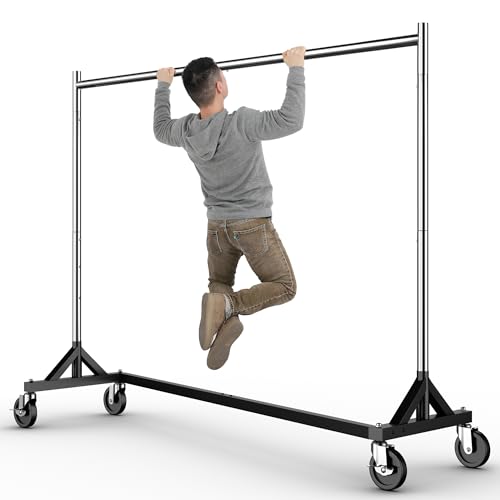
A single rod offers a simple display and generally leaves more open vertical space for long garments. The HOKEEPER 500-LB Z-base rack and Raybee illustrate this format. Raybee adds a wide 75-inch span, while the HOKEEPER model emphasizes a standard Z-rack footprint and height positions.
Double-rod racks increase hanging density, but the distance between rods matters. Wennop documents vertically arranged rods with up to 38.1 inches between them. HOKEEPER’s 650-pound model lists a 22-inch gap, which is intended to accommodate thicker clothing without unnecessary interference. HYSEYY uses a dual-rod layout but does not provide a numeric rod-gap specification in the supplied evidence.
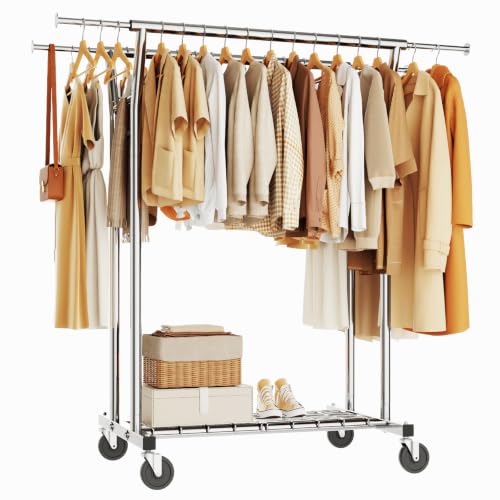
The FYBEE is the only selected model with three documented hanging bars. That configuration can separate shirts, pants, coats, or other categories, but it also creates a more involved storage system. For mixed inventory, count the number of hanging levels and confirm that the available height works for the longest items.
Measure width, depth, and height before ordering
Commercial racks can occupy significant floor area. Record the usable aisle, wall, doorway, and storage dimensions before choosing a model. Raybee is 75 inches wide, while the HOKEEPER 650-pound rack extends to 75 inches. The Simple Houseware 600-pound Z-base rack is 63 inches wide and 24.2 inches deep, a substantial but familiar Z-rack footprint.
Adjustability can make a rack easier to fit into changing spaces. The Simple Houseware double-rail rack expands from 42.75 to 67.75 inches. WATIOWL’s telescoping rail adjusts from 41 to 61 inches, and the HOKEEPER 525-pound model expands from 51 to 75 inches while also offering a documented height range. The HOKEEPER 500-pound rack provides three listed height positions from 59 to 71 inches.
Do not assume that a rack is adjustable in every direction. HYSEYY’s 700-pound model lists a 61.3-inch width and a 63.4-inch height, but the supplied evidence does not provide a numeric adjustment range. Treat those dimensions as the documented baseline.
Consider mobility and stationary stability
Rolling casters help when inventory moves between a stockroom, fitting area, laundry space, studio, or sales floor. Every selected rack documents four wheels or casters, and most specify two locking wheels. Larger wheels may be useful across more demanding surfaces: FYBEE lists 4-inch wheels, as does the Simple Houseware double-rail rack. Several other selections specify 3-inch casters.
Locks help hold a rack in place, but they do not replace sensible loading and adequate clearance. Frame shape also matters to the documented design. The FYBEE uses an H-shaped frame, Wennop specifies a U-frame base, and the HOKEEPER 525-pound rack uses an E-shaped frame. These descriptions identify construction features; they do not establish performance beyond the supplied listing claims.
Use shelves and hooks to organize accessories
A hanging rail is best for garments, but shelves and hooks can reduce the need for a second storage fixture. FYBEE lists shelves and eight side hooks. WATIOWL has two bottom mesh panels. Raybee includes a shelf and four side hooks, while HOKEEPER’s 650-pound model provides two bottom shelves.
If the rack will display complete outfits, shelves can hold shoes, boxes, or folded items. If it will serve as a basic hanging rail, a shelf may add unnecessary width or visual bulk. Z-base models such as the Simple Houseware 600-pound rack prioritize nesting multiple units, which can be more useful than built-in lower storage in a busy back room.
Evaluate setup and storage requirements
Assembly descriptions vary from tool-free snap-together designs to racks supplied with tools and instructions. WATIOWL lists tool-free assembly under 10 minutes, while the Wennop listing gives a 10-minute assembly estimate. The FYBEE listing says tools and instructions are included and specifies a five-year manufacturer warranty.
Foldability is a separate advantage from quick assembly. The HOKEEPER 525-pound rack folds flat without tools, making it a strong option for temporary displays, markets, events, or facilities that must clear floor space. Z-base racks are also storage-oriented because their bases can nest, but they are not the same as a fold-flat frame.
Final Recommendation
FYBEE 960-LB Three-Rod Stainless Steel Rack ranks first overall in this specification-based comparison under the published weighted criteria.
The final choice among the best commercial garment racks depends on the documented features that match your intended use.
FYBEE 960-LB Three-Rod Stainless Steel Rack is the highest-scoring returned product and the first overall specification-based choice. Its documented 960-pound capacity, three rods, shelves, hooks, stainless steel construction, and 4-inch casters give it the broadest feature set for demanding inventory organization.
Wennop is the better fit when two vertically arranged rods are preferable to three. For a conventional retail setup, the Simple Houseware 600-LB Double-Rod Z-Base Rack offers a strong blend of capacity, adjustable bar positions, locking casters, and rack-to-rack nesting. HOKEEPER’s 650-pound double-rod model is compelling when shelves and a wide adjustable frame matter more than compact storage.
Among the top commercial garment racks, the HOKEEPER 525-pound model stands out for fold-flat storage, while WATIOWL is a sensible narrower shelf-equipped alternative. Raybee is the choice for an extra-wide single rail, and the Simple Houseware double-rail rack suits lighter loads where expansion and large casters are priorities. Confirm dimensions, capacity allocation, and the required hanging configuration before purchase.
Frequently Asked Questions
What makes the best commercial garment racks suitable for commercial use?
The selected products document features associated with commercial workflows, including stated capacities from 200 to the current price, steel or stainless steel construction, rolling casters, adjustable rails, multiple rods, shelves, or Z-base storage. Suitability still depends on the intended load, garment type, floor layout, and movement requirements.
Are Z-base garment racks useful when several racks are needed?
Yes, when storage footprint is a priority. The Simple Houseware 600-pound rack and HOKEEPER 500-pound rack both document Z-base designs, and the Simple Houseware listing specifically describes nesting multiple racks. A Z base can help consolidate units when they are not in active use, but you should still verify aisle and clearance dimensions.
Should I choose a double-rod rack for long coats and dresses?
Not automatically. Double rods can increase hanging density, but the vertical gap and total rack height determine whether long garments fit comfortably. Wennop documents a maximum 38.1-inch rod separation, while HOKEEPER documents a 22-inch gap. Review those dimensions against the garments you plan to hang.
Do all of these commercial racks have locking wheels?
The selected listings generally specify four casters with two locking wheels or brakes. FYBEE, Wennop, WATIOWL, Raybee, and both selected HOKEEPER rolling racks explicitly document locking casters. Always engage the locks when the rack is stationary, and avoid treating wheel locks as a substitute for balanced loading.
Which rack is easiest to store between uses?
The HOKEEPER 525-LB Foldable Adjustable Rack is the clearest choice because its listing specifically says it folds flat without tools. Z-base models can also nest for more compact group storage, but nesting is different from folding an individual rack flat.