Buying Guide
Choosing among the best adjustable soldering stations starts with the work rather than the maximum number printed on the box. A station for small circuit boards has different priorities from one for thick wires, stained glass, or hot-air component removal. The products above were selected from public listing information and scored against category-specific specifications. No hands-on testing or customer-opinion analysis was used.
Match power to the work
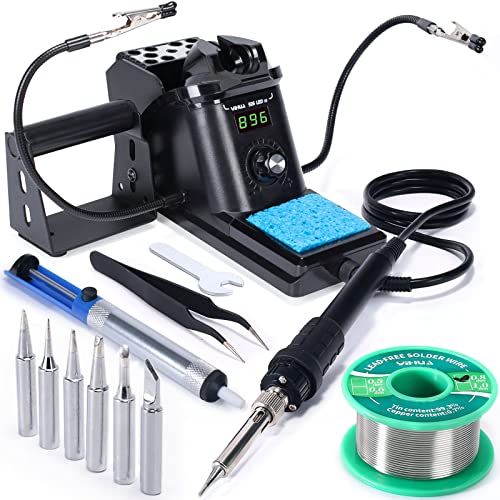
Power is a useful indicator of thermal capacity, but it is not a complete performance measure. The 60W YIHUA 926 III is positioned as a general-purpose starter station, while the 70W Weller WE1010NA and 75W YIHUA 939D+ focus on controlled bench soldering. The 90W TOAUTO DS90 and 110W WEP 927-IV provide more headroom for repair tasks. The 130W WEP 926LED V3, 200W FNIRSI DWS-200, and 300W YIHUA 939D+ IV are better matches for work that can draw heat away quickly.
Higher power does not automatically make a station preferable for every joint. Delicate electronics still benefit from an appropriate tip, a controllable temperature, and careful technique. The YIHUA 939D+ IV is specifically described for large-sized components, thick wires, pins, and stained glass, so its heavy-duty design should be viewed as specialized rather than universally necessary.
Check the usable temperature range
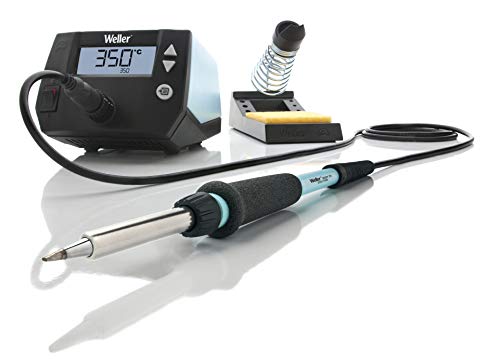
Most selected stations provide digital adjustment and a range that reaches roughly 896°F. The Weller WE1010NA documents temperature stability of ±4°F/2°C and a lock function, while the X-Tronic 3060-PRO documents ±3.6°F/2.0°C static stability, PID control, calibration, and separate set and actual displays. These details are more informative than a broad range alone because they address how the station manages a chosen setting.
The low end also matters. The YIHUA 926 III reaches 194°F, the X-Tronic 3060-PRO reaches 194°F, and the FNIRSI DWS-200 reaches 212°F. The TOAUTO DS90 starts at 302°F, which may be suitable for its intended PCB and SMT work but gives less low-temperature adjustment than those alternatives. Match the station’s documented range to the temperature needs of the solder and components you use.
Decide whether you need presets
Preset channels are useful when a project alternates between recurring temperatures. The FNIRSI DWS-200, YIHUA 939D+ IV, WEP 927-IV, and X-Tronic 3060-PRO each document multiple stored settings or preset functions. This can reduce repeated knob adjustments during a session. The Weller WE1010NA takes a different approach with temperature lock and password protection, which may be preferable when preventing accidental changes is more important than switching among several saved settings.
Digital displays also vary in usefulness. A display showing both the set and actual temperature, as documented for the X-Tronic 3060-PRO and WEP 927-IV, gives more information than a setpoint-only readout. Calibration support appears across several models, but the supplied listings do not provide independent accuracy testing, so it should be treated as a control feature rather than proof of measured precision.
Consider ESD and static protection
For sensitive electronics, look for explicit static-control language. The Weller WE1010NA, X-Tronic 3060-PRO, YIHUA 939D+ IV, YIHUA 939D+, and TOAUTO DS90 listings document ESD-safe, contact-safe, anti-static, grounding, or related protection features. The TOAUTO DS90 includes a grounding-wire design and static-elimination sheet.
Not every listing supplies the same level of detail. The WEP 926LED V3 and FNIRSI DWS-200 provide useful station features but do not document the same specific ESD provisions in the supplied evidence. That does not establish that they are unsuitable; it means buyers who require a documented static-control setup should verify the product information before purchase.
Look at sleep, standby, and shutdown behavior
Sleep and standby functions reduce idle heating when the iron rests in its holder. The X-Tronic 3060-PRO offers selectable sleep intervals, the YIHUA 926 III documents five-, 10-, and 30-minute settings, and the FNIRSI DWS-200 provides sleep and auto-standby functions. The TOAUTO DS90 also documents automatic standby and sleep behavior. These controls can help manage tip and heating-element wear, but the listings do not provide long-term test results.
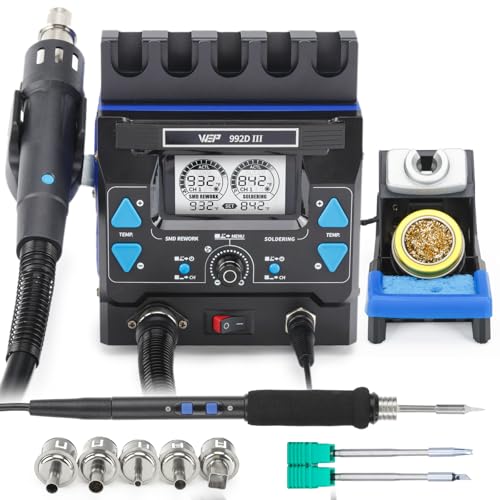
Some stations go further. The WEP 882D includes soldering-iron sleep, hot-air standby, automatic shutdown, and separate controls for its two systems. The cordless WEP 937D-I 3 was not selected because it depends on a compatible battery and does not include a power cord. For a conventional bench setup, corded stations offer a simpler power arrangement.
Evaluate the accessory package
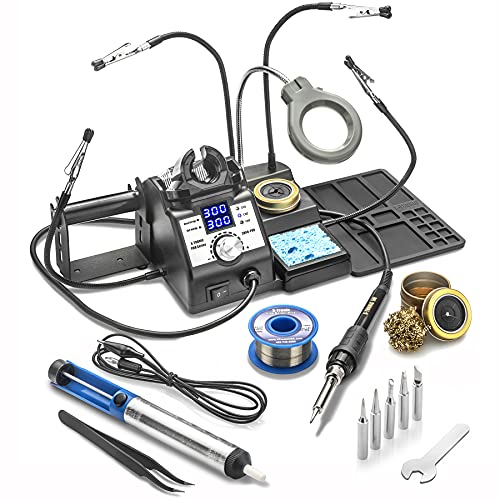
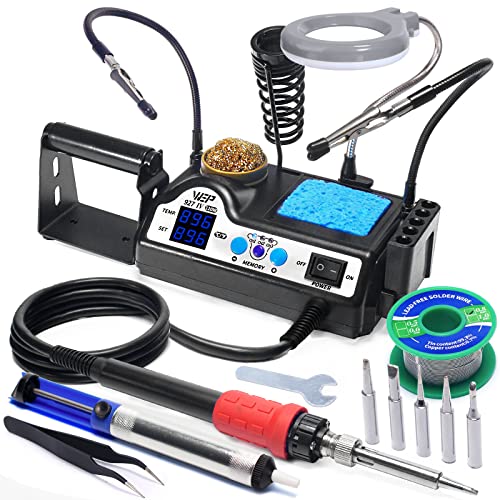
Accessories can change how much additional equipment is needed. The WEP 927-IV integrates a magnifying glass, LED lighting, helping hands, a solder dispenser, and tip storage. The X-Tronic 3060-PRO includes a mini magnifying lamp, four helping hands, extra tips, cleaning supplies, and solder-related accessories. The YIHUA 926 III includes two helping hands, six tips, solder, tweezers, a sucker, and cleaning tools.
The FNIRSI DWS-200 takes a different approach by including two handles and two adjustable helping hands. That arrangement may appeal to users who alternate between precision and higher-power work. The WEP 882D’s accessories are oriented toward rework, with hot-air nozzles alongside soldering tips. Remember that included tips are useful only if their shapes and replacement availability suit your projects.
Final recommendation
X-Tronic 3060-PRO 75W Soldering Station Kit ranks first overall in this specification-based comparison under the published weighted criteria.
X-Tronic 3060-PRO 75W Soldering Station Kit is the first overall specification-based choice in this comparison.
The X-Tronic 3060-PRO is among the best adjustable soldering stations because its 75W output, broad range, display feedback, presets, ESD-safe design, and extensive bench accessories cover varied documented uses. Choose the Weller WE1010NA when temperature stability and control protection matter more than a large accessory bundle. The FNIRSI DWS-200 is a flexible option with two handles, while the YIHUA 939D+ IV is intended for larger thermal loads.
Among the top adjustable soldering stations, the WEP 927-IV and YIHUA 926 III are practical bundled choices for repair and learning. Select the TOAUTO DS90 when explicit static-management features are important. For hot-air rework, the WEP 882D adds a second adjustable system; for compact higher-power soldering, the WEP 926LED V3 is a specification-based alternative. Confirm voltage requirements, tip compatibility, workspace dimensions, and included support tools before ordering.
Frequently Asked Questions
What are the best adjustable soldering stations for electronics?
The best adjustable soldering stations for electronics depend on the required power and static controls. The Weller WE1010NA, X-Tronic 3060-PRO, YIHUA 939D+, and TOAUTO DS90 all document digital temperature management, while the TOAUTO DS90 additionally lists grounding and static-elimination features. The YIHUA 926 III is an accessory-focused option for general electronics and hobby work.
Is more wattage always better in a soldering station?
No. Higher wattage can provide more thermal capacity for thick wires, large components, or stained glass, but a lower-powered station may be easier to match to delicate electronics. The YIHUA 939D+ IV is specifically aimed at heavy-duty work, whereas the YIHUA 926 III is a 60W general-purpose kit. Tip size, temperature control, and the material drawing heat from the joint also matter.
Are two-in-one hot-air stations worth considering?
A two-in-one unit is worth considering when the work includes hot-air rework as well as iron soldering. The WEP 882D documents separate soldering and hot-air temperature controls, variable air volume, nozzles, standby, and automatic shutdown. If the work only involves conventional iron soldering, its second system may add features that are not needed.
Which selected station is best for a small workbench?
The WEP 927-IV integrates its holder, helping hands, magnifier, LED lighting, dispenser, and tip storage into one station. The WEP 926LED V3 also documents a compact body with an integrated iron holder. These layouts can reduce the need for separate bench accessories, although the actual space required should be checked against the available work area.
What should I verify before buying an adjustable soldering station?
Verify the temperature range, power level, voltage, tip series, included handle, sleep behavior, and any ESD or grounding claims. Also check whether the included accessories match the job. For example, the YIHUA 939D+ IV and WEP 927-IV are identified for 110–127V USA specifications. Product listings can change, so confirm current specifications before purchase.