Buying Guide
Choosing the best hot tub and pool safety covers starts with identifying what the cover is expected to do. The products in this comparison are mostly outdoor protector covers or caps that sit over a spa’s existing hard or insulated lid. Several listings explicitly say they are not insulated and must not be used alone. That distinction matters: an outer protector can block weather and debris, but it is not automatically a replacement for a load-bearing or heat-retaining spa lid.
Start with the exact shape and measurements
Measure the tub at its longest and widest points, including the outer edge that the cover must overlap. Also note the cover height or side drop. A square cover such as the GARPROVM is designed around an 85 x 85-inch footprint, while the QH.HOME rectangular model is intended for an 85 x 63-inch layout. The COWVIE model is larger at 92 x 92 x 20 inches, and the Kipiea model is rectangular at 89 x 79 x 20 inches.
Shape-specific options can prevent awkward overhang or exposed corners. Cozzka is made for an octagonal spa, while iBirdie is aimed at a round stock tank or cold-tub setup. Do not assume that a round, square, or octagonal cover can substitute for another shape simply because the nominal width is similar. For unusual tubs, the fit around the perimeter is as important as the top measurement.
Choose the right cover type
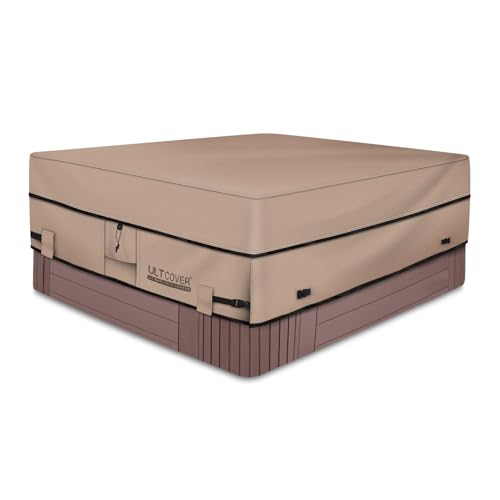
A weather protector is typically made from coated polyester or Oxford fabric. It is intended to protect the underlying spa cover from rain, snow, leaves, dust, and sunlight. GARPROVM, UCEDER, ULTCOVER, QH.HOME, COWVIE, and Kipiea all document fabric and weather-resistance features of this type.
A protective cap has a similar role but is especially useful when an existing insulated cover needs an additional outer barrier. The Cover Guy model explicitly says it does not replace the underlying cover. That makes it a supplemental choice rather than a standalone lid.
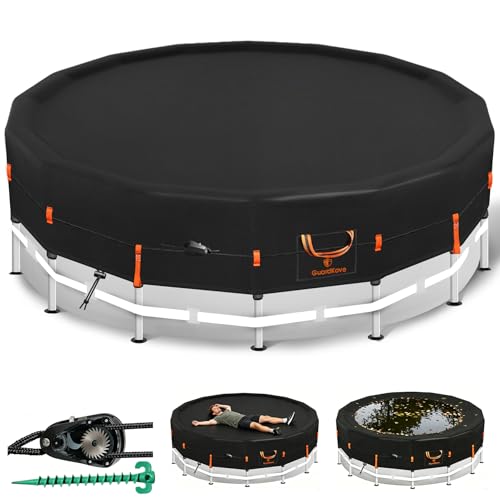
A floating solar or thermal blanket is a different design. It rests on the water surface and may help reduce evaporation or heat loss, but it should not be treated as a walk-on safety barrier. None of the selected products should be assumed to support a person, prevent drowning, or satisfy local pool-barrier regulations unless the manufacturer provides those certifications separately.
Compare material and seam construction
Heavier fabric numbers can indicate a more substantial textile, but they do not by themselves prove long-term performance. The supplied listings provide stronger evidence when fabric weight is paired with coating and seam details. Kipiea lists 600D high-density fabric, double PU coating, and waterproof tape at the seams. COWVIE lists 600D solution-dyed polyester, PVC coating, double stitching, and waterproof tape. GARPROVM lists 600D Oxford fabric, reinforced PU coating, and double-stitched seams.
ULTCOVER and UCEDER also use 600D-class materials, with waterproof backing or TPU backing respectively. The QH.HOME square model claims 1000D construction and an IP65 waterproof specification. These details help compare documented construction, but they are not a substitute for checking how the cover is installed and maintained.
Prioritize fastening in windy areas
A loose cover can shift, flap, or collect water. Look for adjustable systems that match the tub’s shape. Kipiea uses four side straps and four corner straps with buckles. GARPROVM combines dual drawstrings, four tightening points, and corner straps. The narrow QH.HOME model uses a 360-degree ratchet locking system, which may be helpful when a close perimeter hold is needed.
Elastic cords can be simpler and faster to fit. ULTCOVER uses heavy-duty elastic cords, while Cozzka uses elastic straps around the edge. These designs may work well when the cover dimensions are closely matched, but they provide fewer adjustment points than a multi-strap arrangement. Always tighten the system according to the instructions and inspect straps, buckles, cords, and seams periodically.
Do not overlook ventilation
Moisture trapped beneath an outer cover can contribute to condensation and unpleasant odors. Air vents are documented on GARPROVM, UCEDER, both QH.HOME models, ULTCOVER, and The Cover Guy cap. Vents should not be blocked by furniture, straps, or accumulated debris. Ventilation also does not make a cover waterproof by itself; the fabric, coatings, and seam treatment remain important.
Some selected listings do not mention vents. That is not proof that a product has no airflow design, only that the supplied evidence does not document one. For humid climates or covered patios, favor products with clearly stated ventilation and continue to follow the manufacturer’s cleaning and storage instructions.
Consider removal and storage
A large spa cover can be awkward to fold and carry. COWVIE includes reflective handles and an attached storage bag, while GARPROVM lists handles on the top corners. The Cover Guy cap also has built-in handles. These features may make regular removal easier, although the listings do not provide hands-on lifting results.
For seasonal storage, clean and dry the cover before folding it. Avoid storing it where standing water, sharp objects, or prolonged direct sunlight can cause avoidable wear. A zipper or storage bag can help keep the folded protector organized, but the cover should still be fully dry before it is packed away.
Match protection to the underlying lid
Several products clearly state that they must be used over an insulated hard cover. That warning applies to ULTCOVER, UCEDER, and both QH.HOME listings in this selection. Treat those products as weather shells, not as substitutes for the structural cover supplied with the spa. The same principle applies to any cover whose listing does not document insulation or load-bearing construction.
Final Recommendation
QH.HOME 90 x 90 Square Hot Tub Cover ranks first overall in this specification-based comparison under the published weighted criteria.
Kipiea 600D Rectangular Hot Tub Cover is the first overall specification-based choice among these best hot tub and pool safety covers because it combines substantial fabric, coated waterproof construction, taped seams, UV and tear resistance, and an unusually detailed strap system. It is most compelling for a compatible rectangular spa, not as a universal cover.
For a large square tub, QH.HOME 90 x 90 Square Hot Tub Cover and COWVIE 92 x 92 Square Hot Tub Cover offer strong documented weather features, with COWVIE adding especially useful storage details. GARPROVM is a balanced alternative for a common square footprint, while UCEDER offers a noteworthy TPU-backed construction and cold-resistance specification.
The Cover Guy cap is the logical choice when the goal is to shield an existing insulated lid rather than replace it. ULTCOVER remains a straightforward warranty-backed square protector. For nonstandard layouts, the top hot tub and pool safety covers include Cozzka for octagonal spas, QH.HOME’s narrow rectangular model, and iBirdie for a round stock-tank setup. In every case, verify the dimensions, confirm whether an underlying hard cover is required, and do not treat an outer protector as a certified safety barrier without separate documentation.
Frequently Asked Questions
Are these best hot tub and pool safety covers actual safety covers?
Most selected products are weather-protection covers or caps. The supplied evidence does not document load-bearing certification, child-safety certification, or compliance with a particular pool-barrier standard. They should be used only as described by the manufacturer and should not be treated as a substitute for a certified safety system.
Can an outdoor protector replace an insulated hot tub lid?
Not when the listing says it cannot. ULTCOVER, UCEDER, and both QH.HOME models explicitly require an insulated hard cover underneath. The Cover Guy product also states that it is a protective cap and does not replace the underlying cover. Check the product instructions before removing an existing lid.
How should I measure for a hot tub cover?
Measure the outside length and width at the widest points, then measure the required side drop or height. For round tubs, measure the diameter. For octagonal or irregular tubs, record the longest dimensions and the perimeter shape. Compare those measurements with the cover’s stated size rather than relying only on a model name.
Which fastening system is useful in windy conditions?
Multi-point systems generally provide more adjustment than a single elastic edge. Kipiea lists side and corner straps, GARPROVM combines drawstrings with tightening points and buckles, and the narrow QH.HOME model uses a 360-degree ratchet system. Elastic cords can still be suitable when the cover is correctly sized, but the listing evidence does not establish performance for any particular wind speed.
Do vents make a cover waterproof?
No. Vents address airflow and moisture management, while waterproofing depends on the fabric, coating, and seam construction. A cover can have vents and still require correct positioning, secure fastening, and routine cleaning. Keep vents clear and follow the manufacturer’s care guidance.