Buying Guide
The best invitation card stock should be selected by matching the paper’s documented specifications to the invitation format, printer, and visual style. Start with the practical requirements before comparing decorative finishes.
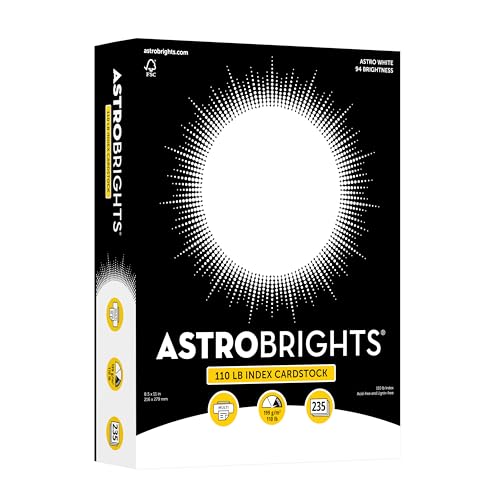
Most selected products use the standard 8.5 x 11-inch sheet. That format is useful when you plan to print a full-page design, fold a letter-size sheet, or trim several smaller pieces from one page. Astrobrights Premium White 110 lb Index Cardstock, WritePads Veritas White 110 lb Index Cardstock, and Cranium Press White 80 lb Cardstock all use this size and can support custom layouts before trimming or folding.
Pre-sized 5 x 7-inch sheets can reduce cutting for a conventional invitation. None of the selected products in this ranking uses that format, so this comparison concentrates on letter-size stock and the design flexibility it provides. If the final invitation must fit a fixed envelope, measure the folded or trimmed piece first, then confirm the printer can accept the chosen sheet dimensions.
Check printer compatibility before choosing weight
Printer compatibility is one of the most important specifications. PrintWorks White 67 lb Vellum Bristol Cardstock lists compatibility with inkjet printers, laser printers, copiers, and die-cut machines. Astrobrights also lists inkjet, laser, and copier compatibility, along with electronic cutting-machine support. Neenah Exact Index 110 lb White Card Stock is likewise described for inkjet and laser printers.
Specialty finishes can narrow the options. Hamilco White Glossy 100 lb Cover Cardstock is designed for laser printers only, while Hamilco Natural Linen 80 lb Cover Cardstock is designed for inkjet printers and is not recommended for laser printers. These restrictions are not minor details: a printer may require a heavy-paper setting, and the device manual remains the right source for confirming supported stock weight.
Understand cover, index, and GSM descriptions
Listings express thickness in several systems, including cover weight, index weight, and GSM. They should not be treated as identical scales. In this group, 67 lb vellum bristol is lighter than 80 lb cover, 100 lb cover, or 110 lb index products. GSM gives another reference point: selected products range from 147 GSM for PrintWorks to 270 GSM for Hamilco Glossy.
For a more substantial invitation, look toward the 199 to 270 GSM products, such as WritePads Veritas, Astrobrights, OcePor Cream, and Hamilco Glossy. For easy everyday printing and broad handling flexibility, the lighter PrintWorks stock may be sufficient. Cranium Press and Hamilco Linen occupy a middle ground with 216 GSM specifications.
Select a surface that fits the design
Smooth matte stock is a versatile starting point for text, illustrations, and handwriting. Staples Matte White 110 lb Cardstock, Joyberg White 230 GSM Matte Cardstock, and Neenah Exact Index provide smooth or matte surfaces suited to clean layouts. Matte paper also avoids the reflective appearance associated with gloss.
Glossy stock is more image-forward. Hamilco White Glossy has a smooth gloss finish on both sides and is positioned for photo cards, invitations, and brochures. Its surface can create a polished visual effect, but the laser-only limitation must fit the production setup.
Linen texture adds a tactile, formal appearance. Hamilco Natural Linen has linen texture on both sides and is specifically positioned for wedding invitations, save-the-dates, stationery, and certificates. Texture can be a strong design feature, but it is worth checking how small text and fine details reproduce on the chosen printer.
Consider color and edge appearance
White cardstock gives a neutral background for dark text and colorful artwork. Astrobrights lists 94 brightness, while Staples lists 92-bright white and Neenah Exact Index also lists 94 brightness. These figures can help distinguish the documented whiteness of the stocks, though the final appearance also depends on ink and the printer.
OcePor Cream Cardstock offers a warm cream alternative. Its listing states that the paper is fully dyed with no white core, so cut or folded edges are intended to remain consistent with the sheet color. This can be useful for invitations where a softer tone is part of the design.
Look for durability and preservation features
Acid-free and lignin-free construction is documented for several selected products, including Astrobrights, WritePads Veritas, Hamilco Linen, Hamilco Glossy, Neenah Exact Index, and PrintWorks. These properties are relevant when invitations are intended to be saved as keepsakes. FSC or SFI certification is also listed for some products, including Astrobrights, Cranium Press, Neenah Exact Index, and PrintWorks.
The best invitation card stock is not automatically the heaviest option. A thick sheet can feel substantial, but printer limits, folding needs, and the intended envelope still matter. Check the printer manual, test the layout on a single sheet when possible, and confirm that the selected finish works with the ink or toner system.
Plan for folding, cutting, and finishing
Cranium Press documents support for die-cutting, scoring, and folding. OcePor describes a sharp crease and support for cutting, folding, stamping, markers, and watercolor. PrintWorks lists die-cut-machine compatibility. These details make the stocks suitable for invitations with layered panels, custom edges, or handmade additions.
For a simple flat card, broad printer compatibility may matter more than craft handling. For a folded or embellished invitation, structure and crease behavior deserve more attention. Also verify the sheet count against the number of invitations, test sheets, and possible reprints required for the project.
Final Recommendation
Astrobrights Premium White 110 lb Index Cardstock ranks first overall in this specification-based comparison under the published weighted criteria.
The final choice among the best invitation card stock depends on the documented features that match your intended use.
Astrobrights Premium White 110 lb Index Cardstock is the highest-scoring returned product and the first overall specification-based choice. It combines 110 lb structure, 94 brightness, archival construction, broad printer compatibility, and electronic cutting-machine support. For a formal textured design, Hamilco Natural Linen is the top invitation card stock choice. Choose Hamilco Glossy when a laser printer and reflective image-led finish are appropriate, or OcePor Cream when warm color and full-dyed edges are central to the design. For straightforward smooth white printing, WritePads Veritas, Neenah Exact Index, Staples, and Cranium Press offer well-documented alternatives.
Frequently Asked Questions
Among the best invitation card stock, what weight is suitable for invitations?
The selected listings cover a broad range, from PrintWorks at 67 lb and 147 GSM to Hamilco Glossy at 100 lb cover and 270 GSM. Mid-to-heavy options such as 80 lb cover, 110 lb index, and 250 GSM cardstock can provide a more substantial feel, but the printer’s supported media range should guide the final choice.
Is linen cardstock suitable for wedding invitations?
Hamilco Natural Linen is specifically listed for wedding invitations and save-the-dates. It has linen texture on both sides, an 80 lb cover specification, and a natural color. It is designed for inkjet printers, so confirm that limitation before selecting it.
Can glossy cardstock be used in an inkjet printer?
The selected Hamilco Glossy product is documented as laser-printer compatible only and is not compatible with inkjet printers according to its listing. Printer-specific coated media should be selected only after checking the device instructions.
Is cream cardstock a good alternative to white?
OcePor Cream provides a documented cream-color option at 250 GSM and 92 lb. Its full-dyed construction is intended to avoid white edges after cutting or folding, making it useful when a warm, consistent color is part of the invitation design.
Should invitation cardstock be acid-free?
Acid-free construction is documented for several selected products and may be relevant when invitations are intended to be retained. It is one specification to compare alongside weight, finish, printer compatibility, and color rather than a replacement for those considerations.