Buying Guide
Choosing the best electronic iron ferrites is mostly about matching the toroid to the electrical environment, the mechanical fit, and the way you plan to wind or install it. The listings reviewed here describe ferrite rings, sleeves, and choke cores that target specific combinations of frequency range, current handling, and physical size, so a careful read of the spec table will usually beat a generic recommendation. Use the sections below to walk through the key decision points before you shortlist any of the top electronic iron ferrites for your project.
Understand the ferrite material class
The listings call out several material families. Ferroferric oxide, the basis for the uxcell T60-26 and T44-26 toroids, is commonly associated with general-purpose power and signal applications. Manganese-zinc ferrites, used in the MECCANIXITY 3.0-4.0 uH and 2.0-3.0 uH toroids, are typically chosen for high-frequency noise suppression on data cables and audio transformers. Iron-silicon-aluminum composites, such as the MECCANIXITY 24x40x15mm cores, are associated with higher saturation behavior and high-temperature stability under heavy load. Picking the material that aligns with your expected frequency range is a useful first filter when comparing the best electronic iron ferrites.
Match toroid size to your winding or cable plan
Toroid dimensions dictate what physically fits. Small 3.5 mm OD sleeves like the MinnowXY ferrite sleeves are intended for compact PCB or thin-cable placements, while 8.2 mm OD cores such as the uxcell T60-26 support common through-hole inductor work. Larger 42 mm OD cores from uxcell, Taigoehua, MECCANIXITY, Fielect, and Tanstic open up heavier cable bundles and power transformer builds. Choosing a size that accepts your wire gauge or connector without forcing a tight wrap helps keep winding losses low and installation simple.
Use AL value and impedance claims as design anchors
Some listings state an AL value, which lets you calculate expected inductance for a given number of turns. The MECCANIXITY 3.0-4.0 uH and 2.0-3.0 uH toroids explicitly publish their AL ranges, while others describe behavior such as RF and EMI suppression without numerical AL data. If your project depends on a specific inductance, prefer the entries that publish those values; if you mainly need a broadband suppressor on a cable, behavioral descriptions may be enough.
Consider installation style and mechanical fit
Clip-on ferrite housings, like the Tanstic 32-piece kit, allow quick retrofitting on existing cables without threading the wire. Solid toroid cores typically require sliding the wire through the inner diameter or winding it directly. Listings for the POERTYUI black ferrite rings explicitly mention both clip-on and cable-through installation, which adds flexibility. Think about whether you will be working on finished cables or building a circuit from scratch, since this affects whether a clip-on or slip-on design is more practical.
Match application coverage to your use case
Most candidates list the circuits or cables they are designed for. Power transformers, instrument transformers, inductors, chokes, ballasts, voltage stabilizers, and filters appear across the uxcell T60-26 and T44-26 descriptions. Data and AV cables are explicitly referenced by POERTYUI, Taigoehua, and Tanstic. Audio transformers, communications, and control circuits are highlighted by MECCANIXITY and the manganese-zinc ferrite toroids. Selecting a product whose listed applications overlap with your use case is the most reliable way to narrow the best electronic iron ferrites.
Weigh pack quantity against project scale
Pack sizes vary widely, from two cores in the uxcell 24x42x16mm iron set to 100 sleeves in the MinnowXY 3.5x5x1.5mm pack. Larger packs make sense for prototyping or repetitive builds, while smaller packs are appropriate when you only need a few matched cores for a power transformer or a few specific cables. The Tanstic 32-piece kit blends multiple sizes, which can be useful when cable diameters vary across a system.
Final recommendation
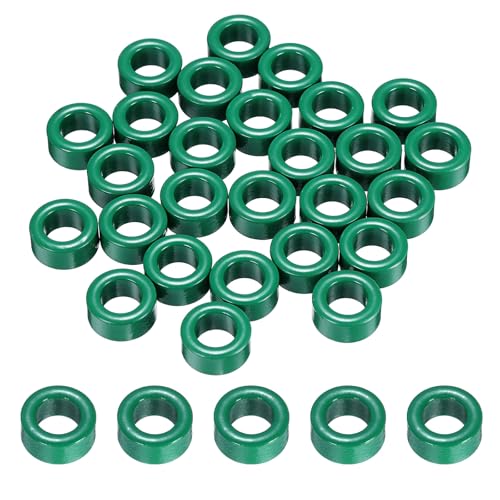
uxcell T60-26 Toroid Core 35-Pack 8.2x15.5x6.2mm ranks first overall in this specification-based comparison under the published weighted criteria.
For an overall specification-based choice, the MECCANIXITY Iron-Silicon-Aluminum Toroid 5-Pack 24x40x15mm stands out for its documented high critical temperature, composite iron-silicon-aluminum material, and broad application coverage including voltage regulators, ballasts, instrument transformers, and welding transformers. It combines strong material specification with a size that fits common power-oriented designs, which is why it earns the top slot in this comparison of the best electronic iron ferrites. If your focus is cable EMI suppression and you prefer explicit inductance data, the MECCANIXITY 50-Pack Mn-Zn Ferrite Choke 3.0-4.0uH is a strong secondary option among the top electronic iron ferrites, and smaller builds can rely on the uxcell T44-26 50-Pack or the uxcell T60-26 35-Pack for general-purpose winding work.
Frequently Asked Questions
Larger outer diameters in the 40 to 42 mm range, such as the MECCANIXITY 24x40x15mm, the uxcell 24x42x16mm iron core, and the Taigoehua 42x24x16mm set, are typically described as suitable for power transformer and high-current applications. Smaller toroids are better matched to signal-level inductors and chokes.
Are manganese-zinc ferrite toroids better for high-frequency noise?
Listings for the MECCANIXITY 3.0-4.0 uH and 2.0-3.0 uH packs describe manganese-zinc ferrites as anti-interference components aimed at high-frequency noise on data cables, audio transformers, and communications circuits. If your concern is high-frequency EMI, those entries are among the best electronic iron ferrites to evaluate first.
Can a clip-on ferrite ring replace a solid toroid in a power circuit?
Clip-on designs, such as the Tanstic 32-piece kit, are explicitly aimed at cable EMI suppression rather than transformer winding. For power transformer cores that need a defined magnetic path and high saturation, solid toroids like the uxcell 24x42x16mm iron core or the MECCANIXITY 24x40x15mm core are more appropriate than clip-on ferrite housings.
Why do some ferrite cores publish an AL value and others do not?
An AL value, like the 3.0-4.0 uH range on the MECCANIXITY manganese-zinc toroids, gives you a reference for calculating inductance once you know the number of turns. Products without a published AL value still describe their behavior, such as interference suppression or electrostatic pulse absorption, which can be enough when you mainly need broadband noise reduction rather than a precise inductance.
How do I pick between ferroferric oxide and iron-silicon-aluminum cores?
Ferroferric oxide cores, including the uxcell T60-26 and T44-26 toroids, are presented as general-purpose choices for transformers, chokes, and filters. Iron-silicon-aluminum cores, such as the MECCANIXITY 24x40x15mm, are documented for higher saturation and high-temperature operation, which can be advantageous in regulator or ballast duty. Match the material description to the thermal and current demands of your circuit.