Buying Guide
The best keyless door levers are not all designed for the same door or routine. The first decision is whether you need an electronic entry lock for an exterior door or a mechanical privacy lever for an interior room. The Philips, Schlage Encode, TEEHO, and Veise models document keypad-based or connected access, while the Copper Creek Avery and Kwikset Milan are simpler privacy products for bedrooms and bathrooms.
Match the lever to the door location
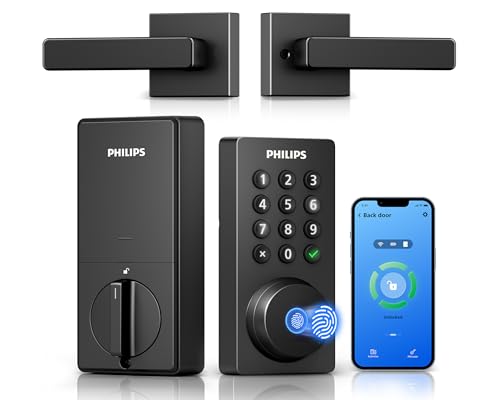
For a front or other exterior door, prioritize a complete handle set, code management, automatic locking, and some form of weather or durability documentation. The Philips 4200 Series includes a matching handle set and supports WiFi, app, voice, fingerprint, and PIN access. The TEEHO TE004, Veise KS01B, Veise KS02B, and Veise RZ-C document IP54 resistance and ANSI Grade 3 specifications, making them the more clearly documented choices for doors exposed to ordinary outdoor conditions.
Interior doors have different needs. A bedroom or bathroom usually needs privacy rather than remote access. The Copper Creek Avery uses a push button inside and an emergency release outside, while the Kwikset Milan uses a keyless push-button privacy lock. Neither requires electronic programming or battery replacement. That simplicity can be an advantage when the door does not need guest codes or exterior entry management.
Choose the access method
Keypad locks are useful when several people need entry without sharing a physical key. The Schlage Camelot stores up to 19 codes, and the TEEHO TE004, Veise KS01B, and Veise RZ-C support up to 20 user PINs in the supplied listings. TEEHO and the Veise models also document one-time codes, which are particularly relevant for guests, cleaners, deliveries, or short-term access.
Fingerprint access can make daily entry faster for users who prefer not to type a code. The Veise KS02B documents fingerprint, PIN, temporary-code, and physical-key access. The Philips model also documents fingerprint entry, alongside app and voice control. These options offer more flexibility, but they introduce more electronic features than a basic keypad or mechanical privacy lever.
WiFi access is the most connected option in this group. Philips connects directly to 2.4GHz WiFi without a hub, while Schlage Encode uses built-in WiFi and the Schlage Home app for remote control and monitoring. Check the network requirements and desired app functions before choosing a connected lock. Neither listing should be treated as a hands-on performance guarantee; the comparison reflects only the supplied specifications.
Review locking modes
Auto-lock is useful for users who may forget to secure a door. Philips documents an adjustable 0-to-180-second setting. TEEHO and the Veise keypad models document settings from 10 to 99 seconds. One-touch locking is also documented on TEEHO, KS01B, KS02B, and RZ-C, allowing the outside keypad to initiate locking without entering a code.
Passage mode keeps a door from automatically locking when frequent movement is expected. It appears on TEEHO and the Veise keypad models. Privacy mode or a thumb turn provides a different function: it allows manual control from inside, which is more relevant to rooms or shared spaces. Vacation Mode on the Veise products can restrict ordinary codes while the household is away. Schlage Camelot takes a simpler approach with Flex Lock, which switches between unlocked and automatic re-locking operation.
Check door fit before ordering
Measure door thickness, backset, handing, and bore-hole size before selecting a lever. TEEHO TE004, Veise KS01B, Veise KS02B, and Veise RZ-C document compatibility with doors from 1-3/8 to 2 inches thick and standard 2-1/8-inch bore holes. The Copper Creek Avery fits standard interior doors and supports 2-3/8 or 2-3/4-inch backsets. Kwikset Milan is reversible, but the supplied listing does not provide its complete dimensional range, so measurement is especially important.
Reversible construction is useful when the same product may be installed on either side of a doorway. Philips, TEEHO, the Veise keypad models, Copper Creek, and Kwikset Milan document left- and right-hand compatibility or reversible installation. Installation claims should still be checked against the existing latch and bore configuration. A screwdriver-only installation does not eliminate the need to verify measurements.
Consider durability and maintenance
Electronic levers require a battery plan. Philips documents up to six months of daily operation and a low-battery alert, while the Veise keypad models document up to one year with four AA batteries. Schlage Camelot documents up to two years of typical use with a low-battery indicator. Batteries are not included with the Philips, TEEHO, and Veise models in the supplied evidence.
Mechanical privacy levers avoid battery replacement and programming. Copper Creek and Kwikset Milan are therefore suited to buyers who want a keyless room lock with minimal ongoing maintenance. Their emergency-release designs are not substitutes for exterior access control: they are intended for interior privacy and can be opened from outside with a coin, screwdriver, or release tool, depending on the model.
For exterior use, look for documented resistance and certification rather than assuming every keyless lever is weather-ready. TEEHO and the Veise products list IP54 resistance, and the Veise KS02B also lists an operating range. Schlage Camelot and Schlage Touch document Grade 2/AAA construction, while Copper Creek and Kwikset Milan document residential-grade certifications. These are specification indicators, not results from independent testing in this comparison.
Final recommendation
Veise KS02B Fingerprint Keypad Lever ranks first overall in this specification-based comparison under the published weighted criteria.
The final choice among the best keyless door levers depends on the documented features that match your intended use.
Philips 4200 Series WiFi Keypad Door Lock with Handle is the highest-scoring first overall specification-based choice. It offers the broadest documented access mix, combining app control, voice compatibility, fingerprint entry, and several PIN types in a complete handle set. Among the top keyless door levers, it is the best fit for a connected front-door setup when 2.4GHz WiFi is available.
Choose the Veise KS02B when fingerprint access matters more than app control, or the TEEHO TE004 when temporary codes and practical mode controls are the priority. Schlage Camelot is the stronger straightforward keypad option for buyers who value documented battery longevity and Grade 2/AAA construction. For interior rooms, Copper Creek Avery and Kwikset Milan avoid battery management and provide the simple privacy function those doors commonly need.
Before buying, confirm the door thickness, backset, bore-hole layout, handing, and whether the product is intended for an exterior entrance, bedroom, bathroom, closet, or hallway. That compatibility check is more important than selecting the most feature-rich model.
Frequently Asked Questions
What are the best keyless door levers for a front door?
The Philips 4200 Series, Schlage Encode, TEEHO TE004, Veise KS01B, Veise KS02B, and Veise RZ-C are the most specification-aligned documented front-door candidates in this comparison. Philips and Schlage Encode add connected control, while TEEHO and the Veise models emphasize keypad access, temporary codes, automatic locking, and documented IP54 resistance.
Are mechanical privacy levers suitable for exterior doors?
The Copper Creek Avery and Kwikset Milan are documented as interior privacy products for bedrooms and bathrooms. Their emergency-release functions are intended to allow outside opening with a tool, so they should not be treated as equivalent to an exterior keypad or smart entry lock.
Do keyless door levers need batteries?
Electronic models generally do. Philips, TEEHO, and the Veise keypad products document battery-powered operation, with alerts for low power on the listed models. Schlage Camelot also uses a battery and documents a low-battery indicator. Mechanical privacy levers such as Copper Creek Avery and Kwikset Milan do not require batteries.
What should I measure before installing a keyless lever?
Measure door thickness, backset, bore-hole size, and handing. Several selected electronic models fit 1-3/8 to 2-inch doors with standard 2-1/8-inch bore holes, while the Copper Creek Avery and other interior models use standard interior-door dimensions. Always compare those measurements with the specific listing before installation.
Is fingerprint access better than a keypad?
Fingerprint access can reduce the need to remember or enter a code, but it adds another electronic access method. The Veise KS02B and Philips models document fingerprint entry as well as PIN access, while keypad-only models may be simpler to manage. The better choice depends on whether your priority is biometric convenience or a straightforward code system.