Buying Guide
The best keyless door handle sets differ less by appearance than by the way they manage entry, power, and installation. The products above include basic keypad models, fingerprint locks, and connected sets with app or Wi-Fi control. Because this is a specification-based comparison rather than a hands-on test, use the documented features as a checklist and verify your door measurements before ordering.
Choose the access method first
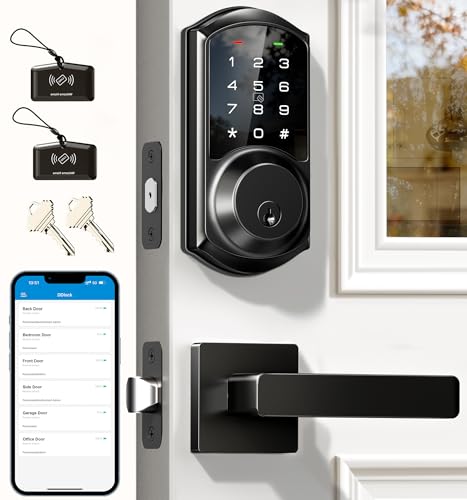
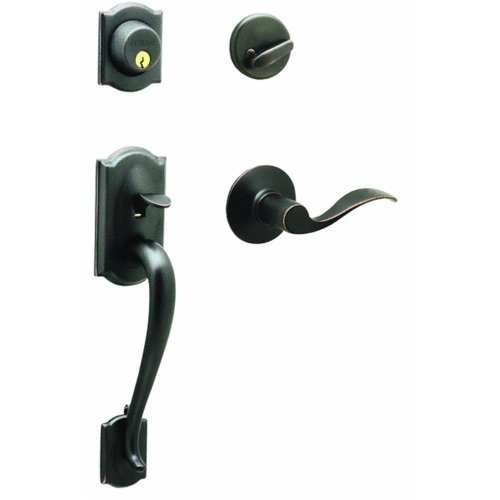
A keypad is the simplest keyless format in this group. The Veise RZ-C and Schlage Camelot use codes while retaining physical-key backup. They suit households that want to stop carrying keys without adding app accounts or wireless setup. Code capacity varies, so consider whether you need a few household codes or temporary access for guests and service providers.
Fingerprint models add a fast local option for family members. The Veise KS02B and KS02D document fingerprint, passcode, one-time-code, and physical-key entry. The Ulecoce fingerprint model goes further in stated storage capacity, supporting up to 512 fingerprints and keypad passcodes. Fingerprint access can be useful when hands are occupied, but buyers should still plan around the supplied backup methods and battery warnings.
Decide whether you need app or Wi-Fi control
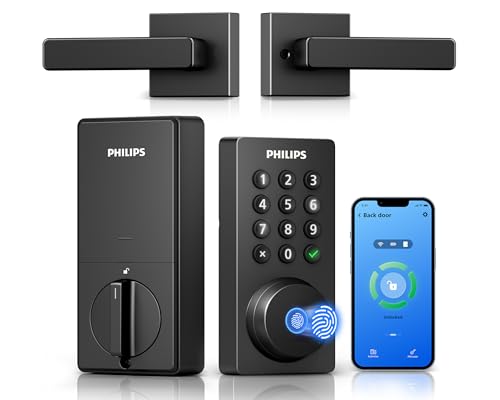
Connected models are useful when access must be managed away from home. The Veise VE017G-H documents built-in Wi-Fi, activity logs, temporary codes, fingerprint access, and voice control. The Philips upgraded set also connects directly to 2.4GHz Wi-Fi and supports app status checks, access alerts, and temporary codes. The Philips 4200 Series adds recurring and periodic PIN choices.
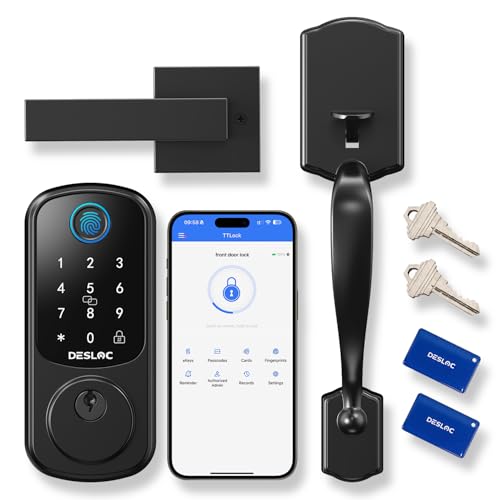
Not every smart-looking lock has the same connectivity. The Veise VE06-L documents app and web-portal control, while remote access and voice functions require its separately sold G2 gateway. DESLOC B200 similarly provides Bluetooth app control as standard and gateway-based remote control as an upgrade. Check whether your preferred functions are built into the lock or depend on another device.
Check your door before comparing finishes
Several selected products specify compatibility with doors between 1-3/8 and 2 inches thick. The Veise VE017G-H, Philips upgraded set, Veise KS02B, Veise RZ-C, and other models also describe left- and right-handed installation. Some listings identify bore-hole requirements, including the common 2-1/8-inch opening, while the Veise VE06-L lists 1-1/2-inch and 2-1/8-inch options.
Measure door thickness, bore diameter, backset, and the existing handle arrangement. A complete handle set may still require attention to hole spacing or door orientation. The Schlage Camelot listing supports screwdriver installation but does not provide door-thickness details in the supplied evidence, so measurement verification is particularly important there.
Compare durability and security documentation
ANSI and BHMA references provide useful specification points, but they do not replace checking the exact installation conditions. The Veise KS02B, KS02D, and RZ-C document ANSI Grade 3 and IP54 protection. The DESLOC B200 also lists IP54, while the Philips upgraded model specifies IP53. The Schlage Camelot lists a Grade 2/AAA rating and metal construction.
Other useful features include anti-peep code entry, wrong-attempt lockouts, vacation mode, silent mode, and passage mode. These functions address different situations: anti-peep entry helps conceal a code, vacation mode can disable ordinary codes while away, and passage mode keeps the door unlocked for gatherings or frequent movement. Choose features that match your routine rather than assuming every mode is necessary.
Plan for batteries and emergency access
Battery details vary widely. Several Veise models specify four AA batteries and more than one year of operation, while the Philips 4200 Series states up to six months. The Schlage Camelot uses an included 9V battery and states up to two years of typical use. Actual duration can vary with use, so a low-battery alert and a physical key remain valuable.
The Veise VE017G-H and DESLOC B200 document emergency power ports. These can be helpful if batteries are depleted, but keep the required cable or power source available. Locks that include physical keys provide another backup route. Review the battery type, whether batteries are included, the alert method, and the location of any emergency power connection before installation.
Final recommendation
Veise VE017G-H Wi-Fi Smart Door Lock ranks first overall in this specification-based comparison under the published weighted criteria.
The final choice among the best keyless door handle sets depends on the documented features that match your intended use.
Veise VE017G-H is the first overall specification-based choice among these top keyless door handle sets. Its combination of built-in Wi-Fi, eight documented access methods, fingerprint entry, voice compatibility, temporary codes, activity logs, and an emergency power port gives it the broadest feature coverage in this comparison.
Choose the Veise VE06-L if managing many credentials is more important than built-in remote connectivity, or choose the Philips upgraded Wi-Fi set for direct Wi-Fi access with fingerprint and voice options. DESLOC B200 is a practical alternative when USB-C emergency power matters. For a simpler non-app installation, the Veise KS02B, KS02D, RZ-C, and Schlage Camelot cover different balances of biometrics, keypad controls, durability documentation, and battery planning.
Frequently Asked Questions
What should I measure before buying one of the best keyless door handle sets?
Measure door thickness, bore-hole diameter, backset, and the existing handle configuration. Many selected listings support 1-3/8-to-2-inch doors, but bore-hole options differ. Confirm left- or right-hand compatibility and whether the set replaces both the handle and deadbolt components.
Are fingerprint locks better than keypad-only models?
They provide another local access method, which may be convenient for households that prefer not to enter a code. However, keypad-only products such as the Veise RZ-C and Schlage Camelot can be simpler to manage. Compare the documented access methods, backup keys, battery warnings, and installation requirements for your use case.
Do smart handle sets need Wi-Fi?
Not always. Some models provide keypad, fingerprint, or app access over local connections. The Philips upgraded set, Philips 4200 Series, and Veise VE017G-H document built-in Wi-Fi. The Veise VE06-L and DESLOC B200 document gateway-dependent remote features, so check the connectivity requirements before choosing.
What happens if the batteries run out?
The selected products use different backup approaches. Physical keys are documented on several models, including the Veise KS02B, KS02D, and DESLOC B200. Emergency power ports are documented on the Veise VE017G-H and DESLOC B200. Regardless of model, pay attention to low-battery alerts and keep the specified backup method accessible.
Is IP54 enough for an exterior door?
IP54 is a documented dust- and water-resistance rating on several products, including the Veise KS02B, Veise KS02D, Veise RZ-C, and DESLOC B200. It is a product specification, not a guarantee for every installation environment. Follow the manufacturer’s installation instructions and compare the rating with the exposure at your particular door.