Buying Guide
The best kids’ alarm clocks are not all designed for the same age or routine. Some are visual sleep trainers for toddlers, while others are conventional digital alarms for children who already understand clock numbers. The most useful comparison is therefore feature-based: look at how the clock communicates bedtime, how much control it gives caregivers, how clearly it displays time, and whether it fits the room’s power and placement needs.
Match the clock to the child’s routine
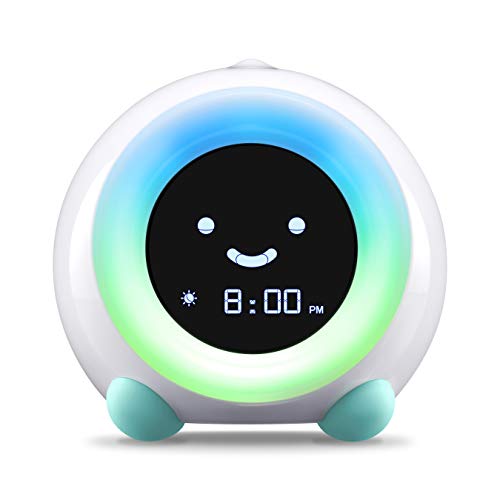
For a toddler who gets up before the intended wake time, a color or graphic cue can be easier to understand than a digital time. LittleHippo Mella, iHoo, ANALOI, and ANNNGUL all document visual sleep or wake guidance. Mella uses facial expressions and yellow-to-green cues. iHoo uses sun-and-moon graphics with red and green lighting, while ANALOI also uses sun-and-moon imagery. ANNNGUL keeps the idea especially direct with green and red lights.
These products are best viewed as routine aids rather than substitutes for teaching. A caregiver still needs to explain what each color or image means and use the same schedule consistently. A clock with a silent countdown, such as Mella, may also help with transitions that are not limited to waking, including bedtime preparation or timed activities.
For an older child who mainly needs to wake on school mornings, a conventional alarm may be more suitable. DreamSky, Peakeep, Plumeet, and the Cadmos G10 emphasize digital time displays and alarm controls instead of toddler-specific signals.
Consider alarm schedules
A single daily alarm can be enough for a consistent routine, but weekday and weekend controls reduce repeated changes. AFEXOA documents daily, weekday, and weekend modes, and the Cadmos G10 lists separate weekday and weekend modes with dual alarms. These are useful when school mornings differ from non-school days or when two people share a bedside area.
iHoo specifically notes that it does not provide weekday and weekend alarms, so it is better suited to a simple repeating routine. Plumeet also keeps its design simple, with a conventional alarm, snooze, and ascending sound rather than multiple schedules.
Decide how much sound support is useful
Some children need only a dependable beep. Others settle more easily with background audio or prefer a gentler wake-up sound. REACHER documents 20 soothing sounds and six wake sounds, while AFEXOA lists eight sleep sounds and seven wake-up sounds. Mella includes three sleep sounds and three alarm sounds, and iHoo provides six soothing sounds.
Sound options can add bedtime utility, but they also make a clock more feature-heavy. If a child only needs a morning alarm, DreamSky or Plumeet may be easier to understand. The listing for Cadmos G10 emphasizes a loud 105 dB alarm, which may suit children who sleep through quieter alarms but may be excessive for light sleepers. Alarm volume should be chosen carefully and placed at a suitable distance.
Check display and night-light behavior
A readable display matters once children start using a clock independently. DreamSky lists two-inch LED digits, while Cadmos G10 lists two-inch digits and four brightness levels. The larger display on these conventional clocks can be useful from across a room. Plumeet instead uses a large LCD with a brief backlight activated by the snooze-light button, which limits constant nighttime glow.
Night lights vary from simple illumination to colorful room lighting. Peakeep uses three night-light dimmer settings and an ambient light sensor. REACHER combines adaptive display brightness with an eight-color bottom light. AFEXOA offers RGB lighting, while Mella lists five night-light colors. Look for dimming or automatic behavior if a bright display could interfere with sleep.
Review power and placement
Power determines where the clock can be used. Peakeep and Plumeet run on AAA batteries, making them practical for travel or rooms without a convenient outlet. Their batteries are not included. ANALOI is described as rechargeable, while many feature-rich clocks use an adapter.
DreamSky, ANNNGUL, Cadmos G10, and REACHER are intended for outlet use. DreamSky and Cadmos G10 document battery backup for settings, but that does not make them fully battery-powered. AFEXOA includes a USB charging function, yet the supplied evidence does not establish that it operates without its normal power connection. Check the power arrangement before choosing a permanent bedside location.
Keep setup realistic
Simple controls can matter as much as the feature list. Plumeet has dedicated buttons for time, alarm, snooze, light, and alarm on or off. DreamSky also emphasizes intuitive operation. ANNNGUL places buttons on the clock face and describes its setup as easy. By contrast, sound machines and dual-schedule clocks offer more adjustment, which can be useful but may require more caregiver involvement.
Material and construction details may also matter in a child’s room. Mella lists child-safe ABS and silicone, ANALOI lists ABS plastic and silicone, and Plumeet has a shock-proof silicone cover. These are documented design details, not guarantees against damage, so normal care remains appropriate.
Final recommendation
LittleHippo Mella Kids Alarm Clock ranks first overall in this specification-based comparison under the published weighted criteria.
LittleHippo Mella is the highest-scoring returned product and the first overall specification-based choice among the best kids’ alarm clocks. Its visual cues, countdown, night light, sleep sounds, alarm choices, and stated child-safety approvals give it the broadest documented fit from toddler sleep training through older-child routines.
For a household focused on flexible schedules and varied audio, AFEXOA is a strong alternative. REACHER is the better fit when a sound machine and extensive brightness control matter most. ANALOI and iHoo are targeted choices for younger children who benefit from sun-and-moon or color-based cues. For conventional alarms, DreamSky favors readability, Peakeep favors cordless placement, Plumeet favors travel, and Cadmos G10 favors large digits and weekday scheduling. ANNNGUL is a focused option when an uncomplicated OK-to-wake signal is the priority. Together, these are the top kids’ alarm clocks for different documented needs rather than a single universal design.
Frequently Asked Questions
Are the best kids’ alarm clocks mainly for toddlers?
No. Sleep-training clocks such as Mella, iHoo, ANALOI, and ANNNGUL are aimed at children learning bedtime and wake-up cues, but conventional models can suit older children. DreamSky and Cadmos G10 emphasize readable digital displays, while Plumeet offers a compact design for children who need a straightforward alarm. The right choice depends on whether the child needs a visual routine signal or simply a reliable time display and alarm.
Should I choose a battery or plug-in kids’ alarm clock?
Choose a battery model when portability or flexible placement is important. Peakeep uses three AAA batteries, and Plumeet also uses three AAA batteries, though neither listing says batteries are included. Choose a plug-in model when the clock will stay on one nightstand and you want stable operation or features such as sound playback. Remember that backup batteries in models such as DreamSky and Cadmos G10 preserve settings but do not necessarily power normal operation.
Do these clocks all include a night light?
No. The selected products document different lighting approaches. Mella has five night-light colors, REACHER has an eight-color bottom light, Peakeep has three dimmer settings, and AFEXOA provides RGB lighting. Plumeet’s backlight is tied to the snooze-light control rather than a continuously described night-light mode. Review the brightness controls and automatic behavior if the light will be used near bedtime.
Which selected clock has the most alarm schedule flexibility?
AFEXOA and Cadmos G10 provide the clearest documented schedule flexibility. AFEXOA lists dual alarms with daily, weekday, and weekend modes. Cadmos G10 lists dual alarms with weekday and weekend modes. These features can reduce daily reprogramming. By comparison, iHoo explicitly notes that it does not include weekday and weekend alarms, making it more appropriate for a simpler repeating routine.
Are loud alarms suitable for every child?
No. Cadmos G10 lists a 105 dB alarm, while DreamSky describes an adjustable alarm range and several other models offer volume controls. A louder alarm may help a deep sleeper, but it may be uncomfortable for a light sleeper. Start with the lowest practical volume, place the clock appropriately, and consider a gentler sound option such as the wake sounds documented for REACHER or AFEXOA.