Buying Guide
Choosing among the best lightweight safety vests starts with the work environment rather than the pocket count alone. A vest for a hot outdoor shift has different priorities from one used by a surveyor carrying a phone, radio, pens, identification, and other small items. The products above are compared from supplied listing evidence only; this is not a hands-on test and does not summarize customer opinions.
Confirm the required visibility class
For regulated work, start by checking the employer, project, or roadway requirement. Several selected products document Class 2 information, including Pioneer, XIAKE, Neopelta, and ASIPHITU. Pioneer lists ANSI/ISEA 107-20 Class 2 Type P and R, while XIAKE and ASIPHITU identify Class 2 Type R. ProtectX lists ANSI 107-2015 Type R Class 2 and EN471. Neopelta lists ANSI/ISEA 107-2020 Class 2.
A general statement such as “ANSI compliant” is less specific than a named class and type. G & F Products states ANSI-compliant construction, but the supplied evidence does not identify a class. That may still be useful for general visibility work, but it should not be treated as interchangeable with a documented classification. Always compare the vest’s stated designation with the rules for your job.
Color can also matter. ASIPHITU is listed in an H-black color. Reflective tape improves the documented visibility design, but the required background color may be set by a site policy or safety plan.
Prioritize mesh when airflow matters
Breathable polyester mesh is a recurring design choice in this category. Pioneer specifically describes its polyester mesh as breathable and cooling, and its listing supplies a 0.35-pound weight. XIAKE, JKSafety BX320, JKSafety BX331, and ASIPHITU also describe lightweight or breathable mesh construction. Mesh can help reduce the sense of bulk during warm work, though the supplied listings do not establish identical comfort or durability in real use.
A solid-front and mesh-back design, as documented for ProtectX, creates a different balance. It retains mesh airflow at the back while adding a more substantial front panel and extensive storage. A padded collar, as listed for Neopelta, may be useful when carrying equipment, but it can add structure compared with a simple sleeveless mesh layer.
Match storage to the job
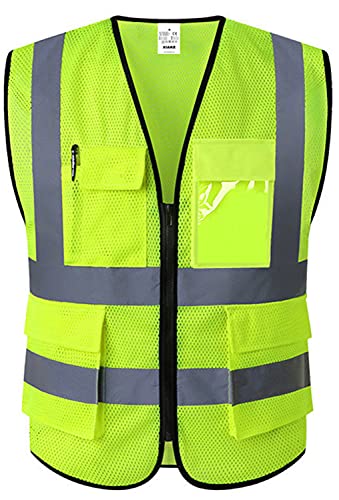
Pocket design is one of the clearest differences among the top lightweight safety vests. A simple vest may be preferable when the goal is visibility over a shirt or jacket. Pioneer emphasizes visibility, breathability, and a zipper but does not document pockets. G & F Products offers a zippered front pocket and a hook-and-loop clamshell pocket for basic carry needs.
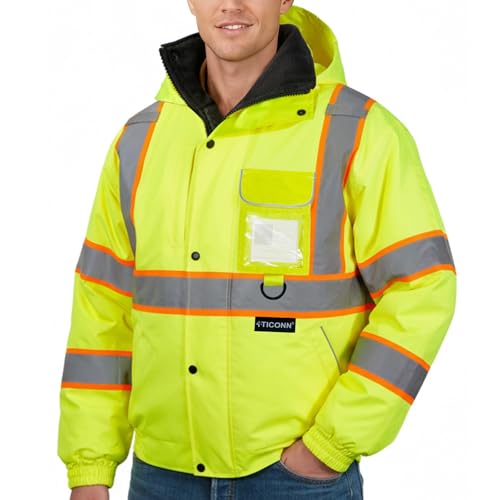
For more equipment, look at the stated layouts. ProtectX documents six pockets, including pen slots, a phone pocket, two large lower pockets, and two inner pockets. TICONN lists an ID pocket, pen holder, radio pocket, and two large pockets. JKSafety BX320 and ASIPHITU each document eight pockets or compartments. Neopelta includes phone and ID storage, a pencil pocket, two lower cargo pockets, and microphone tabs. A-SAFETY lists seven front pockets and microphone-related features.
More storage can also mean more structure and potential bulk. Consider whether you need every compartment or whether a lighter, less crowded front will be easier to layer and move in.
Check closure and fit details
A zipper is useful for quick on/off and a more secure front. TICONN describes a smooth zipper, and JKSafety BX320 includes a zipper front in its title.
Fit matters when the vest is worn over work clothing. XIAKE warns that loose-fit shoppers may need one or two sizes up. A-SAFETY documents a broad size range, from XS through 8XL, while several selected listings provide a specific size such as Large or X-Large. Use the supplied size chart rather than assuming a standard garment size, especially when layering over a coat or tool belt.
Consider maintenance and job limitations
Several listings mention machine washing, including XIAKE, JKSafety BX331, G & F Products, A-SAFETY, and ASIPHITU. Follow the product’s care label, because the supplied evidence does not establish that every reflective material will behave identically after repeated washing.
Also review exclusions. JKSafety BX320 states that it is not designed for anti-static or FR standards. A-SAFETY is not rated as anti-static or flash-fire gear. Those limitations are important because a high-visibility vest is not automatically protective clothing for arc-flash, flash-fire, or other specialized hazards. Choose equipment that matches the full hazard assessment, not just the color and reflective tape.
Final recommendation
ASIPHITU H-Black Reflective Construction Vest ranks first overall in this specification-based comparison under the published weighted criteria.
ASIPHITU H-Black Reflective Construction Vest is the highest-scoring returned product and the first overall specification-based choice among the best lightweight safety vests.
It combines breathable mesh, eight pockets, two-inch reflective tape, a zipper front, and documented ANSI/ISEA 107 Class 2 Type R compliance. ProtectX is a strong alternative when detailed storage matters, while Pioneer is a sensible option when listed weight and breathable Class 2 mesh are key priorities. XIAKE, TICONN, and the two JKSafety models offer different combinations of coverage and storage. Neopelta adds reinforced workwear details, A-SAFETY offers broad documented sizing, and G & F Products provides a dual-closure layout.
The final choice among the top lightweight safety vests depends on the documented features that match your intended use. Verify the required class, background color, fit, care instructions, and hazard controls before purchase. Treat these rankings as a specification-based starting point rather than a substitute for workplace safety guidance.
Frequently Asked Questions
What should I look for in the best lightweight safety vests?
Check the documented visibility class first, then compare mesh construction, reflective coverage, closure type, storage, sizing, and care instructions. Pioneer is notable for its listed weight and Class 2 Type P and R information, while ProtectX and ASIPHITU provide more extensive pocket evidence.
Is a mesh safety vest suitable for hot weather?
Mesh is generally selected to encourage airflow, and Pioneer, XIAKE, JKSafety BX320, JKSafety BX331, and ASIPHITU describe breathable or lightweight mesh. However, the supplied evidence is listing-based rather than a comparative heat test, so actual comfort can vary with fit, clothing layers, and work conditions.
Do more pockets make a safety vest better?
Not automatically. ProtectX, JKSafety BX320, and ASIPHITU document extensive storage, which can help when carrying tools or identification. A simpler option such as Pioneer may be preferable when low bulk and airflow matter more than equipment organization.
Are all high-visibility vests rated for specialized hazards?
No. JKSafety BX320 states that it is not designed for anti-static or FR standards, and A-SAFETY is not rated as anti-static or flash-fire gear. A vest’s reflective design and ANSI information do not replace hazard-specific protective equipment requirements.
How should I choose a vest size for layering?
Use the supplied size chart and consider the clothing worn underneath. XIAKE advises loose-fit shoppers to order one or two sizes up, and A-SAFETY documents sizes from XS through 8XL. Do not rely only on the nominal size shown in a product title.