Buying Guide
The best male-to-male mini sas cables are selected by connector family first, then by the storage protocol and physical layout they must support. A cable can be technically well specified and still be the wrong choice if one end does not match the controller, host bus adapter, backplane, enclosure, or shelf. The products above include internal SFF-8087 and SFF-8643 assemblies plus external SFF-8088 and SFF-8644 assemblies. Those formats are not interchangeable simply because each is described as Mini SAS.
Match the connector family
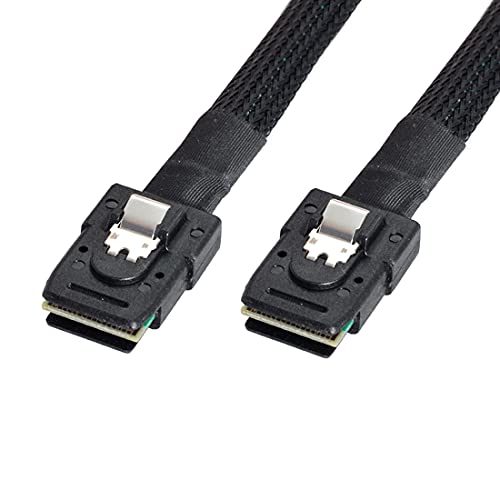
SFF-8087 is a 36-pin internal Mini SAS format commonly listed for controller-to-backplane wiring. The OIKWAN, Cable Plus, chenyang, and IQlionco selections use SFF-8087 male connectors on both ends. This is the straightforward choice when both compatible ports are internal 36-pin receptacles.
SFF-8643 is the high-density internal Mini SAS HD format. The 10Gtek same-port cable uses SFF-8643 at both ends, while the 10Gtek hybrid and CableCreation hybrid selections combine SFF-8643 with SFF-8087. A hybrid cable is relevant only when the two connected devices expose different internal connector families. Confirm the exact port drawing or system documentation before choosing it.
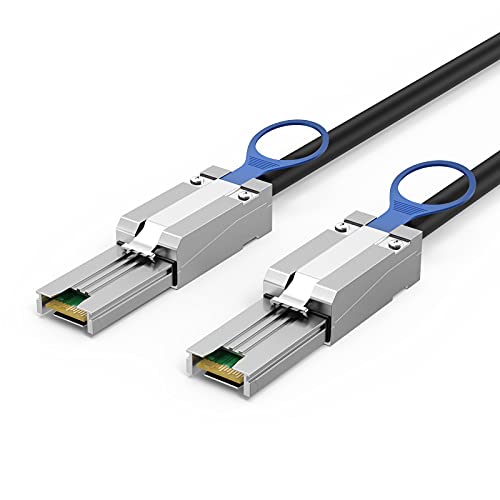
External connections use different formats. CableCreation’s SFF-8088 model has external 26-pin male connectors at both ends. The 10Gtek SFF-8644 model uses external SFF-8644 connectors at both ends. These should be considered external link designs, not substitutes for internal SFF-8087 or SFF-8643 cables.
Check the documented bandwidth
The listings cover several generations and stated transfer levels. The 10Gtek SFF-8643-to-SFF-8087 cable documents 12Gb/s SAS 3.0 with backward compatibility to 6Gb/s SAS 2.0. The H!Fiber.com cable also states 12Gb/s support and SAS 2.1 and SAS 3.0 compliance. The 10Gtek SFF-8643 pair lists both SAS 2.1 and SAS 3.0, and the external SFF-8644 cable lists 12Gb/s with 6Gb/s backward compatibility.
Other selections have narrower documentation. Cable Plus states 6Gb/s, IQlionco states 6Gb/s, and chenyang describes SAS/SATA generations I and II without a 12Gb/s claim. CableCreation’s external SFF-8088 listing states 3.0Gb/s. These statements should be treated as the documented ceiling for comparison, not as a promise that every connected component will operate at that level. The controller, backplane, drives, enclosure, and host configuration can all affect the active link.
Consider signal-control details
Impedance and cable construction can help distinguish otherwise similar assemblies on paper. The 10Gtek hybrid cable specifies 100-ohm impedance, 30 AWG silver-plated copper, and reduced EMI and signal loss in its listing. The H!Fiber.com model specifies 100-ohm twinaxial construction, 30 AWG conductors, and low-skew design. The external 10Gtek SFF-8644 cable lists 100-ohm, eight-pair twinaxial shielding and 30 AWG wiring.
The OIKWAN internal cable lists individually shielded ribbon cables and an industrial woven mesh sheath. Cable Plus identifies solid tinned copper conductors and aluminized polyester foil shielding. IQlionco specifies 100-ohm shielded twinax copper wiring. These details are useful when comparing documented construction, but they do not remove the need to verify the port standard and system compatibility.
Choose length for the chassis
Short cables can be easier to route inside compact equipment. H!Fiber.com lists 0.5 m, CableCreation lists 0.5 m, and IQlionco lists 0.5 m, 0.8 m, and 1 m options. Cable Plus lists 0.6 m, chenyang lists 70 cm, and the two 10Gtek internal assemblies list 0.8 m. The OIKWAN listing includes a 1.6 ft size, while its description also references a 3.3 ft version, so the selected listing size deserves careful verification.
For external runs, the SFF-8088 CableCreation cable is 2 m and the SFF-8644 10Gtek cable is 1 m. Extra length can help reach a shelf or enclosure, but unused cable may complicate routing. Measure between the actual ports, account for bend direction, and check whether a left-angle connector is useful. CableCreation’s hybrid model specifically lists a left-angle SFF-8087 end.
Review retention and sideband features
Retention matters when a cable will remain installed in a server or storage chassis. OIKWAN lists stainless-steel latches, 10Gtek’s hybrid cable lists a stainless-steel lock on the SFF-8087 plug, and the external SFF-8644 cable lists positive-click retention. Chenyang specifies positive and passive latching, while the external SFF-8088 cable uses release rings. These are different mechanical approaches, so match them to the receptacles and the way the equipment is serviced.
Sideband wiring can matter in storage enclosures that use compatible management signaling. OIKWAN identifies integrated sideband wires and SGPIO support when connected to a compatible system. H!Fiber.com also identifies sideband support. Do not assume that every Mini SAS cable includes the same sideband conductors; look for explicit documentation when that function is required.
Internal selection method
For an internal controller-to-backplane run, first identify whether both ports are SFF-8087, both are SFF-8643, or one of each. Then compare the required SAS generation and cable length. The 10Gtek SFF-8643-to-SFF-8087 cable is the clearest documented mixed-generation option. The 10Gtek SFF-8643 pair fits same-port HD connections, while the SFF-8087 models offer several choices for standard internal ports.
External selection method
For an external enclosure or rack link, identify SFF-8088 or SFF-8644 before considering length. The CableCreation SFF-8088 cable provides a 2 m same-port option with release rings. The 10Gtek SFF-8644 model provides a 1 m same-port option with 12Gb/s and 100-ohm details. Neither should be selected for an internal port simply because the product title includes Mini SAS.
Final Recommendation
10Gtek SFF-8644 to SFF-8644 12G Mini SAS HD Cable ranks first overall in this specification-based comparison under the published weighted criteria.
10Gtek SFF-8643 to SFF-8087 Mini SAS HD Cable is the first overall specification-based choice. It combines a clearly documented hybrid connector layout, 12Gb/s SAS 3.0 support, SAS 2.0 backward compatibility, 100-ohm wiring, 0.8 m length, and a two-cable configuration. For a same-port internal HD connection, the 10Gtek SFF-8643 to SFF-8643 cable is the more direct match. For an external link, the 10Gtek SFF-8644 to SFF-8644 model belongs among the top male-to-male mini sas cables because its external format, 12Gb/s support, shielding, and positive-click retention are all clearly stated.
The best male-to-male mini sas cables are not interchangeable by name alone. Select the exact connector family, confirm the supported SAS generation against the connected hardware, and choose a length that follows the intended route without stressing the ports. The SFF-8087 choices are appropriate for documented internal 36-pin connections, while SFF-8643 hybrids address systems that mix internal Mini SAS HD and standard Mini SAS ports. External SFF-8088 and SFF-8644 choices belong to compatible external equipment.
Frequently Asked Questions
Among the best male-to-male mini sas cables, are SFF-8087 and SFF-8643 cables interchangeable?
No. They are different internal connector formats. An SFF-8087-to-SFF-8087 cable is intended for two compatible SFF-8087 ports, while an SFF-8643-to-SFF-8643 cable is intended for two compatible SFF-8643 ports. A hybrid SFF-8643-to-SFF-8087 cable is designed for systems that expose one of each. Verify both ports before selecting a cable.
What is the difference between internal and external Mini SAS cables?
Internal assemblies in this comparison use SFF-8087 or SFF-8643 connectors and are described for server, workstation, RAID, HBA, or backplane layouts. External assemblies use SFF-8088 or SFF-8644 connectors and are described for enclosure, shelf, rack, or controller links. Their plugs and intended installation environments differ.
Do all male-to-male mini sas cables support 12Gb/s?
No. The supplied listings document different levels. Several 10Gtek and H!Fiber.com models state 12Gb/s support, while Cable Plus and IQlionco state 6Gb/s. Chenyang describes SAS/SATA generations I and II, and CableCreation’s external SFF-8088 listing states 3.0Gb/s. Match the cable specification with the system’s documented requirements.
When are sideband wires important?
Sideband wires can be relevant to compatible storage-management functions such as SGPIO. OIKWAN identifies integrated sideband wires and SGPIO support, and H!Fiber.com identifies sideband support. Because the feature is not stated for every selection, confirm that the chosen cable and connected hardware support the required sideband function.
How should cable length be chosen?
Measure the route between the actual ports, including the direction in which each connector exits. Short internal options include 0.5 m and 0.6 m assemblies, while other internal choices list 70 cm or 0.8 m. External choices in this comparison include 1 m and 2 m. A left-angle connector, as documented on one CableCreation hybrid model, may help with clearance in a particular chassis.