Buying Guide
Choosing among the best metal garden trellises starts with the plant and the space, not just the stated height. A climbing rose may need a tall, broad panel or tower, while peas and cucumbers can be better matched with an A-frame. Containers often benefit from a narrow obelisk or a modular panel that does not overwhelm the pot.
Match the structure to the plant
Flat panels give stems a broad vertical surface. The YOBAZAN, VEVOR, and LZRS options are panel-style choices, while ArdeFentium uses two panels that can be separated or combined. These formats are useful when you want to train growth across a visible plane beside a fence, bed, wall, or planter. A wide panel can also create a decorative backdrop, although the available width should be checked against the planting area.
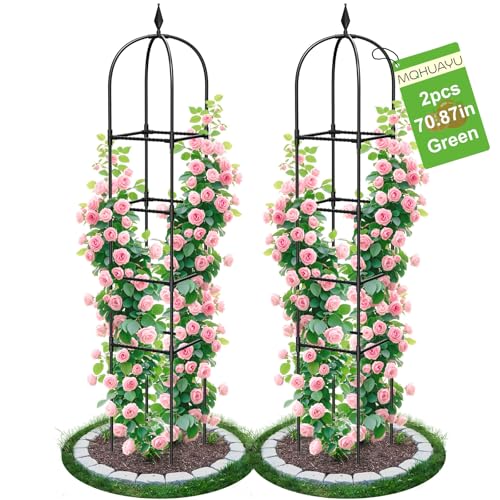
Obelisks take a different approach. The MQHUAYU 71-inch model, ParseBio, LeJoy Garden, and MQHUAYU 65-inch model create three-dimensional towers that guide growth upward around a central form. This can conserve ground space and add height in a small bed. Towers are especially suitable for flowering vines, roses, tomatoes, beans, and other plants that can be trained around vertical supports. Their footprints are generally narrower than broad panels, but they do not provide the same flat surface for side-to-side training.
The Trellume is an A-frame. Its triangular structure is particularly relevant to cucumbers, peas, morning glories, and similar vines, and the listing describes the design as promoting air circulation and spreading growing space. An A-frame needs floor width on both sides, so measure the bed or row before choosing it.
Check height and usable width
A listed height does not always equal the amount of support available above the soil. Some products include ground stakes in their overall dimensions, and the installed climbing area may therefore be shorter. The YOBAZAN and VEVOR panels are among the tallest options here, at roughly 87 inches. ParseBio provides two 6.6-foot obelisks, while LeJoy Garden reaches 66.1 inches. These taller choices can suit mature vines, but they may look oversized in a small container.
Shorter supports can be easier to place in pots, grow bags, and raised beds. Hensal reaches 46.6 inches and uses three sections, so gardeners can choose one, two, or all three sections. The LZRS pair is wide rather than exceptionally tall, and its two panels can be positioned side by side. ArdeFentium is useful when the plant is still developing because the listing gives a configuration range from 23.8 to 71 inches.
Before buying, measure the available width, depth, and overhead clearance. Also consider whether the plant will be trained on one side or allowed to wrap around a tower. A narrow tower may fit a container but offer less room for a plant that spreads laterally.
Evaluate material and outdoor finish
Most selected products describe either powder-coated metal or a coated steel or iron construction. Trellume and the two MQHUAYU models describe additional plastic coatings over metal or steel components. These descriptions are useful specifications, but they are not a substitute for checking the finish after installation.
The stated tubing details can help distinguish designs. ArdeFentium lists 10mm frame tubing, ParseBio lists 13mm tubing, and LeJoy Garden lists 16mm pipes. Hensal lists a 6mm round-tube frame, while VEVOR identifies Q195 metal without giving a tube diameter. A larger stated tube diameter may indicate a more substantial frame, but it does not establish a universal load limit. None of these listings should be treated as proof that a trellis will support every mature or wind-exposed plant.
Consider anchoring and installation
Ground insertion is important for freestanding trellises. YOBAZAN includes an 11.8-inch reinforced spike, Hensal lists 8.6-inch stakes, and ArdeFentium lists 11.8-inch stakes. ParseBio describes inserting its towers 6 to 8 inches into soil. These details help compare anchoring approaches, but soil firmness, plant weight, and wind exposure still affect real-world stability.
Setup ranges from push-in designs to multi-part assemblies. The MQHUAYU 71-inch obelisk and 65-inch obelisk describe tool-free assembly, while Trellume says setup takes about 10 to 15 minutes. ParseBio and LeJoy Garden require assembly of pre-cut or pre-drilled parts. Read the assembly instructions and confirm that the selected location has enough firm soil for the stated stakes.
Think about storage and seasonal changes
Modular and detachable designs are easiest to adapt or put away. ArdeFentium is described as flat-storage friendly. Hensal’s three sections can be changed as the plant grows. Trellume can be disassembled, and the MQHUAYU 71-inch obelisk has a detachable design. These features matter for renters, container gardeners, and anyone who stores garden equipment during the off-season.
A fixed tall panel can be simpler once installed, but it may need more storage space. A two-pack or four-pack is helpful when several plants need support, though unused panels still require storage. Choose the quantity based on the number of planting locations rather than assuming a larger set is automatically more useful.
Final recommendation
ArdeFentium Adjustable Metal Trellis ranks first overall in this specification-based comparison under the published weighted criteria.
ArdeFentium is the highest-scoring returned product and the first overall specification-based choice among the best metal garden trellises. Its adjustable 23.8-to-71-inch range, two-panel layout, 10mm frame, long stakes, and flat-storage design make it the most adaptable option in this comparison. For broader fixed-panel coverage, VEVOR and YOBAZAN are strong alternatives; for compact vertical growing, the MQHUAYU 71-inch obelisk is a better shape. Gardeners seeking top metal garden trellises for tall focal points should also consider ParseBio or LeJoy Garden, while Trellume is the more targeted choice for an A-frame vegetable setup.
Frequently Asked Questions
Choose based on the plant’s expected growth and the location’s scale. The selected products range from 46.6-inch modular supports to 87-inch panels, with several obelisks around 65 to 71 inches. Remember that listed dimensions may include stakes or represent the assembled product before insertion into soil.
Yes, several selected listings explicitly mention pots or indoor planters. Hensal is listed for large pots, grow bags, and raised beds, while the MQHUAYU obelisk models are described for potted plants. Use a stable, soil-filled container and select a footprint that does not crowd the plant or make the pot top-heavy.
Is an obelisk better than a flat panel?
Neither shape is universally better. An obelisk provides three-dimensional support and can save ground space, while a flat panel offers a broad plane for training stems. Choose an obelisk for a central vertical focal point or narrow footprint, and choose a panel when you want coverage beside a wall, fence, bed, or planter.
Check the total height, width, stake length, assembly method, and finish description. Confirm that the soil is deep and firm enough for the listed stakes and that the structure will not block a walkway. For a wind-exposed site or a heavy mature vine, look for the clearest frame and anchoring specifications rather than relying on appearance alone.
ArdeFentium provides the broadest documented height flexibility, with two panels that can be used separately or combined. Hensal also offers section-based adjustment, while the MQHUAYU obelisk models describe adjustable assembly. These designs are useful when plant size or garden layout may change during the season.