Buying Guide
Choosing among the best metal garment racks starts with the load you expect to place on the frame, not simply the number of rods. Listing capacities in this group range from 82 to the current price, but those figures are not directly interchangeable: some describe the whole rack, while others divide capacity between hanging rods and shelves. Treat the published number as a planning specification and leave room for uneven loading.
Match capacity to clothing type
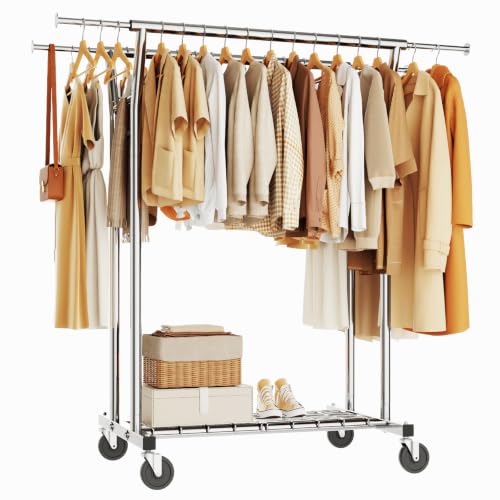
Light shirts and everyday outfits place different demands on a rack than winter coats, dresses, or boxed storage. The MISSLO SPJ-215-FT is aimed at compact storage but does not publish an overall numeric capacity. By contrast, the HYSEYY 700-LB rack, WATIOWL GR210A, and HYSEYY 620-LB rack publish much higher total capacities. Those designs are better candidates when the rack will hold a substantial wardrobe or serve a light commercial setting.
The HYSEYY 620-LB listing is useful for planning because it states separate figures for the double rods and bottom shelves. The SONGMICS wardrobe also provides separate rail and shelf figures. This kind of breakdown is more informative than a single headline number when you expect to combine hanging garments with shoes, boxes, or folded clothes.
Decide between single, double, and wardrobe layouts
A single rod is simple and leaves more open hanging height. The SLEEPING LAMB 43-inch rack is a wide single-rod design, while the MISSLO small rack is a narrower single-rod option with a mesh shelf and hooks. These layouts work when most items need one continuous rail or when floor width is limited.
Double rods divide clothes by type or length. The MISSLO 77-inch rack adds adjustable middle-rod placement, and the HYSEYY double-rod rack adds side rods and lower bars. Fixed rods, as used by the Sakugi USSKH0YJ022, favor a set arrangement and are described as helping prevent loosening. Adjustable rods offer more flexibility, but they also introduce more configuration decisions.
For shelf-heavy organization, the SONGMICS ULGR010BZ03S provides two hanging rods, seven shelves, and four S-hooks. It is closer to an open wardrobe than a basic rolling rail. Choose that format when folded clothing, boxes, shoes, and accessories need dedicated places.
Measure width, depth, and height
Measure the intended position, including clearance for doors, walking paths, and wheel movement. The widest selected designs are the HYSEYY 700-LB rack at 61.3 inches and the WATIOWL rack with an adjustable 41-to-61-inch rail. They provide more hanging area but need a larger footprint. The HYSEYY 450-LB rack can extend from 48.6 to 68.4 inches wide, so its maximum setting requires careful planning.
For tighter rooms, the MISSLO small rack measures 18.5 inches wide by 15.5 inches deep, while the Sakugi US621 is listed at 28 by 16.9 by 59 inches. Narrow designs conserve floor space but generally offer less total hanging area. Height matters for long garments: the 77-inch MISSLO rack is the tallest selected design, while the 63-inch SLEEPING LAMB rack and 60-inch Sakugi double-rod rack suit more moderate vertical clearance.
Check shelves, hooks, and garment stops
A rack with shelves can reduce the need for a separate shoe or storage unit. The WATIOWL uses two bottom mesh panels, the SLEEPING LAMB rack has a bottom shelf, and the selected Sakugi models use mesh shelving. Mesh can help retain smaller items compared with an open tube-only shelf, according to the supplied listings.
Hooks add another layer of organization. The MISSLO small rack includes two side hooks, while the SONGMICS wardrobe includes four S-hooks. When comparing racks, look for the exact accessory or shelf feature you will use rather than assuming every metal frame includes one.
Evaluate wheels and stationary control
Rolling racks are useful when clothes need to move between a bedroom, laundry area, or storage location. Most selected rolling models list four swivel or universal casters, and many specify two locking wheels. The HYSEYY 700-LB rack uses four 3-inch casters; the other selected rolling options emphasize 360-degree movement and locking control.
Wheel locks help keep a rack in position, but the supplied evidence does not establish performance on every floor type or under every load. Consider the floor surface, loaded width, and available turning space. A rack without documented casters, such as the SONGMICS wardrobe, may be preferable when a stationary open closet is the goal.
Review assembly and frame details
Assembly claims vary from tool-free snap connections to screw-based construction. The HYSEYY 450-LB rack states a five-minute snap assembly, WATIOWL states under ten minutes without tools, and the HYSEYY 700-LB rack states a 12-minute snap-button setup. Screw connections can require more hands-on work but may be chosen for a more fixed structure; Sakugi products document screw connections and provide tools or instructions.
Material details also matter. Several racks specify carbon steel, stainless-steel tubing, or all-steel tubes. The WATIOWL listing identifies 1-inch carbon-steel tubes, the HYSEYY 620-LB rack identifies thickened stainless-steel tubing, and the SLEEPING LAMB rack specifies 25.4-millimeter all-steel tubes. These are documented construction details, not independent durability-test results. Use them to compare designs while keeping the stated load and dimensions in view.
Final recommendation
WATIOWL GR210A 650-LB Rolling Rack ranks first overall in this specification-based comparison under the published weighted criteria.
WATIOWL GR210A 650-LB Rolling Rack is the highest-scoring returned product and the first overall specification-based choice.
The WATIOWL GR210A is one of the best metal garment racks here because it combines a high stated capacity with adjustable width, two mesh storage levels, locking casters, and tool-free assembly. The HYSEYY 700-LB Heavy-Duty Rolling Rack is a strong alternative for users prioritizing the highest stated capacity and dual rods. For flexible double-rod organization, the HYSEYY 620-LB model is a useful choice. Smaller rooms should look first at the MISSLO SPJ-215-FT or Sakugi US621, while the SONGMICS wardrobe is the better format for extensive shelving. These are the top metal garment racks here by documented specifications, not by hands-on testing or customer sentiment.
Frequently Asked Questions
Start with a published load capacity and confirm whether it applies to the whole rack or separate components. The HYSEYY 700-LB, WATIOWL 650-LB, and HYSEYY 620-LB models publish the highest overall figures in this selection. Also check the frame description, base design, rod arrangement, and wheel locks. Avoid treating a capacity claim as a guarantee for every loading pattern; distribute garments across the documented rods and shelves.
Are double-rod garment racks better than single-rod racks?
They are useful when you want to separate clothing by length, category, or household member. The MISSLO 77-inch rack uses a high and low arrangement with adjustable middle-rod placement, while the Sakugi USSKH0YJ022 uses fixed double rods. A single rod may be preferable for long garments or a simpler layout, especially when the rack is narrow or available height is limited.
How much space does a rolling garment rack need?
Use the listed width and depth as the starting footprint, then add clearance for turning and access. The selected compact options include the MISSLO small rack at 18.5 by 15.5 inches and the Sakugi US621 at 28 by 16.9 inches. Wider models such as the HYSEYY 700-LB rack need considerably more room. Measure the complete placement area before choosing an adjustable rack at its maximum width.
No. Shelf designs vary from a single lower mesh shelf to two mesh levels or a full open wardrobe with seven shelves. The WATIOWL, SLEEPING LAMB, Sakugi US621, Sakugi USSKH0YJ022, and SONGMICS models document lower storage. If you need shoes, folded clothing, or boxes, verify the shelf count and material in the listing rather than assuming a hanging rack includes one.
Are wheel locks important on a garment rack?
They are useful when you want a rolling rack to remain in place after repositioning it. Most selected rolling designs document two locking casters, including the HYSEYY and MISSLO models. Locks do not replace sensible loading or adequate floor clearance, and the supplied specifications do not provide independent testing for stability on every surface.