Buying Guide
The best moon phase wall clocks vary in what “moon phase” means. Some use a moving mechanical dial intended to follow the lunar cycle, while others show phase icons or incorporate a moon-phase scale into decorative artwork. A few combine lunar information with temperature, calendars, alarms, or lighting. Decide whether the moon display is the main reason for buying or an additional feature on a general-purpose clock.
Choose the type of lunar display
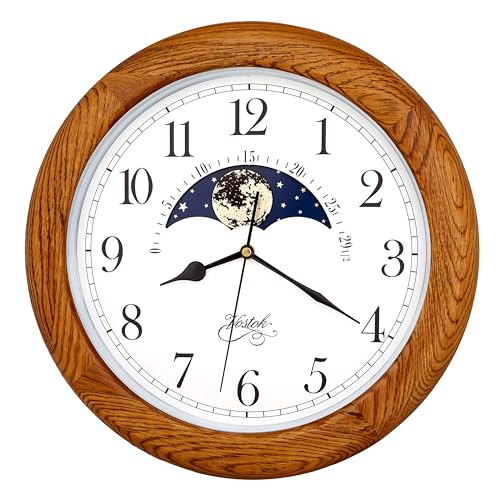
A dedicated analog tracker is the clearest choice when the lunar cycle should be central to the clock. Tabic Planeteco Moon Master describes a precision movement and informative dial, while JUSTIME documents a mechanical moving dial that follows the lunar cycle. Tabic Planeteco Garden Master takes a more specialized approach by presenting lunar information as a gardening reference.
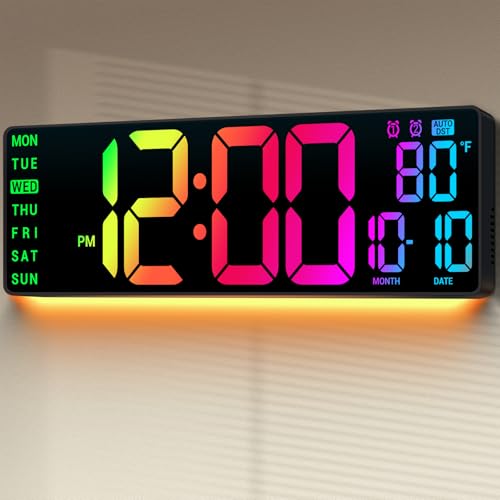
Digital clocks are more suitable when you want moon information alongside practical data. La Crosse 513-75624-INT lists a moon-phase display with atomic time, indoor and outdoor temperature, and large two-inch digits. La Crosse BBB86118-INT adds a calendar, temperature trends, alarms, and a curved gunmetal case. MARATHON uses moon-phase icons with time, temperature, a full calendar, and up to three alarms.
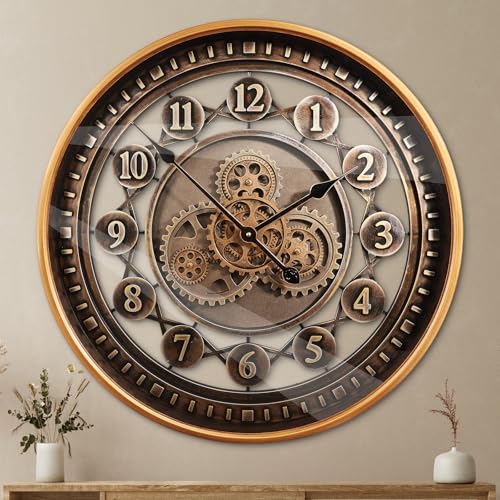
Decorative designs need closer interpretation. SOL PIXIE DUST is described as a moon-phase tracker, while IndieClock presents moon phases on a backlit vinyl record. The bmuvghi clock uses a celestial moon-phase pattern, but the listing does not document a moving lunar mechanism. QUANNIL includes a moon-phase scale as part of a double-sided corner clock. These distinctions matter if you want phase tracking rather than moon-themed appearance.
Check readability and size
Size should match viewing distance and available wall area. The bmuvghi clock is documented at 24 inches, making it a statement piece for a broad wall. JUSTIME measures 14 inches, and several decorative choices are approximately 12 inches. A larger diameter can make analog numerals easier to see, but it also requires more surrounding space.
Digital readability depends on the information layout and digit treatment. La Crosse 513-75624-INT specifically lists two-inch time digits and both 12-hour and 24-hour modes. MARATHON is compact, so it may be better for a nearby wall or smaller room than for reading across a large space. Consider whether you need a clock face visible at an angle, especially for corner installations such as QUANNIL.
Prioritize quiet operation where needed
Bedrooms, offices, and study areas often favor sweep or silent movements. JUSTIME, SOL PIXIE DUST, IndieClock, bmuvghi, and QUANNIL each document quiet or non-ticking operation. These descriptions support a quieter design choice, but they do not establish independent noise measurements.
The Tabic listings emphasize precision lunar movement, materials, and craftsmanship rather than explicitly stating non-ticking operation. If silence is essential, prioritize products whose supplied evidence directly names a silent sweep or non-ticking mechanism.
Compare materials and decorative style
Material affects visual character as much as construction. Tabic uses beechwood with dovetail joints and a glass lens, while JUSTIME specifies solid oak. IndieClock uses a vintage vinyl record, and bmuvghi uses wrought iron. These choices suit different interiors: wood can support traditional or natural décor, vinyl creates a music-oriented accent, and metal offers an industrial or statement-wall appearance.
The supplied evidence does not justify claims about long-term durability beyond the materials and construction stated by each listing. Treat handcrafted, solid wood, metal, and vinyl descriptions as design and specification information rather than proof of independent durability testing.
Review power and placement requirements
Battery operation is common among the analog selections. JUSTIME and bmuvghi list one AA battery, while SOL PIXIE DUST also lists one AA battery for the clock mechanism. Lighting can create a separate requirement: SOL PIXIE DUST uses USB power for optional RGB illumination, and IndieClock uses an eight-foot USB cable for its backlight while the clock movement uses one AA battery.
Digital multifunction models may need more batteries because of wireless sensors. The La Crosse clocks document separate sensor requirements, and MARATHON lists two AA batteries as included. QUANNIL is plug-in and uses remote-controlled lighting, so it may work best where an outlet and corner mounting position are convenient.
Match features to the room
For a bedroom, quiet movement and unobtrusive lighting may matter most. For a living room, size, materials, and visual impact can take priority. A kitchen or home office may benefit from temperature, calendar, and alarm functions. Garden Master is the most specialized option because its documented purpose relates to lunar gardening tasks.
Final Recommendation
JUSTIME 14-Inch Solid Oak Moon Phase Clock ranks first overall in this specification-based comparison under the published weighted criteria.
JUSTIME 14-Inch Solid Oak Moon Phase Clock is the first overall specification-based choice in this comparison.
The final choice among the best moon phase wall clocks depends on the documented features that match your intended use. JUSTIME combines a documented mechanical lunar movement, quiet sweep operation, solid oak construction, readable numerals, and straightforward battery operation. Tabic Planeteco Moon Master is a suitable alternative when dedicated lunar tracking and handcrafted beechwood construction matter more than explicitly documented quietness.
Choose La Crosse 513-75624-INT when atomic time, temperature, and large digital digits are more useful than traditional styling. For decorative lighting, SOL PIXIE DUST and IndieClock offer different illuminated approaches, while bmuvghi is intended for a large statement wall. Among the top moon phase wall clocks, the right choice depends on whether lunar tracking, utility, silence, lighting, or room-scale décor is the primary requirement.
Frequently Asked Questions
What makes the best moon phase wall clocks different from moon-themed clocks?
A moon-themed clock may show lunar artwork without documenting a changing phase display. In this comparison, Tabic Planeteco Moon Master and JUSTIME explicitly describe lunar-cycle tracking, while the La Crosse models and MARATHON document moon-phase information in digital displays. Decorative models such as bmuvghi document a celestial moon-phase pattern, so buyers should distinguish visual styling from an actual phase function.
Are moon phase wall clocks usually silent?
Not always. JUSTIME, SOL PIXIE DUST, IndieClock, bmuvghi, and QUANNIL explicitly list non-ticking, silent, or quiet movement. The supplied evidence for the Tabic clocks focuses on lunar precision and materials instead. If the clock will be placed near a bed or desk, select a model whose listing directly documents quiet operation.
La Crosse 513-75624-INT combines atomic time, indoor and outdoor temperature, a moon-phase display, large digits, and a wireless sensor. BBB86118-INT and MARATHON also add calendars, temperatures, and alarms, but their documented display details differ.
Do illuminated moon phase clocks need an outlet?
Illumination requirements vary. SOL PIXIE DUST uses USB power for its optional RGB lighting, and IndieClock uses USB power for its backlight while its clock movement uses a separate AA battery. QUANNIL is described as plug-in. Check cable length, adapter requirements, and the wall location before choosing an illuminated design.