Buying Guide
The best non-slip staircase step treads should be selected by stair surface and grip design, not appearance alone. The selected products fall into three main groups: rubber-backed loose-lay mats, carpet-style peel-and-stick treads, and clear adhesive covers. Each group addresses a different installation preference.
Start with the stair surface
Identify whether your stairs are smooth wood, tile, marble, glass, metal, concrete, or an outdoor textured material. OJIA documents use on smooth wood, tile, marble, and other flat indoor surfaces. Gmonby also lists smooth wood, tile, metal, and glass. Those claims are useful starting points, but the stairs still need to be clean and dry before placement.
For indoor stairs, rubber-backed products can avoid permanent adhesive. OJIA and PADOOR describe non-adhesive rubber backing placed directly on clean stairs. Lahome uses TPE backing and likewise says no adhesive is needed. This can suit shoppers who want to preserve the stair finish or remove the treads later. Loose-laid products should be checked for a close fit, especially on unusually smooth, narrow, or irregular steps.
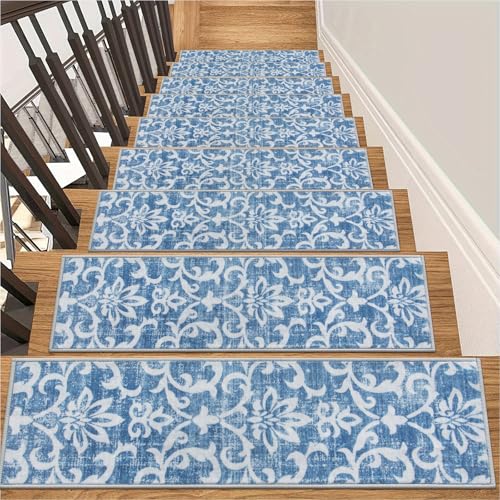
Adhesive-backed carpet treads create a more fixed installation. KOOTETA, PATTENGO, tchdio, and PADOOR’s 3D model describe peel-and-place application. Their listings also describe residue-free removal, but that does not eliminate the need for careful surface preparation. Dust, wax, moisture, or an uneven finish can affect how well an adhesive-backed tread seats.
Compare backing and traction
Backing is one of the most important specifications in this category. Rubber and TPE backing are documented on several selected products, while the clear STEPCORE and THUNDER GRIP models use adhesive placement. Carpet-style products may feel more comfortable, but a soft surface should not be treated as proof of superior traction. Review the stated backing, intended surface, and installation instructions together.
A textured or raised surface can add a different type of underfoot contact. PADOOR’s 3D model uses varying woven heights, while STEPCORE uses a clear grip-cover format. These designs address different priorities: visible texture and cushioning on one hand, and a less noticeable stair treatment on the other.
Measure before ordering
Many selected options use an 8-by-30-inch format. KOOTETA, PATTENGO, tchdio, Lahome, Gmonby, and both PADOOR listings document dimensions in or around that range. A 15-piece pack may cover a standard flight, but stair width and tread depth vary. Measure the usable horizontal area of every step, including any overhang, and compare it with the stated width and length.
Clear models are narrower. STEPCORE measures 6 by 30 inches, while THUNDER GRIP measures 6 by 24 inches. These may suit shoppers who prefer a transparent strip or whose step dimensions match, but they leave less covered area than an 8-inch tread. KOOTETA and PATTENGO document cutting guidance, which may help with unusual dimensions.
Decide between carpet, rubber, and clear designs
Carpet-style treads are the most comfort-oriented group in this comparison. PATTENGO, tchdio, Lahome, and Gmonby describe soft surfaces, cushioning, or noise reduction. PATTENGO’s listing includes an approximately 20% noise-reduction claim, but that is manufacturer-provided information rather than an independent measurement. tchdio emphasizes plush comfort and sound absorption, while Lahome describes moderate cushioning.
Rubber-backed options focus on simple placement and surface protection. OJIA and PADOOR describe non-adhesive backing, while OJIA also specifies machine washing and vacuum cleaning. These products may be a better match for a homeowner who does not want sticky backing, but confirm that the stair surface is among those documented by the listing.
Clear treads are the low-visibility choice. STEPCORE and THUNDER GRIP are designed to leave more of the original stair appearance visible. They can suit homes where a carpet runner would conflict with the décor, but their supplied evidence does not suggest the same cushioning or sound-softening characteristics as the carpet-style products.
Plan cleaning and removal
Cleaning details vary, so treat them as a selection criterion. Several carpet-style products document vacuuming and machine washing, including OJIA, KOOTETA, PATTENGO, tchdio, Lahome, Gmonby, and PADOOR. Care instructions differ, so check the individual listing before washing. Air drying may be required.
For removable treads, note whether the backing is adhesive or rubber. Adhesive-backed products may be repositionable or residue-free according to their listings, but removal should be slow and controlled. Rubber-backed products avoid adhesive residue by design. Either way, inspect the stairs after removal and keep reusable treads flat during storage.
Check indoor versus outdoor suitability
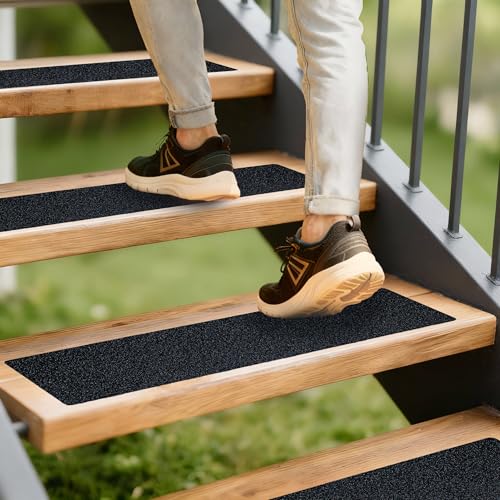
The selected top 10 are primarily indoor products. OJIA, KOOTETA, Gmonby, STEPCORE, and the carpet-style models describe indoor smooth surfaces. Do not assume that an indoor tread is appropriate for a wet porch, exposed deck, or exterior concrete stair. Outdoor candidates in the supplied pool use weather-resistant rubber or abrasive grit, but they have different comfort, fastening, and coverage trade-offs.
If your stairs are outside, look specifically for weather, water, temperature, and surface guidance. Outdoor products may also require different fastening methods than indoor carpet treads. For a covered interior stairwell, the selected indoor products provide the more directly documented fit.
Final Recommendation
OJIA Extra Non-Slip Rubber Stair Treads ranks first overall in this specification-based comparison under the published weighted criteria.
OJIA Extra Non-Slip Rubber Stair Treads is the highest-scoring returned product and the first overall specification-based choice.
Its rubber backing, no-adhesive placement, machine-washable construction, and broad smooth-surface guidance make it a balanced option for many indoor staircases. PADOOR Rubber Backing Stair Treads is an alternative for a dense-weave, non-adhesive carpet look, while PADOOR 3D Peel-and-Stick Stair Treads suits shoppers who want added visual texture and cushioning. KOOTETA is practical when trimming and easy maintenance matter. For softness, compare PATTENGO, tchdio, and Lahome. For a discreet appearance, STEPCORE and THUNDER GRIP are suitable options.
These top non-slip staircase step treads should not be treated as interchangeable. Match the backing to the stair finish, confirm the dimensions, and follow the supplied preparation and care instructions. The best non-slip staircase step treads for one home may be unsuitable for another if the surface, moisture exposure, or tread depth differs.
Frequently Asked Questions
How do I choose the best non-slip staircase step treads for smooth wood?
Start with products that explicitly document smooth wood use and identify their backing. OJIA, KOOTETA, Gmonby, and STEPCORE provide relevant indoor surface guidance. Decide whether you prefer non-adhesive rubber placement or a peel-and-stick tread, then measure each step before ordering.
Are rubber-backed stair treads better than adhesive-backed ones?
Neither design is universally better. Rubber-backed OJIA, PADOOR, and Lahome models avoid permanent glue and can simplify removal. Adhesive-backed KOOTETA, PATTENGO, tchdio, and STEPCORE models may provide a more fixed placement. The right choice depends on the stair finish, installation preference, and product guidance.
Can carpet stair treads be washed?
Several selected listings document vacuuming and machine washing, including OJIA, KOOTETA, PATTENGO, tchdio, Lahome, Gmonby, and PADOOR. Care instructions differ, so check the individual listing before washing. Air drying may be required, and washable claims should not be interpreted as permission to use any cleaning method.
What size stair tread should I buy?
Measure the usable tread area and compare it with the listed dimensions. Many selected carpet models measure about 8 by 30 inches, while STEPCORE and THUNDER GRIP are 6 inches wide. Products such as KOOTETA and PATTENGO document cutting guidance, but a cut piece should still provide the coverage you need.
Are these stair treads suitable for outdoor stairs?
Most selected products are described for indoor stairs and smooth indoor surfaces. Do not assume they are weatherproof. Outdoor stairs need a product whose listing specifically documents weather exposure, moisture, temperature, and the relevant surface type. Outdoor abrasive or rubber designs may also require different fastening methods than indoor carpet treads.