Buying Guide
Choosing the best office window films starts with the privacy problem rather than the appearance alone. A street-facing office may need a reflective film that preserves a daytime outward view, while a conference room or glass partition may need frosted coverage that obscures views more consistently. Review the window location, lighting balance, glass surface, and required amount of daylight before selecting a roll.
Choose reflective film for daytime privacy
Reflective one-way films are designed to look mirror-like from the brighter side while allowing the darker side to look outward. Coavas, FuFin, rabbitgoo One Way, SUNBABY, FILMGOO, and WPCTEV all document this general design. It can work well on exterior-facing office windows where daylight is stronger outside than inside.
This privacy method has an important limitation: it is not a permanent day-and-night screen. When interior lighting becomes stronger after sunset, the reflective effect may reverse or disappear. If a reception room, executive office, or meeting room must remain private after dark, use a frosted option such as rabbitgoo Frosted, Haton Frosted, or LOVEPEA instead, or plan for blinds or another interior covering.
Match the film to glare and solar exposure
Sun-facing offices need more than privacy. Infrared-control claims address heat entering through the glass, while UV-control claims relate to sun exposure and fading. The supplied listings document both types of control across several reflective films. Coavas and FuFin have especially broad solar-control descriptions, while rabbitgoo One Way, SUNBABY, FILMGOO, and WPCTEV also address heat, UV, or glare.
For desks with monitors, glare reduction can be as important as heat management. FILMGOO and WPCTEV directly position their reflective designs for screens and workspaces. A darker reflective appearance may reduce harsh light but can also change the room’s brightness. Check visible-light information when available and consider whether the office needs a clear view, filtered light, or stronger visual separation.
Pick frosted or reeded film for interior glass
Frosted films blur or block views instead of creating a mirror effect. They are often a better fit for meeting rooms, internal partitions, doors, and offices that require privacy under changing lighting. The rabbitgoo Frosted and Haton Frosted listings describe soft light with strong privacy positioning. LOVEPEA also combines a frosted finish with office applicability and cutting aids.
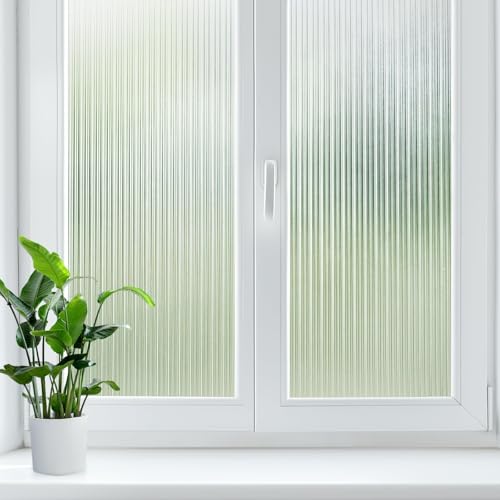
Reeded film adds a vertical patterned appearance. LUTE documents a reeded design and a 38% high light-transmission figure, making it a candidate when daylight is important but a clear view is not. Patterned films can provide visual interest, although the pattern should be coordinated with the office’s existing glass, furniture, and interior style.
Check installation method and glass compatibility
Static-cling film uses water rather than permanent glue. FILMGOO, WPCTEV, rabbitgoo One Way, rabbitgoo Frosted, Haton, LUTE, and LOVEPEA describe removable or reusable installation. This is useful for leased offices, temporary layouts, and teams that may need to reposition the film. Clean, smooth, flat glass is a recurring requirement, and textured, frosted, curved, or unsuitable panes may not accept every product.
Adhesive film has a different role. Coavas uses pressure-sensitive adhesive and PET construction, which may suit a longer-term installation, but removal and repositioning are less flexible. FuFin also specifies PET construction and includes tools. Regardless of film type, measure the glass carefully, allow trimming room where the instructions call for it, clean the surface thoroughly, and use sufficient water during application.
Plan roll coverage before ordering
Many selected products are supplied in rolls around 17.5 inches wide and roughly 78.7 inches long. That format can suit standard panes, doors, or smaller sections of office glass, but large windows may require multiple strips or a wider size.
Measure each pane separately and account for frames, handles, mullions, and seams. For a glass wall or long partition, a wider roll may create fewer joins. For small windows, a trimmable roll can be more practical. The film’s stated design matters too: one-way reflective products preserve a view only under suitable lighting, whereas frosted and reeded products trade the view for more consistent visual privacy.
Compare the installation kit contents
Tools can make a difference when several panes need coverage. Coavas, FuFin, Haton, and LOVEPEA list tools or installation accessories, while other products explain water-and-squeegee application. A kit does not remove the need for careful preparation, but it can reduce the need to source a scraper, cutter, or spray bottle separately.
For a professional-looking result, clean dust and residue from the glass, cut accurately, peel backing carefully, and push water and air outward with a squeegee. Large panes may be easier with a second person. Static-cling products can usually be repositioned while wet, but follow the supplied product directions rather than assuming every film behaves identically.
Final recommendation
rabbitgoo One Way Privacy Window Film ranks first overall in this specification-based comparison under the published weighted criteria.
Coavas One Way Privacy Window Film is the highest-scoring returned product and the first overall specification-based choice. Its adhesive PET construction, stated solar-control figures, office-partition applicability, and included tools give it the broadest documented package for a lasting installation.
Among the top office window films, FuFin is a strong alternative for PET construction and an included kit, while rabbitgoo One Way and SUNBABY suit offices seeking removable reflective privacy. Choose FILMGOO or WPCTEV when screen glare is central. For consistent privacy in meeting rooms, Haton Frosted, rabbitgoo Frosted, or LOVEPEA are more suitable than one-way mirror designs. LUTE is the decorative daylight-oriented choice when a reeded appearance fits the space.
The best office window films still depend on the window’s lighting, surface, dimensions, and privacy schedule. Confirm whether privacy is needed only during the day, select a compatible film type, and measure before ordering.
Frequently Asked Questions
Are the best office window films private at night?
Not all of them. Reflective one-way films from Coavas, FuFin, rabbitgoo One Way, SUNBABY, FILMGOO, and WPCTEV depend on exterior light being brighter than interior light. After dark, indoor lighting can reduce or reverse the mirror effect. Frosted products such as Haton Frosted, rabbitgoo Frosted, and LOVEPEA are better suited to consistent privacy because they obscure views rather than relying on a lighting balance.
Which film is better for office computer screens?
FILMGOO and WPCTEV directly describe glare reduction for workspaces, monitors, tablets, or similar screens. Other reflective options also document glare or solar control, but screen performance will depend on window direction, desk placement, room lighting, and the film’s visible-light characteristics. Test a small section or use a sample when the exact screen environment is critical.
Can office window film be removed?
Many selected films use static cling and are described as removable, residue-free, or reusable. This includes rabbitgoo One Way, FILMGOO, WPCTEV, rabbitgoo Frosted, Haton, LUTE, and LOVEPEA. Coavas uses pressure-sensitive adhesive, so it may be a better long-term installation but is less flexible to remove. Always follow the product instructions and apply films only to compatible smooth glass.
Does frosted film block all office daylight?
The selected frosted films are described as allowing soft or natural light through, but they obscure the outdoor view. LUTE provides an explicit 38% high light-transmission specification for its reeded design. Actual room brightness will depend on window orientation, existing tint, interior lighting, and the film’s finish. Frosted film is generally a privacy-and-diffusion solution rather than a clear-view solution.
How should office window film be measured?
Measure the visible glass area of every pane, including width and height, and account for frames or obstructions. Compare those measurements with the roll dimensions and allow trimming room where the listing recommends it. For wide panes, look for a wider roll or plan seam placement. Clean, smooth glass is important for both adhesive and static-cling installation.