Buying Guide
Choosing among the best car oil pressure gauge sets starts with identifying whether you need a temporary diagnostic instrument or a permanently installed monitor. The OTC 5610, YSTOOL kit, LEIMO KPARTS tester, and Yonligonju tester are service tools: they use a hose, fittings, and adapters to connect at an engine test point. GlowShift, JJCOCO, TCHENPART, and ZHSYMX are cabin-oriented gauges that use an electronic sensor and vehicle wiring. The Auto Meter 2392 and 2397 use mechanical gauge designs with tubing and console hardware.
Decide between a tester and an installed gauge
A tester is appropriate when the goal is to measure pressure during diagnosis, compare readings at a test port, or check an engine without cutting a permanent dashboard opening. Tester kits generally provide more adapters than installed gauges. The OTC 5610 goes furthest, with separate high- and low-pressure gauges and 13 adapters. YSTOOL and LEIMO KPARTS each document 10 adapters, while Yonligonju also lists 10 adapters and two quick-fitting styles.
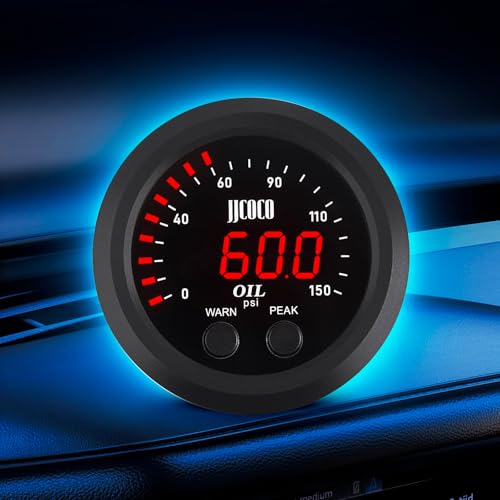
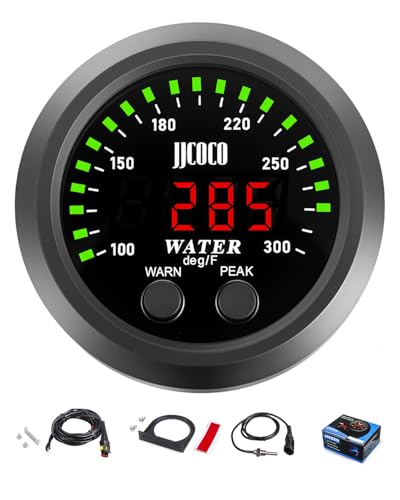
An installed gauge is intended to remain in the vehicle and show pressure while driving or operating equipment. Electronic options require a sensor and power connection. JJCOCO and ZHSYMX add peak recall and warning functions, while GlowShift and TCHENPART emphasize adjustable illumination. A mechanical installation uses a physical pressure line instead of relying on an electronic display signal. Auto Meter’s 2392 and 2397 are the selected examples of that design.
Match the pressure range to the job
Do not assume that a larger number is automatically more suitable. A gauge should cover the pressure you expect while retaining a readable scale. The selected diagnostic kits use 0-140 psi ranges except for the OTC 5610, whose high-pressure gauge reaches 400 psi and whose low-pressure gauge reaches 100 psi. The installed options range from 0-100 psi on GlowShift and the Auto Meter models to 0-150 psi on JJCOCO and ZHSYMX. TCHENPART covers 0-140 psi.
The listing data does not establish measurement accuracy for any model, so these ranges should be treated as selection specifications rather than test results. If your vehicle documentation calls for a particular pressure or fitting, verify that the selected gauge and connection method cover it before installation.
Check the connection method and adapters
Thread compatibility is one of the most important practical checks. Tester kits can offer several adapters, but the adapter still has to match the engine’s test port. Installed electronic gauges generally document a sensor thread instead: GlowShift lists a 1/8-27 NPT pressure sensor, while JJCOCO and ZHSYMX list 1/8-inch NPT sensor mounting. The included sensor does not remove the need to verify the vehicle-side connection.
For a mechanical gauge, the tubing route matters as much as the console. Auto Meter 2392 includes six feet of tubing and several NPT fittings. Auto Meter 2397 also lists multiple NPT fittings, but the supplied evidence does not specify the tubing length. Plan a route that avoids heat, sharp edges, and moving parts, and follow the product instructions. These are installation considerations, not claims about performance.
Compare display and lighting features
A large analog dial can be useful for quick visual tracking, while a digital center readout can show an exact displayed number. The OTC, LEIMO KPARTS, YSTOOL, and Yonligonju products list 3-inch or 3-1/2-inch gauges, with dual scales documented on several tester models. JJCOCO and ZHSYMX combine numeric LED displays with sweeping needle graphics. That combination may appeal to drivers who want both a number and a trend indication.
Lighting is another point of separation. GlowShift and TCHENPART list seven color choices, and the GlowShift kit also lists two color-cycle modes and a dimmer connection. The Auto Meter products use bulb illumination with red and green covers. The triple-reading Auto Meter 2397 adds voltage and water information, but it is a different layout from a single oil-pressure monitor.
Consider storage and workshop organization
If the gauge will live in a toolbox or vehicle, account for the accessories. OTC includes a blow-molded hard case with a removable lid. YSTOOL lists a portable toolbox, and LEIMO KPARTS lists a molded case. These provisions can keep adapters, hoses, and couplers together. Yonligonju documents the gauge, hose, fittings, and adapters but does not list a case in the supplied evidence.
Cabin gauges have a different organization concern: wiring, sensor placement, and mounting depth. ZHSYMX specifically documents a depth under 18.8mm, which may matter where space behind the panel is limited. GlowShift includes a visor and bracket, while JJCOCO lists a bracket and wiring diagram. TCHENPART lists a U-holder and hardware. Confirm the opening size and available rear clearance before committing to a 52mm or 2-1/16-inch gauge.
Review the included parts before installation
Make an inventory before beginning. For a tester, check the hose, couplers, adapters, seals, and case. For an electronic gauge, check the sensor, harness, bracket, power requirements, and instructions. For a mechanical gauge, check tubing, fittings, bulb hardware, and the console. A complete-looking title is not a substitute for the detailed included-parts list, so use the supplied specifications for the exact model.
Also separate documented facts from assumptions. The listings identify ranges, threads, display features, and materials, but they do not provide independent accuracy measurements or hands-on durability results. This comparison therefore ranks specification coverage and installation practicality, not measured performance.
Final Recommendation
OTC 5610 Transmission and Engine Oil Pressure Tester ranks first overall in this specification-based comparison under the published weighted criteria.
OTC 5610 Transmission and Engine Oil Pressure Tester is the first overall specification-based choice among these best car oil pressure gauge sets because it combines two pressure ranges, 13 adapters, quick couplers, protective boots, hanging hooks, instructions, and a hard case. It is the most complete option here for diagnostic work across engine and transmission applications.
For a compact engine tester, YSTOOL and LEIMO KPARTS both document 10 adapters, a 4-foot hose, and a 0-140 psi dual-scale gauge. YSTOOL adds a portable toolbox and replacement gaskets, while LEIMO KPARTS lists a molded case. Choose between them by the storage and accessory details that fit your workflow.
For permanent cabin monitoring, JJCOCO and ZHSYMX are the most feature-oriented selections because both document 0-150 psi readings, peak recall, and warning controls. ZHSYMX is especially notable where shallow mounting depth matters. GlowShift and TCHENPART are more focused on adjustable backlighting, with seven-color display options documented for each.
If the vehicle has limited electrical power or a classic-style installation, Auto Meter 2392 and 2397 use mechanical designs. The 2392 focuses on oil and water, while the 2397 adds voltage. In every case, verify the vehicle connection, pressure range, gauge opening, power or tubing route, and included fittings before installation. Those checks will help narrow the top car oil pressure gauge sets to a format suited to the actual diagnostic or monitoring task.
Frequently Asked Questions
What are the best car oil pressure gauge sets for engine diagnosis?
The OTC 5610, YSTOOL, LEIMO KPARTS, and Yonligonju products are diagnostic tester kits rather than dashboard-only gauges. They include hoses and multiple adapters, with pressure ranges documented up to 140 psi on the latter three. OTC is differentiated by its separate 0-400 psi and 0-100 psi gauges and 13 adapters. Match the adapter and pressure range to the engine’s test port and specified operating range.
Are electronic or mechanical oil pressure gauges easier to match to a vehicle?
Neither format is universally easier. Electronic models need a compatible sensor connection and vehicle power; JJCOCO and ZHSYMX list 12V/24V DC operation and 1/8-inch NPT sensor mounting. Mechanical models use tubing and fittings; Auto Meter 2392 and 2397 list multiple NPT fittings. The available mounting space, wiring access, and preferred installation method should guide the choice.
Do all selected gauges use the same pressure range?
No. GlowShift and both selected Auto Meter models document 0-100 psi oil-pressure scales. TCHENPART, YSTOOL, LEIMO KPARTS, and Yonligonju document 0-140 psi, while JJCOCO and ZHSYMX document 0-150 psi. OTC provides both a 0-100 psi low-pressure gauge and a 0-400 psi high-pressure gauge. Confirm the required range before selecting a set.
What should be checked before installing a 52mm gauge?
Check the panel opening, rear clearance, sensor thread, wiring path, and the supplied bracket or holder. GlowShift, TCHENPART, JJCOCO, and ZHSYMX are listed as 52mm or 2-1/16-inch formats, but their included hardware and power details differ. ZHSYMX documents an under-18.8mm depth, while the other listings emphasize different mounting parts or display features.
Can a tester kit remain installed in the vehicle?
The selected tester kits are described for testing and diagnosis, with hoses, couplers, adapters, and storage cases. They are not presented in the supplied evidence as permanent dashboard monitors. For continuous in-vehicle monitoring, use an installed electronic or mechanical gauge whose sensor, wiring or tubing, and mounting components are intended for that installation approach.