Buying Guide
The best pass-through av receivers sit between source devices and a television or projector, routing video while handling audio amplification and decoding. The right choice depends less on a single headline specification than on how many sources you connect, which display formats you use, how many speakers you plan to install, and whether you need network or multi-room features.
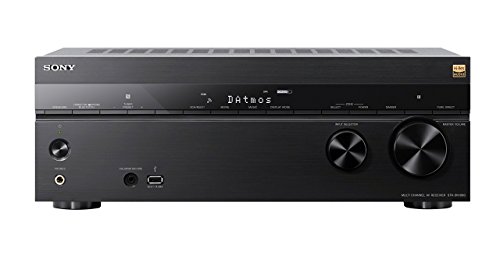
Check the receiver’s documented pass-through capability against the display and source devices. A 4K system may be well served by the Sony STR-DH790, Sony STR-DN1080, or Yamaha RX-V385. Their listings identify 4K or 4K HDR handling, with the Sony STR-DH790 also naming Dolby Vision, HDR10, and HLG.
For newer televisions, consoles, or projectors, an 8K-capable HDMI section gives more headroom. The Denon AVR-X2800H lists 8K/60Hz pass-through and three 8K inputs, while the Denon AVR-X1700H lists three dedicated 8K inputs plus 4K/120Hz support. Yamaha RX-V6A, Sony STR-AN1000, Onkyo TX-NR6100, Denon AVR-S570BT, and Pyle PT890BT also document newer HDMI or 8K features. Confirm that the specific input and output combination supports the signal you intend to route; an 8K label alone does not describe every port equally.
Match channels to the speaker plan
A 5.1 or 5.2 receiver is a sensible match for five main channels and one or two subwoofers. The Denon AVR-S570BT and Yamaha RX-V385 fit that conventional arrangement. The Sony STR-DH790 and Sony STR-DN1080 move to 7.2 channels, which can support a wider surround layout or provide more flexibility for compatible processing.
If overhead or height effects are part of the plan, look for explicit format support rather than assuming that a high channel count guarantees it. The Denon AVR-X2800H and AVR-X1700H list Dolby Atmos and DTS:X, while the Sony STR-DH790, Sony STR-DN1080, Yamaha RX-V6A, Sony STR-AN1000, and Onkyo TX-NR6100 also document immersive formats. The Onkyo specifically lists 5.2.2-channel Dolby Atmos and DTS:X playback. The Pyle PT890BT lists nine channels, but the supplied evidence does not name Dolby Atmos or DTS:X, so its channel count should not be treated as equivalent to documented object-based decoding.
Count every source before choosing a receiver. A television, streaming device, disc player, game console, and cable box can quickly use four or more HDMI inputs. The Denon AVR-X2800H provides six HDMI inputs and two outputs, and the Sony STR-AN1000 also lists six inputs and two outputs. The Sony STR-DN1080 lists six inputs and two outputs as well. These layouts are useful when a display and another output device must remain connected.
The Denon AVR-S570BT lists four HDMI 2.1 inputs and one output, while the Yamaha RX-V385 and Sony STR-DH790 each list four HDMI inputs and one output. That can be sufficient for a smaller system, but leave room for future sources. Also check whether eARC is listed if you want audio from compatible television apps to return through the receiver. The Denon AVR-X2800H, AVR-X1700H, Yamaha RX-V6A, and Denon AVR-S570BT document eARC.
Consider gaming and HDR support
Gamers should inspect the listed refresh-rate and signal features, not just the resolution. The Denon AVR-S570BT specifies 4K/120-related support, VRR, and QFT. The Denon AVR-X1700H and Sony STR-AN1000 also list 4K/120 support. Yamaha RX-V6A documents 4K120AB, while the newer HDMI claims on the Onkyo TX-NR6100 and Pyle PT890BT may appeal to systems built around current source hardware.
HDR compatibility also matters for the complete source-to-display path. Denon AVR-X2800H, Denon AVR-X1700H, Denon AVR-S570BT, Sony STR-AN1000, Yamaha RX-V6A, and Yamaha RX-V385 list combinations of Dolby Vision, HDR10, HLG, or HDR10+. Match those formats with the source and display specifications.
Review streaming and control needs
Bluetooth is useful for direct playback from a phone or computer, and it appears on many products here, including the Denon AVR-S570BT, Sony STR-DH790, Yamaha RX-V385, and Pyle PT890BT. Networked receivers add broader control and multi-room options. The Denon AVR-X2800H and AVR-X1700H list HEOS, Wi-Fi, and Bluetooth; the Yamaha RX-V6A lists MusicCast, Wi-Fi, AirPlay 2, Spotify Connect, and voice control; and the Sony STR-DN1080 lists Chromecast, AirPlay, Google Home compatibility, and multi-room connectivity.
Choose the platform that matches devices already in your home. A receiver with many streaming services is less useful if the control method is unfamiliar or incompatible with your preferred ecosystem.
Automatic calibration can simplify speaker setup. The Sony STR-DH790 lists D.C.A.C. calibration, the Yamaha RX-V385 lists YPAO, the Yamaha RX-V6A lists YPAO R.S.C. multipoint, and the Sony STR-AN1000 lists Digital Cinema Auto Calibration IX and 360 Spatial Sound Mapping. These are documented setup features, not a substitute for checking speaker placement and room constraints.
Expansion may include second-zone playback, extra subwoofer outputs, or multiple HDMI outputs. The Denon AVR-X2800H lists dual subwoofer outputs, the Denon AVR-X1700H lists two subwoofer pre-outs, and the Onkyo TX-NR6100 and Sony STR-DN1080 document zone connectivity. These details matter when the receiver must serve more than one listening area or a larger speaker arrangement.
Final Recommendation
Denon AVR-X2800H ranks first overall in this specification-based comparison under the published weighted criteria.
Denon AVR-X2800H is the highest-scoring returned product and the first overall specification-based choice among the best pass-through av receivers. Its combination of 8K/60Hz pass-through, three 8K inputs, six HDMI inputs, two outputs, immersive decoding, dual subwoofer outputs, HEOS, Wi-Fi, Bluetooth, and phono connectivity gives it the broadest documented role in this comparison.
The Denon AVR-X1700H is a close alternative for a 7.2-channel system that needs 8K inputs, 4K/120Hz support, HEOS, and multi-room control. Choose Yamaha RX-V6A when MusicCast and network services are central. The Sony STR-AN1000 is especially relevant when six HDMI inputs and two outputs are priorities, while Onkyo TX-NR6100 is the focused pick for documented THX Select, 5.2.2 playback, and Zone 2.
For simpler layouts, Denon AVR-S570BT offers a capable 5.2-channel foundation with modern HDMI 2.1 inputs. Sony STR-DH790 is notable for its low-profile immersive design, Yamaha RX-V385 for straightforward YPAO-assisted 5.1 setup, and Pyle PT890BT for its nine listed amplification channels and varied physical inputs. Together, these top pass-through av receivers cover compact, connected, immersive, multi-zone, and high-channel-count designs without treating one specification as suitable for every room.
Frequently Asked Questions
What should I check first when choosing the best pass-through av receivers?
Start with the display and source requirements: resolution, refresh rate, HDR formats, HDMI version, eARC, and the number of inputs and outputs. Then match those requirements to the receiver’s speaker-channel layout and audio formats. For example, the Denon AVR-S570BT documents four HDMI 2.1 inputs, eARC, 8K support, and 4K/120-related gaming features, while the Yamaha RX-V385 is a simpler 5.1 model with 4K HDR support.
Is an 8K receiver necessary for a 4K television?
Not necessarily. A 4K display can work with a receiver such as the Sony STR-DH790, Sony STR-DN1080, or Yamaha RX-V385 when their documented 4K capabilities match the connected sources. An 8K-capable model may be more suitable if your sources or future display plans require 8K, 4K/120, or newer HDMI features. Always verify the formats supported by the exact inputs and outputs you will use.
Does more amplification channels automatically mean better surround sound?
No. Channel count describes available amplification or processing capacity, but the supported surround formats and your speaker layout also matter. The Pyle PT890BT lists nine channels, yet the supplied evidence does not identify Dolby Atmos or DTS:X. Conversely, the Onkyo TX-NR6100 explicitly lists 5.2.2 Dolby Atmos and DTS:X playback, and the Denon AVR-X2800H documents Dolby Atmos, DTS:X, and virtual height options.
Which receiver features help with a multi-room system?
Look for documented zone outputs or multi-room platforms. Denon AVR-X2800H and AVR-X1700H list HEOS, while Yamaha RX-V6A lists MusicCast. Sony STR-DN1080 documents multi-room connectivity and second- and third-zone capability, and Onkyo TX-NR6100 lists discrete Zone 2 audio and video. These features differ, so match the receiver to the devices and rooms you intend to connect.
Do I need automatic room calibration?
It can help organize the setup, especially when speaker distances and room positions vary, but it is not mandatory for every installation. Yamaha RX-V385 lists YPAO, Yamaha RX-V6A lists YPAO R.S.C. multipoint, Sony STR-DH790 lists D.C.A.C., and Sony STR-AN1000 lists Digital Cinema Auto Calibration IX with 360 Spatial Sound Mapping. Treat calibration as a documented convenience and still follow the receiver’s installation instructions.