Buying Guide
Choosing among the best streaming av receivers starts with the system you want to build, not with a single headline specification. Count the speakers you use now, identify the sources that need HDMI switching, and decide whether music must reach additional rooms. The receivers below cover compact seven-channel systems through advanced layouts with multiple subwoofers and height speakers.
Match processing channels to the speaker layout
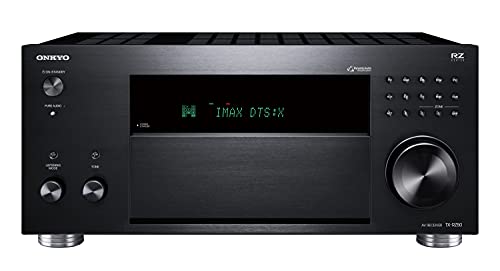
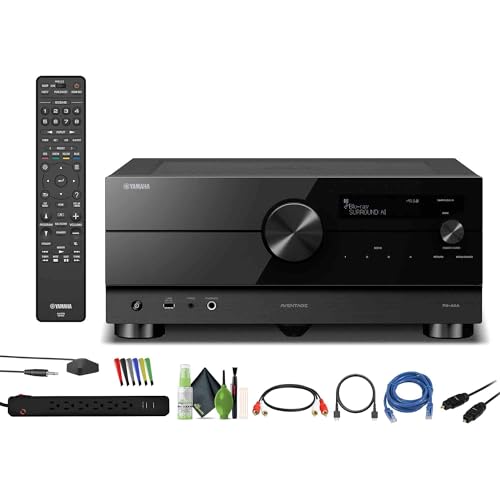
Channel count describes how many amplifier or processing positions the receiver can address, but the listings do not all describe it in exactly the same way. The Yamaha RX-A8A documents 11.2-channel capability, while the Yamaha RX-A6A and Denon AVR-X4800H provide 9.2 and 9.4 channels respectively. The Onkyo TX-RZ50 lists 11.2 channels of processing and pre-outs for a 7.2.4 system.
For a conventional surround system, seven processing channels can cover layouts such as 5.1 or 7.1. The Denon AVR-S980H and Sony STR-AN1000 are examples in this group. If you want overhead effects, the Onkyo TX-NR6100 documents 5.2.2 playback, while the Onkyo TX-NR7100 supplies nine processing channels. More channels can also help when you plan to use external amplification or separate listening zones, but the receiver, speaker layout, and room should be considered together.
Check streaming and multi-room compatibility
Streaming features vary considerably even when two receivers have similar surround formats. Yamaha’s MusicCast platform appears on the RX-A8A, RX-A6A, RX-A4A, and RX-V6A, with Wi-Fi, Bluetooth, and additional services or protocols depending on the model. Denon uses HEOS on the AVR-X4800H and AVR-S980H, with the listings describing multi-room playback to compatible speakers.
The Sony STR-AN1000 lists Chromecast built-in, Spotify Connect, Apple AirPlay, Wi-Fi, and Bluetooth. The Onkyo TX-RZ50 and TX-NR7100 list Bluetooth, DTS Play-Fi, and Sonos certification. The TX-NR6100 listing supplies fewer network-streaming details, so it is better evaluated primarily on its HDMI, THX, and surround specifications. Confirm that your preferred phone platform, music service, and multi-room speakers fit the receiver’s documented ecosystem.
Evaluate HDMI for displays and gaming
Modern HDMI support matters when the receiver sits between a console or media player and a television or projector. Several of the best streaming av receivers list 8K/60 and 4K/120 support. The Yamaha RX-A4A specifies that all HDMI inputs support those formats at 40 Gbps and also lists VRR and ALLM. The Denon AVR-S980H adds VRR, ALLM, and AMD FreeSync, while the Onkyo TX-NR7100 and TX-RZ50 document HDMI 2.1, 4K/120, and 8K support.
Also count inputs and outputs. The Denon AVR-X4800H lists 10 HDMI ports, with seven inputs and three outputs. The Yamaha RX-A6A lists seven inputs and three outputs, and the Sony STR-AN1000 lists six inputs and two outputs. Multiple outputs can be useful for a television and projector or for separate zones, but eARC is also important when the television is the source of streaming-app audio.
Dolby Atmos and DTS:X are common across this selection, but some models document additional formats. The Denon AVR-X4800H lists DTS:X Pro, IMAX Enhanced, and Auro 3D. Yamaha’s RX-A8A adds CINEMA DSP HD3 and Surround:AI, while the RX-A4A lists Auro-3D and Surround:AI. Onkyo’s TX-RZ50 and TX-NR7100 include Dolby Atmos and DTS:X, with the listings also describing virtual height options.
Do not assume that a format list determines the final result in every room. Speaker placement, available channels, and the receiver’s calibration system all affect how a compatible layout can be configured. Use the format information to confirm compatibility with your discs, games, streaming devices, and planned speakers.
Room calibration is particularly useful when the listening space, speaker positions, or furnishings make manual setup difficult. Yamaha lists YPAO-R.S.C. on the RX-A8A, RX-A6A, RX-A4A, and RX-V6A, including multipoint or 3D measurement on several models. Denon lists Audyssey calibration on the AVR-S980H, and Sony lists Digital Cinema Auto Calibration IX with 360 Spatial Sound Mapping on the STR-AN1000.
Onkyo’s TX-RZ50 and TX-NR7100 specify Dirac Live. The listings say setup can use the included wired microphone, while computer-based workflows may use a compatible third-party USB microphone. That distinction matters when planning installation. Calibration is not a substitute for selecting suitable speakers and placing them correctly, but it is a meaningful differentiator between receivers with otherwise similar channel and HDMI specifications.
Consider zones, pre-outs, and physical installation
A receiver may serve more than the main theater. The Yamaha RX-A4A includes Zone 2, the Onkyo TX-NR6100 documents discrete Zone 2 audio and video, and the Denon AVR-X4800H lists four RCA/XLR subwoofer outputs. The Onkyo TX-RZ50’s pre-outs support a 7.2.4 layout, which can matter if external amplification is part of the plan.
Finally, check the cabinet dimensions and ventilation space. The larger Yamaha AVENTAGE models are substantially deeper and heavier than several alternatives, while the Onkyo and Sony listings show different chassis dimensions. Leave room for cables, airflow, and access to rear-panel connections rather than choosing solely by channel count.
Final Recommendation
Yamaha AVENTAGE RX-A8A ranks first overall in this specification-based comparison under the published weighted criteria.
The final choice among the best streaming av receivers depends on the documented features that match your intended use.
The Yamaha AVENTAGE RX-A8A is the highest-scoring returned product and the first overall specification-based choice for a large, feature-rich home theater. Its 11.2-channel processing, MusicCast streaming, extensive video support, Dolby Atmos and DTS:X decoding, and multipoint YPAO R.S.C. calibration cover the widest range of documented system needs.
Among the top streaming av receivers, the Onkyo TX-RZ50 is a strong fit when Dirac Live, THX certification, and 11.2-channel processing matter most. The Denon AVR-X4800H is the more connection-focused alternative, with 10 HDMI ports, four subwoofer outputs, HEOS, and unusually broad immersive-format support.
For a seven-channel system, compare the Yamaha RX-A4A, Denon AVR-S980H, Sony STR-AN1000, Onkyo TX-NR6100, and Yamaha RX-V6A according to streaming ecosystem, gaming connections, calibration, and planned speaker layout. The right selection is the one whose documented inputs, outputs, processing, and wireless platform align with the equipment you will actually connect.
Frequently Asked Questions
Among the best streaming av receivers, what makes a receiver suitable for streaming?
A suitable model should document a network or wireless path for audio, such as Wi-Fi, Bluetooth, AirPlay 2, Chromecast built-in, Spotify Connect, MusicCast, HEOS, DTS Play-Fi, or another listed service platform. The Yamaha RX-V6A, Denon AVR-S980H, and Sony STR-AN1000 illustrate different approaches. Check both the services you use and whether multi-room playback is required.
Do all of these receivers support 8K video?
No. The selected models with documented 8K support include the Yamaha RX-A8A, RX-A6A, RX-A4A, and RX-V6A; the Onkyo TX-RZ50, TX-NR7100, and TX-NR6100; the Denon AVR-X4800H and AVR-S980H; and the Sony STR-AN1000. Always check the stated refresh-rate and HDMI details, not only the resolution label.
How many channels do I need for Dolby Atmos?
The answer depends on the speaker layout. The Onkyo TX-NR6100 documents a 5.2.2 configuration, which adds two height channels to a five-channel bed. Receivers with more processing channels, such as the Yamaha RX-A8A or Onkyo TX-RZ50, can support more elaborate layouts when the rest of the system is compatible. Count the intended bed, height, and subwoofer arrangement before selecting a receiver.
Is room calibration included on these models?
The listings document YPAO-R.S.C. for the Yamaha RX-A8A, RX-A6A, RX-A4A, and RX-V6A; Audyssey for the Denon AVR-S980H; Digital Cinema Auto Calibration IX for the Sony STR-AN1000; and Dirac Live for the Onkyo TX-RZ50 and TX-NR7100. The Denon AVR-X4800H listing does not provide a named calibration system in the supplied evidence, so that feature should be verified separately if it is important to your setup.