Buying Guide
The best plastic cable ties are selected by matching the tie’s documented dimensions and construction to the bundle, rather than by choosing the longest item automatically. A narrow 8-inch tie can be appropriate for organized cable runs, while a 16-, 18-, or 20-inch tie may be needed when the bundle is wide or the tie must reach around an object. The listings in this comparison provide different combinations of length, width, tensile-strength claims, tooth patterns, environmental specifications, and pack sizes.
Start with length and bundle diameter
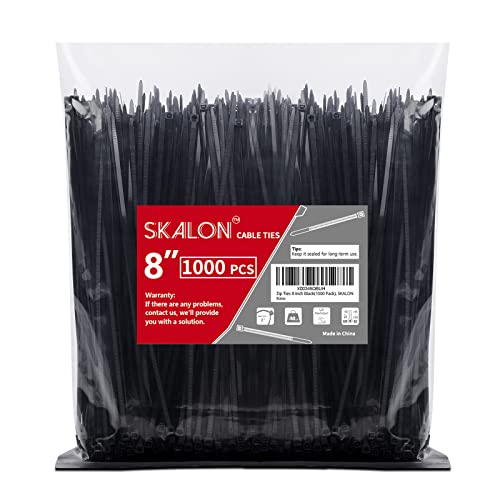
Length determines how much material is available to wrap around a bundle, but the listed maximum bundle diameter is the more useful reference when it is supplied. SKALON’s 8-inch model lists a 2-inch maximum bundle diameter, while ANOSON’s 18-inch model lists 5 inches. The yoyoellafa 20-inch tie also lists a 5-inch maximum diameter. These figures help separate ordinary cable organization from larger outdoor or workshop tasks.
Assorted packs address projects with changing dimensions. SiKuLin includes 4-, 6-, 8-, and 12-inch ties, making it suited to small and medium jobs. JIANYANG’s selected assorted pack covers 8, 12, 14, and 18 inches, while Doubtie combines 12- and 18-inch pieces. An assortment can reduce the need to use excess tail length on a small bundle, but it may not provide enough compact ties if most of the work involves thin wires.
Compare tensile capacity with tie width
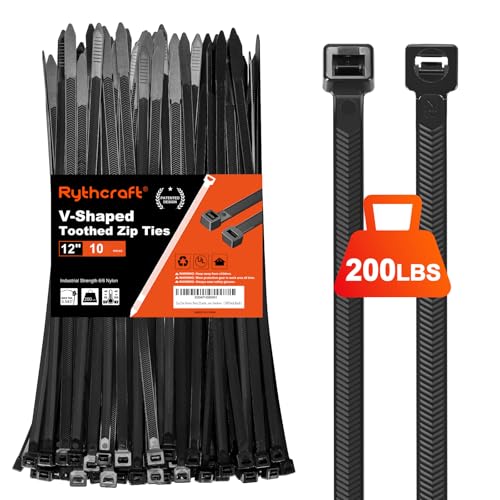
Tensile strength is a stated product specification, not a promise of performance in every installation. The supplied listings generally connect greater width and thickness with higher capacity. Rythcraft lists a 0.3-inch width, 0.076-inch thickness, and 200-pound tensile strength. XINGO lists a 0.36-inch width and 200-pound capacity, while yoyoellafa lists a 12 mm width and 250-pound capacity. These wide profiles are designed around large bundles and demanding tie-down tasks.
For general cable management, a lower stated capacity may be sufficient. SiKuLin lists an 18- to 45-pound range across its four sizes, SKALON lists 40 pounds, and RAZCC lists 70 pounds for its 12-inch format. The right comparison depends on bundle size and the load being secured. Avoid treating a tensile figure as a substitute for proper installation, suitable attachment points, or an assessment of the surrounding material.
Check nylon and environmental claims
Material details matter when ties will remain outdoors or face temperature changes. Several selected products identify nylon 66 or nylon 6/6 construction. RAZCC, SKALON, XINGO, JIANYANG, Doubtie, and yoyoellafa also provide UV, weather, temperature, fire, or waterproof claims in their supplied evidence. SiKuLin lists a temperature range from -40°F to 185°F and states UV resistance. Those details can help narrow choices for garden, patio, garage, and workshop applications.
The evidence varies by product, so compare only the conditions actually documented. A tie described for indoor and outdoor use is not automatically identical to one with a stated temperature range, UV-resistance claim, and specific material. White options such as SiKuLin and the 18-inch JIANYANG model may suit light-colored installations, while most selected heavy-duty formats are black.
Understand locking and tooth patterns
Most options use a self-locking mechanism, but the tooth design differs. Rythcraft and Doubtie document V-shaped, double-sided teeth. These features are specification differences worth noting when the tie may be folded, adjusted, or routed around a larger object.
The yoyoellafa model is distinct because its four-tooth ratcheting tie can be released with a pin for reuse, although the listing says it may be a little hard to undo. That makes it different from ordinary single-use ties. A reusable design can be useful when a bundle may need to be opened, but it should not be assumed to have the same simplicity as a conventional one-way tie.
Pack quantity should reflect how often the ties will be used and how many sizes are needed. RAZCC and SKALON provide 1,200 and 1,000 pieces respectively, both in a single black size. Those formats are oriented toward repeated organization work.
Focused packs can be easier to match to a specific job. ANOSON supplies 50 18-inch ties, yoyoellafa supplies 40 20-inch ties, and Rythcraft supplies 80 12-inch ties. The smaller quantities may be suitable when the project calls for specialized wide or long ties rather than a broad stock of everyday sizes.
Use a specification-first selection process
First estimate the bundle’s circumference and choose a length that leaves room for the locking head and tail. Next, compare the listed width, thickness, and tensile capacity with the size of the bundle and the type of attachment. Then check whether the material and environmental claims fit the intended location. Finally, decide whether a single size, an assortment, or a release-capable design best suits the work.
This process keeps the comparison grounded in supplied product evidence. It also explains why the list includes both compact bulk packs and extra-large designs: they solve different size and capacity requirements rather than competing on one universal measure.
Final Recommendation
yoyoellafa 20-Inch Reusable Cable Ties ranks first overall in this specification-based comparison under the published weighted criteria.
Rythcraft 12-Inch V-Toothed Cable Ties are the highest-scoring returned product and the first overall specification-based choice. Its stated 200-pound tensile strength, wide body, nylon 66 construction, environmental claims, and V-shaped double-sided teeth create the most complete heavy-duty specification profile in this comparison.
For the largest bundles, yoyoellafa’s 20-inch reusable format and ANOSON’s 18-inch 220-pound tie provide more reach. For routine organization, RAZCC, SiKuLin, and SKALON cover different combinations of quantity and size range. These are the top plastic cable ties here because each has a clearly documented use case supported by dimensions, material information, capacity claims, or design details.
The best plastic cable ties for a particular job still depend on the bundle diameter, required length, environment, and whether the tie must be removed later. Use the listed specifications as a screening tool and select the format that fits those conditions.
Frequently Asked Questions
What length of cable tie should I choose?
Choose a length that can wrap fully around the bundle while leaving enough tail to pass through the locking head. The selected range runs from SKALON’s 8-inch format through yoyoellafa’s 20-inch option. For mixed smaller jobs, SiKuLin includes 4-, 6-, 8-, and 12-inch sizes. For larger bundles, ANOSON, JIANYANG, Doubtie, and XINGO provide 16- or 18-inch choices.
Are nylon 66 cable ties suitable for outdoor use?
Several selected nylon 66 or nylon 6/6 products document outdoor, UV, weather, or temperature-related claims. RAZCC, SKALON, XINGO, JIANYANG, Doubtie, and yoyoellafa include such evidence in their listings. Check the specific product’s stated conditions instead of assuming that every plastic tie has the same environmental properties.
Are double-sided or V-shaped teeth better for a large bundle?
They are design features that may be useful for certain large-bundle applications, but the supplied evidence does not establish a universal performance ranking. Rythcraft and Doubtie document V-shaped double-sided teeth, while selected JIANYANG models use double-sided teeth. Compare those designs with the stated width, thickness, length, and tensile capacity.
Which best plastic cable ties are suited to repeated removal?
The yoyoellafa 20-inch model specifically describes a four-tooth ratcheting design that can be released with a pin for reuse, while noting that it may be difficult to undo. The other selected products are presented primarily as self-locking ties. If removal is important, consider the release detail directly rather than assuming a standard locking tie is reusable.
Should I buy an assorted pack or one size?
An assorted pack is useful when bundle sizes vary. SiKuLin covers 4 to 12 inches, JIANYANG covers 8 to 18 inches, and Doubtie includes 12- and 18-inch pieces. A single-size pack such as SKALON, RAZCC, or ANOSON may be more consistent when the project repeatedly uses one tie length.