Buying Guide
Choosing among the best plastic rolling pins starts with the job you actually do. A short, narrow roller can be easier to control for fondant details or small craft pieces, while a 13-inch roller covers more surface in a single pass. The listings in this comparison include smooth PP cylinders, textured plastic rollers, polyethylene decorating tools, and clear acrylic craft rollers. They are not interchangeable in every situation, so material, working size, surface design, and intended use should guide the decision.
Match the roller to the material
PP plastic is the most common material in the baking-focused picks. HARFINGTON, FdcZeyxior, and lasenersm describe polypropylene construction, while PME identifies polyethylene. These materials are paired with non-stick or smooth surfaces in the supplied listings and are presented for fondant, pastry, cookies, bread, or pizza. That makes them the clearest choices when the primary task is food preparation.
Acrylic is also a plastic material, but the acrylic selections are more craft-oriented. Aemygo and KEPYDRMTF emphasize polymer clay and DIY work, while also identifying fondant as a use. Their transparent bodies are useful when visibility matters, but their shorter, narrower dimensions are less suitable for rolling a wide pastry sheet. They belong in this comparison for fondant and plastic-based craft use, not as direct replacements for a long dough roller.
Decide whether smooth or textured is better
A smooth surface is the safer general-purpose design when you want an even exterior on fondant, pastry, or cookie dough. HARFINGTON, FdcZeyxior, PME, and lasenersm all document smooth or non-stick surfaces. These rollers are also easier to match with decorating work where surface marks would be undesirable.
NentMent takes a different approach. Its matrix of convex points is specifically described as helping roll bubbles out of dough and stretch it. That is a meaningful design distinction, but it also means the tool may not be the first choice for a perfectly smooth fondant finish. TOPINCN similarly mentions a bumped point on the surface, although its supplied dimensional information is less clear. Treat textured designs as task-specific tools rather than universal upgrades.
Consider length and diameter
The 13-inch HARFINGTON and FdcZeyxior rollers offer the broadest documented working length among the baking-focused plastic options. They can be useful for larger pieces of fondant, pastry, pizza, or cookie dough. Their listed diameter is 0.98 inch, giving them a slim cylindrical profile rather than a thick traditional rolling-pin shape.
PME’s 6-inch roller and lasenersm’s 23-centimeter roller are better suited to smaller surfaces, detailed cake decoration, or work where maneuverability matters more than coverage. The acrylic rollers are also short: Aemygo lists 6.5 inches, and KEPYDRMTF lists 7.7 inches. Flahard’s mini rollers are about 9 inches and are explicitly sized for children. These smaller formats may be convenient, but the listings do not support treating them as the fastest choice for a large batch of dough.
Look for thickness control when consistency matters
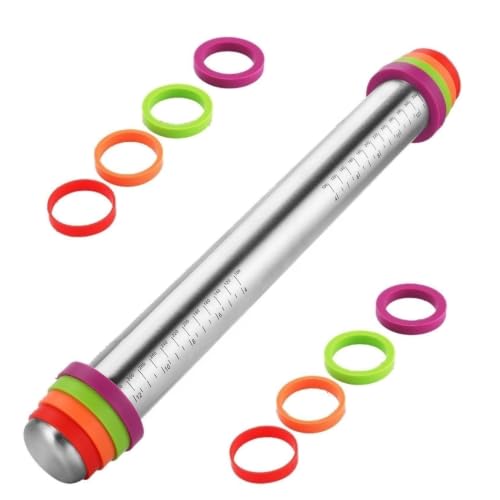
Only one selected product documents adjustable guide rings: the HARFINGTON Fondant Rolling Pin. Its rings are intended to help produce uniform thickness, which can be useful for fondant panels, cookies, and other recipes where matching pieces matters. This feature adds setup and cleaning considerations, but it provides a clearer thickness reference than a plain cylinder.
The other products do not document measurement rings or fixed thickness settings. Their listings describe smooth rolling, even pressure, or broad applications, but those claims should not be expanded into a guarantee of precise thickness. If you select a ring-free roller, thickness will depend on your technique and any separate guides you use.
Think about handling and storage
Lightweight construction appears repeatedly in the listings. HARFINGTON describes its 13-inch roller as very light, FdcZeyxior emphasizes an extremely lightweight design, and NentMent lists a 0.27-pound package weight for its two-piece package. These features may help users who prefer a tool that is easy to maneuver, though the supplied data does not establish how each roller feels during actual use.
The no-handle format is common across these plastic rollers. That keeps the design compact and gives the user direct contact with the cylinder, but it may not suit someone who specifically prefers separate grips. TOPINCN emphasizes compact storage, while the smaller PME, lasenersm, Aemygo, KEPYDRMTF, and Flahard formats are naturally easier to place in a drawer than a long conventional pin.
Several listings describe non-stick or smooth surfaces and easy cleaning. HARFINGTON mentions moisture-resistant material, FdcZeyxior describes the roller as easy to clean, and lasenersm states that its smooth surface is easy to clean. Aemygo and KEPYDRMTF also describe acrylic cleaning with soap, water, or a cloth. These statements indicate maintenance guidance from the listings, not independent testing.
Package size is another practical difference. NentMent supplies two rollers, Aemygo supplies 20, KEPYDRMTF supplies two, and Flahard supplies ten. A multi-piece set can be useful for classes, shared kitchens, or keeping a spare, but it may provide less individual size flexibility than a single longer roller. Pick quantity for your use case rather than assuming more pieces means better baking performance.
How this comparison was ranked
The scoring model uses five category-specific criteria: plastic material fit, surface and roll design, size and thickness control, handling and maneuverability, and use range and cleanup. Material fit and surface design receive the largest weights because a plastic roller should have a clearly documented construction and a surface suited to its stated task. Size and thickness control follow, then handling and maintenance-related utility. The ranking uses listing features and specifications only; it does not use customer sentiment, review information, popularity, or marketplace labels.
Final Recommendation
HARFINGTON Adjustable Fondant Roller, 13-Inch ranks first overall in this specification-based comparison under the published weighted criteria.
The final choice among the best plastic rolling pins depends on the documented features that match your intended use.
HARFINGTON Adjustable Fondant Roller, 13-Inch is the first overall specification-based choice. Its PP construction, non-stick surface, rounded head, broad use list, and adjustable guide rings give it the broadest documented feature combination for fondant and dough work. Among the top plastic rolling pins, it is the clearest fit when consistent thickness is a priority.
Choose the second HARFINGTON 13-inch roller or FdcZeyxior if you want a long, simple, lightweight tool without documented rings. NentMent is the more specialized choice for its convex textured design, while PME and lasenersm make more sense for small decorating surfaces. Aemygo and KEPYDRMTF are better aligned with transparent craft and fondant work, and Flahard is designed around children’s activities and group use.
No product in this list was hands-on tested, and the published evidence does not establish durability or real-world performance beyond the supplied descriptions. Use the dimensions and stated applications as a starting point, especially when deciding between a full-length roller and a compact or craft-focused design.
Frequently Asked Questions
What are the best plastic rolling pins for fondant?
The HARFINGTON Adjustable Fondant Roller is the most specification-aligned option because its listing documents adjustable guide rings, a non-stick PP surface, and a rounded head. The standard HARFINGTON and FdcZeyxior 13-inch rollers are also suitable choices when you want a longer, simple cylinder. PME is more compact and specifically lists sugar paste, rolled fondant, gum paste, and marzipan.
Are acrylic rollers plastic rolling pins?
Yes. Acrylic is a type of plastic, and the Aemygo and KEPYDRMTF listings identify acrylic rollers with fondant use alongside clay and DIY applications. They are best understood as craft- and fondant-oriented plastic rollers. Their shorter lengths and narrow diameters may make them less convenient for large pastry sheets than the selected 13-inch baking rollers.
Is a textured plastic rolling pin better than a smooth one?
Neither design is universally better. NentMent documents convex points intended to help roll bubbles out of dough and stretch it, so that design may fit a specific dough-handling task. Smooth rollers such as the HARFINGTON, FdcZeyxior, PME, and lasenersm models are more directly aligned with fondant and pastry surfaces where a smooth finish is useful. Choose according to the material and finish you need.
What size plastic rolling pin should I choose?
Choose a 13-inch model when you want more coverage for fondant, pastry, pizza, or cookies. A 6- to 7.7-inch roller is more compact for detailed decorating or craft work. The approximately 9-inch Flahard rollers are listed for children and small rollouts. The supplied listings do not establish one universally ideal size, so the size of your work surface and storage space should decide.
Are these plastic rolling pins suitable for children?
Flahard is the clearest child-oriented selection because its listing describes a small format for children, family baking, clay play, and group activities. Other products may also be used for family projects, but their listings do not establish the same child-focused positioning. Adult supervision and the product’s stated materials and intended use should be considered for any children’s activity.