Buying Guide
The best pocket binder index dividers should do more than split pages. They should fit the binder, give each section a readable label, and provide a sensible place for loose papers that do not have punched holes. The products above are compared from listing specifications and feature descriptions, not from hands-on testing or customer opinions.
Start with binder size and hole fit
Most of the selected products are designed for standard three-ring binders and letter-size documents. Oxford, Avery, Dunwell, SUNEE, SKYDUE, and XRUNMIX describe three-hole or standard three-ring compatibility. XRUNMIX specifically identifies US Letter dimensions, while other listings refer to letter-size storage or standard binders. Confirm the binder format before ordering if your system uses a specialty size or unusual hole spacing.
A pocket divider should sit inside the binder without its edges interfering with page turning. The supplied evidence supports standard letter-size use for most selections, but it does not establish compatibility with every planner, mini binder, or nonstandard organizer. Do not assume that a letter-size divider will fit a compact notebook.
Choose the pocket arrangement
Pocket construction is one of the clearest differences between these products. Oxford describes flexible pockets that expand up to 1/4 inch and hold as many as 100 sheets per divider. That makes it a logical choice for handouts, drafts, or project materials that would otherwise need punching.
Avery’s 8-tab and 5-tab Big Tab options provide front and back pockets. Dunwell, SUNEE, SKYDUE, and the XRUNMIX 8-tab design also document two-pocket storage. Dual pockets can separate papers by section or let you store current items on one side and reference material on the other.
Some products use slash pockets rather than a fully enclosed pocket. Dunwell identifies two-sided slash pockets, and SUNEE describes angled slash openings intended to help keep papers from slipping during page turning. Those designs can make access quick, but they may not provide the same coverage as a more enclosed pocket. Amazon Basics and Avery also document two-pocket formats, although the supplied listings provide fewer details about the opening shape.
The Avery Write & Erase set and U Brands use a more limited documented pocket arrangement: a front pocket on each divider. That can be enough for a worksheet or note per section, while also keeping the divider profile simpler. If you routinely carry several loose sheets, prioritize a dual-pocket or expandable design.
Compare tab labeling systems
Tab style determines how quickly a binder can be scanned. Eight-tab products create more sections for subjects, clients, recipes, or projects. Five-tab sets are better when categories are broader and fewer dividers keep the binder visually simpler. The Avery Big Tab 5-tab set and U Brands five-tab set are examples of the latter approach.
Avery’s Big Tab designs emphasize additional writing space and insertable labels. The 8-tab Big Tab option states that it provides 1.5 times more writing space than standard tabs, while the Avery 8-tab set describes 50% more space for text and images. Those features are useful when labels need to include a course number, project code, date range, or longer description.
Reusable labeling is another practical distinction. Avery Write & Erase dividers are designed for write-and-erase use, and U Brands describes tabs that can be written on and erased with a permanent marker and high-polymer eraser. These choices make sense for changing categories. Insertable paper tabs, such as those supplied or described by Oxford, Dunwell, SUNEE, and SKYDUE, are more suitable when you want replaceable printed or handwritten labels.
Consider plastic type and maintenance
Plastic dividers are generally a better fit than paper when the binder will be handled often or exposed to occasional spills. Avery describes its plastic options as tear-resistant and wipeable with most non-abrasive household cleaners. Oxford specifies non-stick polypropylene and describes the material as archival safe. Dunwell identifies acid-free poly, while U Brands, SUNEE, and SKYDUE describe tear-resistant plastic.
These claims describe materials and intended characteristics; they are not independent durability test results. A thicker or more flexible design may still affect how much space the binder needs. Oxford’s expandable pockets, for example, can hold more but may contribute to a fuller binder when loaded. Choose the construction based on the documents you expect to carry rather than assuming every plastic divider behaves identically.
Match capacity to the filing job
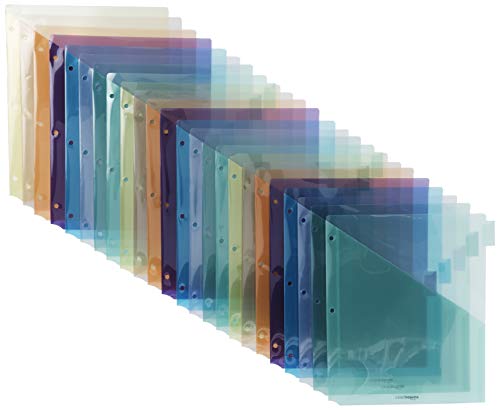
Count the sections first, then consider package coverage. An eight-tab set works well for a single class, project, or general household binder. A five-tab set can be enough for major categories such as planning, receipts, recipes, correspondence, and reference. If you are organizing multiple binders, Amazon Basics lists a 24-count package, while Oxford lists three sets and XRUNMIX lists two packs of eight.
Package structure can matter as much as individual divider design. Multiple sets may provide consistent colors across binders, spare dividers for future sections, or a way to outfit separate work and home systems. Conversely, a single set may be preferable when you want to avoid unused supplies. Review the stated unit count carefully because a listing may describe a set, pack, or number of individual sheets differently.
Final recommendation
Oxford 8-Tab Pocket Dividers, 3 Pack ranks first overall in this specification-based comparison under the published weighted criteria.
Oxford 8-Tab Pocket Dividers, 3 Pack is the highest-scoring returned product and the first overall specification-based choice. Its expandable pockets, three-set format, eight multicolor tabs, included inserts, and polypropylene construction give it the broadest combination of storage and organization evidence. For users focused on larger labels, Avery Big Tab 8-Tab Insertable Pocket Dividers are a close alternative. Avery Write & Erase is better suited to changing categories, while U Brands offers reusable tabs in a five-section format. Among the top pocket binder index dividers, select based on pocket volume, label style, and the number of binders you need to organize. The best pocket binder index dividers are the ones whose documented capacity matches your actual papers without making the binder unnecessarily full.
Frequently Asked Questions
What should I look for in the best pocket binder index dividers?
Check three-hole or standard three-ring compatibility first, then compare pocket arrangement, tab count, label style, material, and package quantity. Expandable or dual-sided pockets are useful for loose papers, while Big Tab or reusable labels help when sections need detailed or changing names.
Are two-pocket dividers better than one-pocket dividers?
Not in every situation. Two-pocket dividers provide more documented storage and can separate papers by side, but a front-only pocket may keep the divider simpler and thinner. Choose dual pockets for frequent loose-paper storage and a single pocket for lighter filing needs.
Are eight tabs or five tabs better for a binder?
Eight tabs suit binders with many subjects or smaller categories. Five tabs work well for broader divisions and can make a short filing system easier to scan. The Avery Big Tab 5-tab and U Brands five-tab options document the smaller format, while Oxford, Dunwell, SUNEE, and several Avery choices provide eight-tab organization.
Can these dividers be used with sheet protectors?
Several Avery listings state that their tabs remain visible beyond sheet protectors. Other selected products are described for standard three-ring binders, but the supplied evidence does not make the same sheet-protector claim for every model. Check the individual listing when that feature is important.
Which selected divider is suited to changing labels?
Avery Write & Erase Pocket Dividers and U Brands 5-Tab View Pocket Dividers both document reusable labeling features. Avery describes write-and-erase tabs, while U Brands describes writing with permanent marker and erasing with a high-polymer eraser. These designs are appropriate when binder categories change over time.