Buying Guide
The best colored file folders with fasteners are not all built for the same filing job. Traditional paper folders are usually the simplest choice for punched documents and cabinet storage, while pocket folders add a place for loose pages. Classification folders take the concept further with dividers and more fastening points. Before choosing, match the folder’s material, internal layout, and capacity to the documents you actually handle.
Most products in this comparison are designed for US letter-size paper measuring 8.5 by 11 inches. That includes the Staples Reinforced Tab Fastener Folder, Smead 12740, Pendaflex 22140GW, Office Depot 144277OD, Smead 12050, FILE-EZ EZ-92500, Amazon Basics AMZ67713, Office Depot OD22740, and Amazon Basics AMZ64075. Letter-size compatibility is the most suitable starting point for ordinary office, classroom, and household records.
The products differ in how they hold documents. Traditional fastener folders attach punched pages to the inside covers. The Staples folder, Smead 12740, Pendaflex folder, and Office Depot 144277OD all document two fasteners. This arrangement creates separate filing surfaces and helps keep pages in a chosen order. FILE-EZ uses three prongs, which may be preferable when a project benefits from a different punched-paper layout.
Compare paper, pressboard, and pocket construction
Paper stock is appropriate when the folder will be stored in a filing cabinet or handled in a normal indoor office. The 11-point construction documented for the Staples, Blue Summit Supplies, Smead 12740, and Office Depot 144277OD folders gives those models a clearer durability specification than listings that do not state a paper weight. Reinforced tabs are also useful because the tab is the area most often labeled and pulled.
The Amazon Basics classification folder uses 25-point pressboard covers and 17-point kraft dividers. That makes it a more structured design for project files with several sections. Its 2-inch expansion spine can accommodate more material than a flat folder, although a fuller file will naturally take more room in storage.
Pocket folders solve a different problem. Amazon Basics AMZ67713 documents two pockets and a business-card holder, while FILE-EZ EZ-92500 specifies two 4.75-inch pockets and reinforced edges. These designs can retain handouts, receipts, forms, or other loose papers that do not have holes. The fasteners still secure punched pages, so the folder can combine both storage methods.
Check fastener placement and capacity
Fastener count alone does not tell the whole story. Look for the placement and the kind of documents you need to organize. The Pendaflex 22140GW has embedded fasteners in positions 1 and 3, while the Amazon Basics classification folder adds fasteners to its dividers as well as its covers. That additional structure may help separate project stages, records, or related document groups.
Expansion is another important specification. The Staples folder expands up to 2 inches, Smead 12740 and Smead 12050 document 3/4-inch capacity, and the Amazon Basics classification folder expands to 2 inches. Pendaflex lists spine score marks that make some room as files grow. If a listing does not state a measurement, do not assume it will accept a thick stack simply because it has fasteners.
Sheet capacity figures also need context. Amazon Basics AMZ67713 states a capacity of up to 135 letter-size sheets, while FILE-EZ describes its pockets as holding 30 or more letter-size sheets each and its fasteners as holding 40 or more punched documents. These figures come from the supplied listings and should be treated as product guidance rather than a universal capacity test.
Use color and tabs as part of the filing system
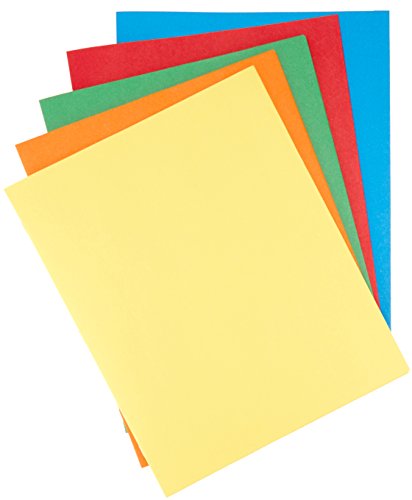
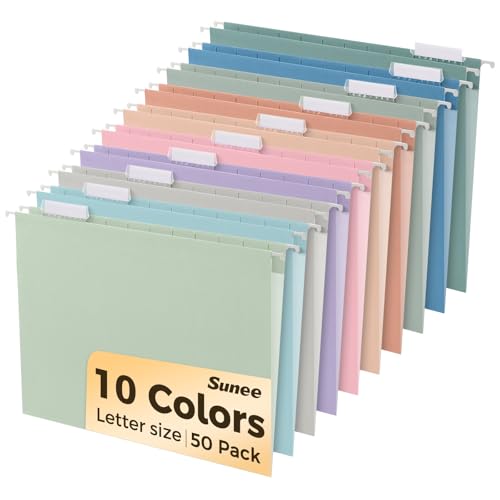
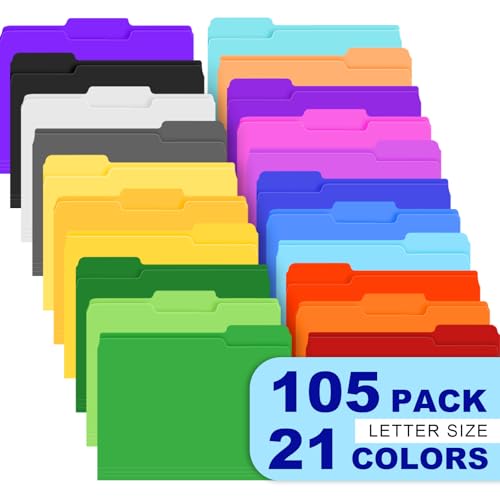
Color is most useful when it follows a consistent rule. For example, one color can identify a department, school subject, client type, or stage of a project. Assorted packs such as the Staples folder, Blue Summit Supplies folder, Office Depot 144277OD, FILE-EZ EZ-92500, and Amazon Basics AMZ67713 offer more than one documented color. Single-color options such as Smead 12740 in red, Smead 12050 in blue, and Pendaflex 22140GW in green can work well when you are replenishing one category.
Tab configuration matters when several folders sit next to one another. Three 1/3-cut positions appear in many traditional designs, including Staples, Smead, Pendaflex, and Office Depot products. Pendaflex specifically describes staggered left, center, and right positions for visibility in vertical or lateral cabinets. The Amazon Basics classification folder uses current listing information-cut tab, so it may be a better fit for users who prefer that labeling position.
Consider pack size and storage conditions
A 50-folder pack is practical for an office, classroom, clinic, or records project that requires consistent replenishment. Smaller sets such as the 21-folder Smead 12050, 25-folder Amazon Basics AMZ67713, and 10-folder Amazon Basics classification folder may be easier to match to a smaller filing task. Pack size can also affect how many unused folders you must store.
The paper products are documented for ordinary filing but are not described as waterproof. Pocket designs made from plastic are a separate category choice when resistance to spills or outdoor handling matters; however, only selected products with that construction should be discussed in a comparison. The selected FILE-EZ and Amazon Basics pocket folders use paper, so they should not be treated as water-resistant alternatives.
Match the design to the job
For standard records with punched pages, choose a two-fastener folder with reinforced tabs. For mixed punched and loose documents, choose a pocket-and-prong model. For project binders inside a folder, choose a classification design with dividers and expansion. For a large color-coded filing rollout, prioritize pack quantity and tab positions. These distinctions make it easier to narrow the field without relying on undocumented assumptions.
Final Recommendation
Staples Reinforced Tab Fastener Folder, 50-Pack ranks first overall in this specification-based comparison under the published weighted criteria.
Staples Reinforced Tab Fastener Folder, 50-Pack is the highest-scoring returned product and the first overall specification-based choice. Its 11-point stock, two fasteners, reinforced tabs, three tab positions, assorted colors, and 2-inch expansion cover the broadest range of everyday filing needs in this comparison.
Smead 12740 is a close alternative for users who prefer a red folder with two filing surfaces and documented recycled content. Blue Summit Supplies is compelling when repeated fastener use and color-coded office files are priorities. Choose Pendaflex 22140GW when staggered tab visibility matters, or Amazon Basics AMZ64075 when dividers and expansion are more important than a large assortment.
For loose documents, FILE-EZ EZ-92500 and Amazon Basics AMZ67713 are the more suitable designs because their pockets complement the fasteners. Among the top colored file folders with fasteners, the best match depends on whether your priority is cabinet filing, project separation, or mixed paper storage. The best colored file folders with fasteners are therefore the ones whose documented capacity and layout fit your workflow rather than simply the ones with the most features.
Frequently Asked Questions
Among the best colored file folders with fasteners, what size papers do these folders hold?
Most selected products are designed for US letter-size sheets measuring 8.5 by 11 inches. This includes the traditional paper folders, pocket folders, and the classification folder in the comparison. Confirm the size before ordering if your documents use a different format.
Are two fasteners enough for ordinary records?
Two fasteners are suitable for many punched-paper filing tasks because they create two filing surfaces inside the folder. The Staples, Smead 12740, Pendaflex, and Office Depot folders document this arrangement. A three-prong design or divider-based classification folder may be more useful for projects requiring additional internal separation.
Should I choose pockets or traditional folder panels?
Choose pockets when you need to store loose, unpunched papers such as handouts or receipts. Traditional panels are simpler when most documents are already punched. FILE-EZ and Amazon Basics AMZ67713 combine pockets with fasteners, while the Staples and Smead traditional folders focus on fastened pages and tabbed filing.
What does expansion capacity mean?
Expansion capacity describes how much the folder’s spine can open to accommodate additional documents. The Staples and Amazon Basics classification folder list 2-inch expansion, while the Smead folders list 3/4-inch capacity. A larger capacity may help with growing files, but it also requires more shelf or cabinet space.
How should I use assorted colors?
Assign each color a consistent meaning, such as department, subject, client, or project status. Assorted packs can support a broader color system, while single-color packs are useful when replenishing one category. Combine color with readable tab labels so the filing system remains understandable when folders are moved.