Buying Guide
Choosing the best blank binder index dividers starts with the binder and documents you already have. The options in this comparison are primarily designed for standard three-ring binders and 8.5 x 11-inch letter-size pages, but their tab layouts, materials, and quantities differ substantially. Match the divider design to the way you file rather than choosing only by appearance.
Most of the paper choices here document a letter-size format and three-hole punching. That matters because a divider that is too small, too large, or punched for another ring system can interfere with page turning and document alignment. YesBes, Oxford, SUNEE, WritePads, Forvencer, and SKYDUE describe compatibility with standard three-ring binders or 8.5 x 11-inch pages. Avery also describes a three-ring binder format.
If your binder uses a horizontal orientation or legal pages, verify that specialized format separately before ordering.
Choose the right number of tabs
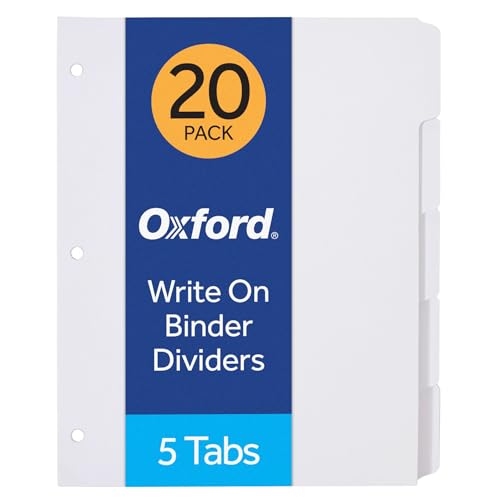
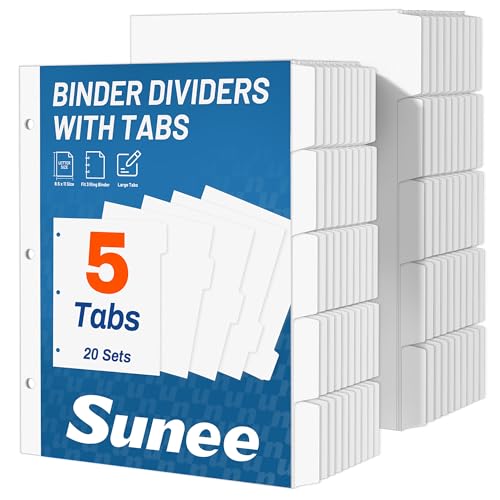
Tab count determines how many categories one complete set can separate. Five-tab designs are a familiar choice for basic subjects, departments, or document stages. Oxford, SUNEE’s 100-pack, Forvencer, Homakover, and Avery use five-tab layouts. They can be easier to plan when a filing system has only a few recurring categories.
Eight-tab sets are better when a single binder covers more subjects or a project has several phases. WritePads and SUNEE’s compact eight-tab pack document eight-tab configurations. SKYDUE also supplies eight dividers, although its design emphasizes plastic pockets and pastel colors as much as tab count.
Six-tab sets sit between those two approaches. The YesBes 204-pack and 120-pack use six-tab sets, providing a moderate number of sections while offering many complete sets for separate binders. Consider how many tabs you will label at once and whether every set needs to be complete.
Paper versus plastic
Paper dividers are generally the simplest option for handwritten labels and large quantities. The selected paper products document white or kraft stock, and several specifically describe smooth surfaces for pen or pencil. YesBes documents 200 gsm stock, while Forvencer documents 180 gsm stock and coated plastic edge reinforcement. Those specifications can be useful when dividers will be handled often, although they do not replace hands-on durability testing.
Plastic dividers are a different design choice. SKYDUE uses flexible PP plastic and supplies two clear pockets on every divider. Avery uses durable plastic with insertable tabs and one pocket per divider. These features can help when binders regularly carry loose handouts, receipts, flashcards, or notes. Plastic may also be easier to wipe clean, but the trade-off is a smaller quantity in the selected packs and a different labeling process for Avery’s insertable tabs.
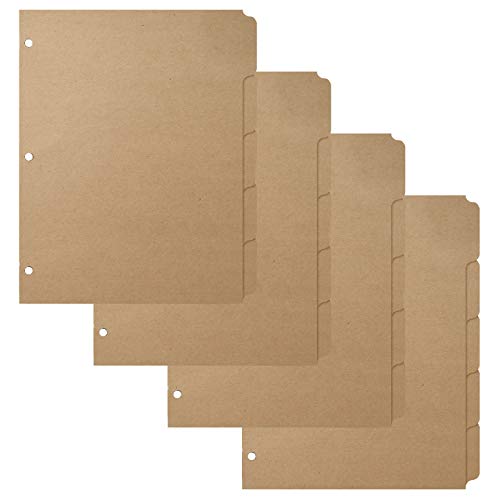
Kraft paper offers a more distinctive appearance. Homakover documents blank kraft paper and a big-tab design with expanded writing space. It may suit recipe binders, college materials, or professional records where a natural paper look is preferred over bright colors or plain white stock.
Think about how labels will be made
Blank tabs are valuable because they let you create categories that are specific to your filing system. Oxford says its tabs can be written on directly with pen or pencil. WritePads describes large blank writable tabs, and the paper designs from SUNEE and YesBes also document customizable writing surfaces. Forvencer adds extra-wide tabs, which may be useful for longer handwritten labels.
Reusable labeling works differently. Avery’s insertable tabs allow labels to be replaced without changing the divider itself, while SKYDUE includes separate blank index labels. This can be preferable for changing school subjects, rotating clients, or project files. However, insertable systems require label inserts, and included labels may be easier to use for some people than creating labels from scratch.
Evaluate pack quantity
Pack size should match the number of binders and the likelihood that labels or dividers will be replaced. The YesBes 204-pack is the largest selected supply, followed by the 120-divider YesBes set, the 100-divider Oxford and SUNEE packs, and WritePads’ 96-divider package. These larger packs are suited to classrooms, offices, households, or anyone maintaining several binders.
Smaller packs can be more appropriate for a single binder. SUNEE’s eight-tab option supplies 32 dividers, Forvencer supplies 30, Homakover supplies 20, and the plastic designs supply eight Avery or SKYDUE dividers. Smaller quantities reduce leftover stock and make it easier to test a format before standardizing a filing system.
Match features to the filing job
For plain paper filing, prioritize the correct page size, a tab count that fits your categories, and a writing surface suited to your labeling tool. For documents that travel, pockets can be more useful than a larger quantity. For repeated handling, documented heavier paper, reinforced edges, or plastic construction may be worth considering. For color-coded workflows, choose the multicolor YesBes, Forvencer, Avery, or SKYDUE designs rather than adding color labels later.
Remember that the specifications describe intended construction and included features; they do not establish long-term performance under a particular workload. The rankings here therefore favor clearly documented compatibility and useful design features instead of claims about results.
Final recommendation
YesBes 204-Pack 6-Tab Blank Dividers ranks first overall in this specification-based comparison under the published weighted criteria.
YesBes 204-Pack 6-Tab Blank Dividers is the first overall specification-based choice in this comparison.
YesBes 204-Pack 6-Tab Blank Dividers is the best blank binder index dividers choice when you need a large supply, six-section organization, and documented 200 gsm paper for letter-size three-ring binders. Its 204-divider configuration gives it a strong overall specification balance in this comparison.
WritePads is a strong alternative for eight-section systems, while Oxford and SUNEE offer straightforward five-tab bulk packs. Choose Forvencer when reinforced edges and multicolor tabs matter. For loose papers, SKYDUE and Avery add pockets, with Avery offering insertable labels for reuse. Among the top blank binder index dividers, the right choice depends chiefly on tab count, material, labeling method, and how many binders you need to organize.
Frequently Asked Questions
Among the best blank binder index dividers, what size binder do these blank dividers fit?
Most selected paper products are documented for standard three-ring binders and 8.5 x 11-inch letter-size pages. Confirm both the binder ring arrangement and page dimensions before purchase, especially if your system is legal-size, landscape, or another specialty format.
Are paper or plastic dividers better for frequent use?
The answer depends on the filing conditions. Forvencer documents coated edge reinforcement, YesBes documents 200 gsm paper, and SKYDUE and Avery document plastic construction. Plastic may be preferable for loose papers or wipe-clean handling, while paper usually offers more choices for large multi-pack quantities and direct writing.
Which tab count should I choose?
Choose five tabs for a simple filing system, six tabs for a middle ground, and eight tabs when one binder needs more categories. WritePads and SUNEE document eight-tab options, while YesBes offers six-tab packs and Oxford, Forvencer, and Homakover use five-tab designs.
Can I change the labels later?
Paper tabs can be relabeled by writing new categories over or replacing the divider, depending on the surface and writing tool. Avery uses insertable tabs, which are specifically suited to changing labels, and SKYDUE includes blank index labels. Check the supplied labeling method before assuming a divider is erasable or reusable.
Do pocket dividers replace sheet protectors?
Pocket dividers can hold loose sheets, but they are not described as full-page sheet protectors. SKYDUE documents two clear pockets per divider, and Avery documents one pocket per divider. Use those pockets for the loose items they are designed to store, and choose another filing accessory when full-page protection is required.