Buying Guide
Choosing among the best pocket radios starts with the kind of broadcast you expect to hear. AM/FM is sufficient for general news, music, sports, and talk programming. Shortwave adds access to a wider range of broadcasts but can require more careful antenna positioning and favorable surroundings. NOAA weather coverage is a separate band capability, so it should not be assumed merely because a radio is described as portable or suitable for emergencies.
The models in this comparison are selected from the supplied listing specifications. The ranking weighs documented radio bands, station controls, power design, portability, and listening features. It does not represent hands-on testing. Claims such as reception quality, sound clarity, or battery duration are included only where the product listing specifically supplies them.
Choose the right radio bands
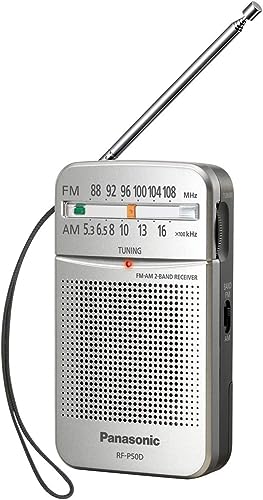
For a conventional daily radio, the Panasonic RF-P50D, Sangean DT-200X, C. Crane CC Pocket, and PRUNUS J-555 all document AM/FM reception. These models are appropriate when you want a familiar local-station format without shortwave controls.
If international or extended-band listening matters, consider the XHDATA D220 or XHDATA D221. Both list AM, FM, and shortwave coverage. The D221 goes a step further by adding the NOAA weather band. Jazmm also lists four-band AM/FM/shortwave/NOAA reception, making it the most expansive band specification in this group alongside the D221.
Weather-band access is especially relevant if you want a radio that can receive NOAA broadcasts. The C. Crane CC Pocket and Sangean DT-400W also list NOAA coverage, but their designs focus on AM/FM and weather rather than shortwave. Check the band list carefully: a radio may have a flashlight, emergency-oriented wording, or a portable design without documenting NOAA reception.
Compare tuning and station storage
Digital tuning is useful when you want repeatable station selection and stored channels. The Sangean DT-400W and DT-200X each list 19 presets. Paeiope lists 50 AM and 50 FM memories, giving it the largest documented station-storage capacity here. Retekess V112 supports manual station storage and both manual and semi-automatic tuning.
Analog tuning can be more direct. Panasonic uses a slide-rule dial with one-finger tuning, while PRUNUS J-555 uses rotary tuning and volume controls. XHDATA D220 combines a tuning knob with a band switch and a volume/power control. These layouts may suit listeners who prefer physical controls over keypad or menu navigation.
A lock button can matter when a radio is carried in a pocket or used during movement. Retekess V112 specifically lists a lock button.
Consider battery and charging arrangements
Power design affects how you maintain a radio. Replaceable AA or AAA batteries are widely familiar and can be swapped when depleted. The C. Crane CC Pocket, Sangean DT-400W, Sangean DT-200X, Panasonic RF-P50D, and XHDATA D220 or D221 use AA batteries according to their listings. PRUNUS J-555 uses AAA batteries and also supports USB-C charging.
Rechargeable models reduce the need to carry replacement cells. Retekess V112 lists a 500mAh rechargeable lithium battery and at least 10 hours of operation depending on volume. Jazmm lists a 1250mAh rechargeable battery and 10 to 12 hours of music and news on one charge. Paeiope lists a 600mAh battery and Type-C charging. Those figures come from product listings, not independent measurement.
Some radios combine radio reception with other playback. Jazmm documents Bluetooth and TF-card MP3 playback, while Paeiope lists TF-card playback for MP3 and WMA files. These features can be useful if you want stored audio as well as broadcasts, but they also add controls beyond a basic AM/FM receiver.
Match the listening hardware to your setting
A built-in speaker is convenient for shared listening or when you do not want to wear earbuds. C. Crane, Panasonic, XHDATA D220, XHDATA D221, Jazmm, and Paeiope all list built-in speakers. Jazmm specifies a 5W speaker, while Panasonic specifies a 2.25-inch speaker; these are product specifications, not comparative sound tests.
Headphone support is useful for private listening. C. Crane includes earbuds, and Retekess V112 documents FM stereo through earphones. The Sangean models, Panasonic, Paeiope, PRUNUS J-555, and both XHDATA selections list headphone or earphone connections. Confirm whether headphones are included: the supplied evidence says C. Crane includes earbuds and Paeiope uses an earphone wire as an antenna, but not every listing includes listening accessories.
Display and control visibility also differ. The C. Crane and Sangean DT-400W list backlit displays, while Paeiope describes a large backlit display. Panasonic uses LED indicators for tuning strength and battery status. Radios with physical dials may be easier to understand at a glance, while digital models can offer presets and automatic seeking.
Check size and carrying details
Pocket suitability is not determined by one dimension alone. Retekess V112 lists a 1.58-ounce weight and a 3.3-by-0.5-by-1.8-inch size, making it the lightest selected model by the supplied specification. PRUNUS J-555 lists a 3.9-by-2.3-by-1.0-inch design with a clip and lanyard. XHDATA D220 and D221 list the same compact 125-by-74-by-30mm body size.
Larger radios may provide room for a bigger speaker, display, or controls. Panasonic lists a 2.25-inch speaker, and Jazmm lists a 5W speaker, but their exact carrying experience is not independently tested here. Before choosing, compare the stated dimensions with the pocket, bag, or belt clip you plan to use.
Final Recommendation
Jazmm Bluetooth AM/FM/Shortwave Radio ranks first overall in this specification-based comparison under the published weighted criteria.
C. Crane CC Pocket is the first overall specification-based choice among these best pocket radios because it combines AM/FM and NOAA reception with presets, a speaker, earbuds, clock functions, backlight, and sleep timer. The Sangean DT-400W is a close fit for listeners who prioritize 19 presets and NOAA access. For the top pocket radios with broader bands, choose XHDATA D221 for AM/FM/shortwave/NOAA or Jazmm for four-band reception plus Bluetooth and TF playback. Retekess V112 is the more focused pick for lightweight rechargeable AM/FM carrying, while PRUNUS J-555 suits people who want both USB-C and AAA power.
The final choice should follow your documented requirements. Select AM/FM-only models for simple local listening, add shortwave when that band is important, and verify NOAA support when weather broadcasts are a priority. Then decide whether presets, a physical dial, rechargeable power, a speaker, or headphone listening matters most to your routine.
Frequently Asked Questions
What should I look for in the best pocket radios?
Start with the bands you need: AM/FM for regular local broadcasts, shortwave for wider-band listening, and NOAA for weather broadcasts. Next, compare tuning style, presets, battery format, dimensions, speaker details, and headphone support. A radio with many features is not automatically the right fit if you only need straightforward AM/FM operation.
Which selected radios include NOAA weather-band reception?
The C. Crane CC Pocket, Sangean DT-400W, XHDATA D221, and Jazmm model list NOAA or weather-band reception. XHDATA D221 and Jazmm also list shortwave, while the C. Crane and Sangean models focus on AM/FM plus weather coverage. Review the stated bands before choosing a weather-oriented radio.
Are rechargeable pocket radios better than battery-operated models?
Neither power design is universally preferable. Rechargeable models such as Retekess V112, Jazmm, and Paeiope can be charged through a cable. Battery-operated models such as Panasonic RF-P50D and XHDATA D220 use replaceable cells. PRUNUS J-555 documents both USB-C charging and AAA operation, which provides two listed power paths.
Do all pocket radios include headphones?
No. C. Crane specifically lists included earbuds, while some other models list only a headphone or earphone jack. Retekess V112 documents FM stereo through earphones, and Paeiope describes the earphone wire as an antenna. Check the supplied accessories and connection details for the exact model you select.
Is shortwave useful on a small radio?
Shortwave can be useful if you want broadcasts beyond standard AM/FM, but reception depends on conditions and antenna placement. XHDATA D220, XHDATA D221, and Jazmm document shortwave coverage. Their listings do not establish universal reception performance, so treat the band specification as capability rather than a guarantee of a particular result.