Buying Guide
The best pointed gardening shovels are defined by more than a sharp-looking tip. A useful comparison starts with the shape of the head, then considers how the handle, foot support, construction, and overall length match the job. The products above are ranked from listing-based specifications, not hands-on testing. Claims about durability or ease of use are included only where the supplied product information describes the relevant material or feature.
Choose the blade shape for the job
A round point is the most flexible design in this group. It suits planting holes, general soil preparation, edging, and moving moderate amounts of loose material. The HIGHLIGHT 41-Inch Round Point Shovel, Professional’s Choice, Cyrico, and Xinmeto models all document round-point heads. A pointed or round-point tip can enter soil more directly than a flat material-moving blade, but the exact advantage depends on ground conditions and the user’s technique.
A narrow drain or transplanting spade is more specialized. The WIKER Sharp Shooter Drain Spade and HIGHLIGHT 45-Inch Spade Shovel document slender profiles for working near roots, opening drainage trenches, or making narrower excavations. These designs can be preferable in established beds because the head is intended to occupy less surrounding soil. They are not the first choice when the main task is shifting large quantities of compost or loose dirt.
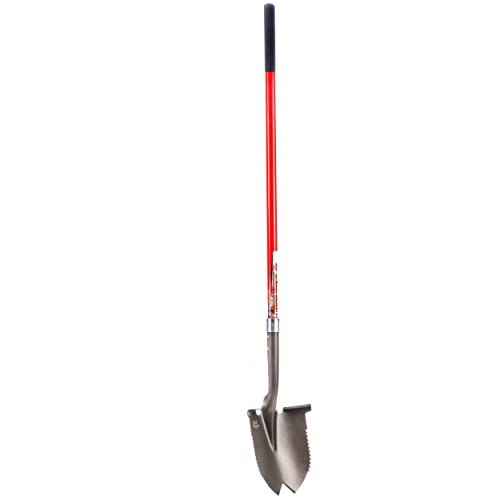
Root-focused edges are another distinct option. Root Slayer’s serrated blade and inverted V cutting tip are specifically documented for sod, compact soil, and stubborn roots. HANTOP also lists a sawtooth blade for harder ground and roots. Serrations add a specialized cutting feature, but they do not make every shovel suitable for every digging task; check whether your work involves roots before prioritizing this design.
Match handle length to your working position
Length changes both reach and control. The 56-inch Xinmeto is the longest selected model and is positioned in its listing for upright digging and taller users. A full-length shovel can reduce the need to crouch, while a 45- or 46-inch tool such as WIKER, HIGHLIGHT 45-Inch, or Bully Tools offers a more conventional long-handle format.
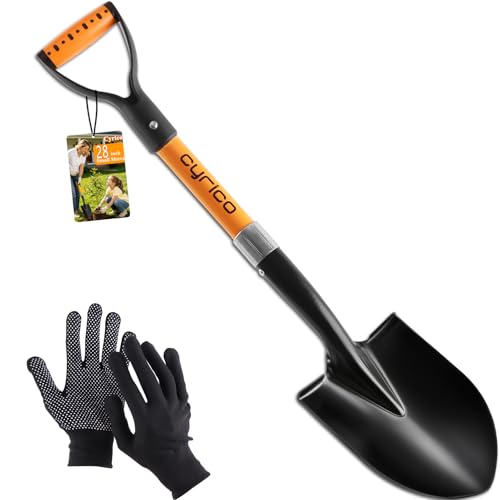
Short shovels trade reach for maneuverability. LUBAN measures 31.5 inches, while Professional’s Choice and Cyrico are 28 inches. These formats can fit raised beds, narrow work areas, trunks, or camping gear more easily. They may also require more bending during extended use. Consider the height of the person using the shovel and whether the work will happen at ground level, inside a garden bed, or in open yard space.
Look at the grip and force-transfer features
A D-grip gives the upper hand a defined holding point and appears across many selected models. It can be useful when lifting, guiding, or turning a blade. Foot platforms are also important for pointed digging because they provide a place to apply downward pressure. LUBAN, Cyrico, HIGHLIGHT 41-Inch, and Xinmeto document foot support or a wide foot tread.
Handle material affects the documented design trade-off. Fiberglass appears on Bully Tools, WIKER, Professional’s Choice, Xinmeto, and HANTOP. Wood appears on the HIGHLIGHT models, while LUBAN uses an all-stainless construction. The listings describe different goals, such as resistance to splintering or corrosion, but they do not establish that one material is universally better. Inspect the joint, grip shape, and maintenance instructions before buying.
Consider blade and shaft construction
The most specification-aligned evidence for heavy-duty construction comes from specific material and reinforcement details. Bully Tools lists a 14-gauge steel head and welded I-beam construction. Professional’s Choice also lists a 14-gauge head, while Root Slayer documents 13-gauge mid-carbon steel. Other selected models identify carbon steel, manganese steel, stainless steel, or rust-resistant coatings.
These specifications help distinguish a shovel intended for repeated soil work from one intended mainly for light portability. They still do not prove a product will never bend, crack, or corrode. Avoid treating promotional wording as a test result, and consider rinsing and drying the blade after use, particularly when working in wet or salty conditions.
Balance portability with digging capacity
Compact models are easier to store but usually provide less reach and a smaller working head. Cyrico, HANTOP, and Professional’s Choice are all 28-inch options, while LUBAN is just over 31 inches.
Longer models provide more reach and may suit open beds, landscaping, and deeper excavation. Root Slayer, Xinmeto, and Bully Tools occupy that end of the comparison. Before choosing, measure your available storage area and decide whether the shovel must fit a car trunk, shed, or camping kit. A technically capable shovel that is difficult to store may be less useful in your routine.
Final recommendation
Root Slayer XL Round Point Digging Shovel ranks first overall in this specification-based comparison under the published weighted criteria.
The final choice among the best pointed gardening shovels depends on the documented features that match your intended use.
Root Slayer XL Round Point Digging Shovel is the highest-scoring returned product and the first overall specification-based choice. Its serrated inverted-V tip, 13-gauge carbon steel, and reinforced fiberglass shaft give it the clearest documented case for root-heavy landscaping. Among the top pointed gardening shovels, WIKER is the more focused choice for narrow trenching and transplanting, while LUBAN is a better fit when compact stainless construction matters. For upright digging, Xinmeto’s 56-inch model offers the most reach. For tight spaces, compare the short Professional’s Choice, Cyrico, and HANTOP designs.
Frequently Asked Questions
What should I look for in the best pointed gardening shovels?
Start with a blade shape that matches the task. Choose a round point for general planting and soil work, a narrow drain spade for transplanting or trenching, or a serrated point when roots are central to the job. Then compare handle length, grip, foot support, blade material, and storage needs. A detailed specification is more useful than a generic claim that a shovel is heavy duty.
Are short pointed shovels useful for gardening?
Yes. Short models such as LUBAN, Professional’s Choice, Cyrico, and HANTOP are documented for compact handling or portable storage. They can be practical in raised beds, tight spaces, car trunks, and camping kits. The trade-off is reduced reach, so users may need to bend more during prolonged digging. Match the length to the user’s height and the position of the work.
Is a narrow spade better for transplanting?
A narrow spade can be a strong fit when the goal is to dig close to existing plants or make a relatively narrow trench. Both WIKER and the HIGHLIGHT 45-Inch Spade Shovel document narrow transplanting or drainage-oriented designs. A narrow head generally moves less soil than a broad round point, so it is more specialized rather than universally better.
Which selected shovel is best for roots?
Root Slayer has the clearest root-specific evidence because its listing describes a serrated blade and inverted V cutting tip. HANTOP also documents a sawtooth blade for harder ground and roots. These features make both worth considering for root-related work, while the longer Root Slayer shaft is better suited to reach and leverage than the mini format.
How should I choose between fiberglass, wood, and stainless construction?
Use the supplied construction details as a comparison point rather than assuming one material always wins. Fiberglass appears on several full-length and compact models, wood appears on the HIGHLIGHT options, and LUBAN documents all-stainless construction. Consider handle length, grip, foot platform, corrosion information, storage, and the type of soil you expect to handle. The listings do not provide controlled tests proving universal superiority for any material.