Buying Guide
The best portable lab oscilloscopes are not defined by one specification alone. A model with the highest bandwidth may be less useful than an instrument with deeper memory, better triggering, more channels, or a battery that suits field work. Start by identifying the signals you expect to inspect, then match the acquisition hardware and workflow features to those tasks.
Choose bandwidth and sampling together
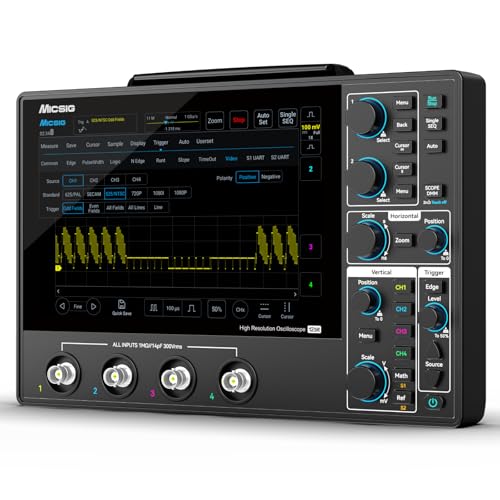
Bandwidth describes the range of frequencies an oscilloscope can represent, while sampling rate describes how frequently it records the signal. Consider both specifications together. The OWON SDS220 and HANMATEK DOS1202 document 200 MHz bandwidth and 1 GSa/s sampling, making them suitable for broad general-purpose bench work. The SainSmart Micsig MHO1 also reaches 200 MHz and adds 12-bit acquisition, although its channel count is not stated in the supplied listing.
The RIGOL DHO802 lists 70 MHz bandwidth, 1.25 GSa/s sampling, and peak detection for glitches down to 1.6 ns. That combination is relevant to power-supply ripple, embedded bring-up, and intermittent-event investigation. For less demanding signals, the PicoScope 2204A documents 10 MHz bandwidth and 100 MS/s sampling. Its limits are clearer, but that can suit basic electronics, teaching, and audio-related work.
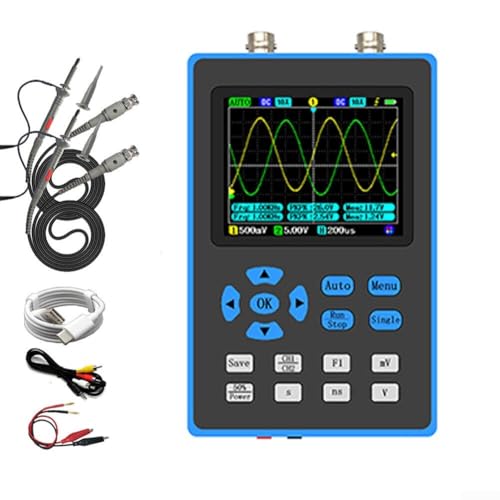
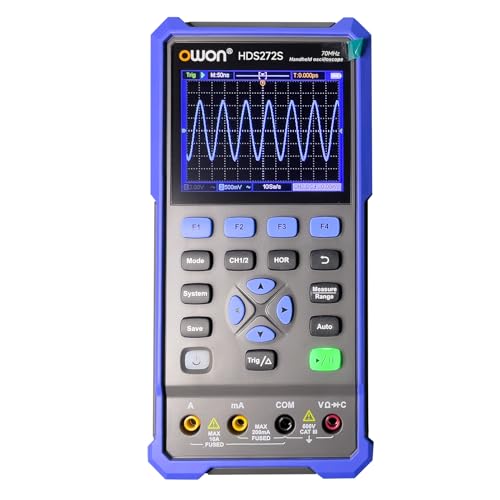
Several handheld choices sit between those specifications. The DSO2512G lists 120 MHz bandwidth and 500 MSa/s sampling, while the FNIRSI 1013D Plus lists 100 MHz and 1 GSa/s. The OWON HDS272S lists 70 MHz and 1 GS/s, and the FNIRSI DS215H lists 50 MHz and 250 MS/s. These models are easier to carry and can cover many repair and hobby tasks, but their smaller records or displays may matter when examining long captures.
Match channel count to the measurement
Two channels are useful for comparing an input and output, checking timing between two nodes, or viewing a reference alongside a measured waveform. The RIGOL DHO802, OWON SDS220, HANMATEK DOS1202, DSO2512G, FNIRSI 1013D Plus, OWON HDS272S, FNIRSI DS215H, and PicoScope 2204A all document two-channel operation.
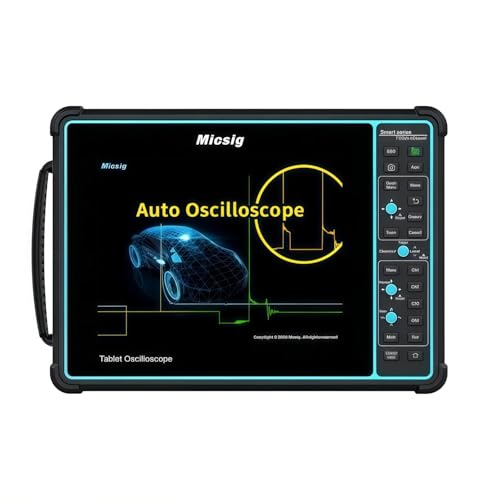
More channels become important when several related signals must be observed at once. The Micsig SATO1004 documents four channels and is designed around automotive work, including sensors, actuators, ignition, charging, starter circuits, and vehicle networks. It is therefore a suitable fit for multi-signal vehicle diagnosis. The SainSmart Micsig MHO1 has extensive acquisition and control features, but the supplied evidence does not identify its channel count; buyers should verify that detail before ordering.
A channel count is not a voltage-safety recommendation. Where the listing supplies a voltage limit, treat it as a product specification rather than a substitute for proper probing practice. The FNIRSI 1013D Plus lists continuous protection up to 400 V, and the OWON HDS272S lists a maximum voltage measurement of ±400 V. Probe attenuation, circuit category, grounding, and the actual signal being measured still need separate consideration.
Look at memory, triggering, and analysis
Memory depth determines how much of a waveform can be retained for later examination. The SainSmart Micsig MHO1 lists 110 Mpts, and the RIGOL DHO802 lists up to 25 Mpts. Those figures are useful when a user needs to zoom into events or preserve a longer acquisition. The Micsig SATO1004 instead emphasizes a 130,000-waveform-per-second capture rate and 32 GB internal storage, which suits repeated automotive diagnostics and file handling.
The DSO2512G lists 128Kbit memory, the FNIRSI 1013D Plus lists 1 GB storage for screenshots and waveform data, and the HANMATEK DOS1202 lists at least 10K sampling points per acquisition and storage for at least 16 waveform groups. The OWON SDS220 also lists storage for at least 16 groups. These specifications are not directly interchangeable, so consider whether your work needs deep single captures, many saved files, or fast repeated updates.
Trigger modes help turn a moving trace into a usable measurement. Automatic, normal, and single triggers appear on several selected models, including the OWON SDS220, FNIRSI 1013D Plus, and FNIRSI DS215H. The RIGOL DHO802 adds peak detection, waveform search, navigation, and an event table. Serial decode is another distinction: the RIGOL DHO802 documents CAN, RS232/UART, I2C, SPI, and parallel decode, while the PicoScope 2204A documents decoding over 30 serial protocols.
FFT is useful when a time-domain waveform needs frequency-domain context. It is documented on the RIGOL DHO802, OWON SDS220, DSO2512G, FNIRSI DS215H, and OWON HDS272S. Generator functions also change the workflow. The DSO2512G, FNIRSI DS215H, and OWON HDS272S include documented signal-generation features, while the PicoScope 2204A supports function and arbitrary waveform generation through its software.
A USB PC scope such as the PicoScope 2204A is the smallest option in this group and is powered through USB. It is well suited to a laptop-based lab, classroom, or travel kit, but it depends on the computer for its interface. Tablet-style instruments such as the RIGOL DHO802, SainSmart Micsig MHO1, and Micsig SATO1004 provide integrated screens and controls. They occupy more space than a small handheld, but their larger displays can make multi-trace viewing and documentation easier.
Handheld instruments prioritize mobility. The DSO2512G, FNIRSI 1013D Plus, FNIRSI DS215H, and OWON HDS272S document rechargeable batteries or battery-powered operation. The HDS272S is also a multimeter and signal generator, which may reduce the number of separate devices needed during field service. The FNIRSI DS215H is more compact, but its 3.5-inch display and 1 Kpts record length make it better suited to quick checks than extensive waveform history.
Check connectivity and documentation needs
Connectivity matters when measurements need to be saved, shared, automated, or viewed on another display. The RIGOL DHO802 offers LAN, Web Control, LXI-C, SCPI, USB, and HDMI. The SainSmart Micsig MHO1 supports SCPI, mobile-app control, PC control, and HDMI. The Micsig SATO1004 lists Wi-Fi, LAN, HDMI, Type-C, and USB, along with internal storage. These are the most extensively documented choices for remote or connected workflows.
The HANMATEK DOS1202 lists LabVIEW communication and SCPI compliance, while the PicoScope 2204A supports Windows, Linux, and Mac through PS7 software. More basic handheld scopes still provide useful transfer options: the DSO2512G supports USB export, and the OWON HDS272S supports Type-C transfer for captured images. Before buying, confirm the operating system, cable, software, and storage method that fit your existing setup.
Final recommendation
SainSmart Micsig MHO1 ranks first overall in this specification-based comparison under the published weighted criteria.
SainSmart Micsig MHO1 is the highest-scoring product and the first overall specification-based choice among these best portable lab oscilloscopes.
The SainSmart Micsig MHO1 combines 12-bit resolution, 200 MHz bandwidth, deep memory, a large touch display, battery operation, and connected-control options. The RIGOL DHO802 is a strong alternative for users who prioritize serial decode, automatic measurements, glitch capture, and LAN-based workflows. The OWON SDS220 and HANMATEK DOS1202 suit users seeking 200 MHz dual-channel bench coverage.
For automotive work, the Micsig SATO1004 offers the clearest multi-channel and vehicle-system focus. The PicoScope 2204A is the most travel-friendly PC instrument, and the OWON HDS272S is practical when an oscilloscope, multimeter, and generator need to share one handheld enclosure. The DSO2512G, FNIRSI 1013D Plus, and FNIRSI DS215H cover lighter mobile repair and education needs with different balances of display size, memory, generator capability, and portability. These top portable lab oscilloscopes should be compared by task rather than by headline bandwidth alone.
Frequently Asked Questions
What should I prioritize when choosing the best portable lab oscilloscopes?
Prioritize the signal frequency range, sampling rate, number of channels, record depth, trigger features, and power format. For remote work, also check battery operation, display size, file transfer, and software support. A two-channel scope can cover many electronics tasks, while automotive diagnosis may benefit from the four-channel Micsig SATO1004.
Are portable oscilloscopes suitable for bench work?
Yes. Models such as the RIGOL DHO802, OWON SDS220, HANMATEK DOS1202, and SainSmart Micsig MHO1 document features associated with bench analysis, including high sampling rates, large displays, memory, measurements, and connectivity. Tablet and handheld formats can also be useful when the instrument must move between a bench and a field location.
Is a USB PC scope different from a handheld oscilloscope?
A USB PC scope uses a computer for power, display, and control. The PicoScope 2204A follows this format and supports PS7 software on Windows, Linux, and Mac. A handheld or tablet scope has its own display and controls and may include a rechargeable battery. The better format depends on whether you value minimum size and computer analysis or independent operation.
Which selected model includes a signal generator?
The PicoScope 2204A includes function and arbitrary waveform generation through its software. The DSO2512G, FNIRSI DS215H, and OWON HDS272S list integrated generator functions. The HDS272S additionally combines its generator with multimeter functions, while the DS215H emphasizes a compact DDS generator and the DSO2512G lists output up to 10 MHz.
Can I use these scopes for automotive troubleshooting?
Several selected products document automotive-oriented use. The Micsig SATO1004 is the most specialized in the comparison, listing ignition, sensor, actuator, network, charging, starter, and pressure tests. The OWON HDS272S, FNIRSI DS215H, DSO2512G, and SainSmart Micsig MHO1 also support portable repair or field work. Verify voltage limits, probes, grounding, and application requirements before connecting to a vehicle system.