Buying Guide
Choosing among the best rectangular wastebaskets starts with the space, the type of waste, and how often the container will be emptied. Rectangular sides can use wall-adjacent floor area efficiently, but the actual footprint varies substantially. Measure the available length, width, and height, then leave room for removing a liner or opening a lid.
Match capacity to the room
Small bathroom and bedroom bins generally favor compact capacities. The iDesign Mono is listed at 2.5 gallons, while the SIDIANBAN is listed at 1.3 gallons. These sizes can make sense for paper, packaging, tissues, and other light daily waste, but smaller containers may need more frequent emptying. The Sterilite 5.5-gallon model offers a middle ground and is documented to accommodate an 8-gallon liner.
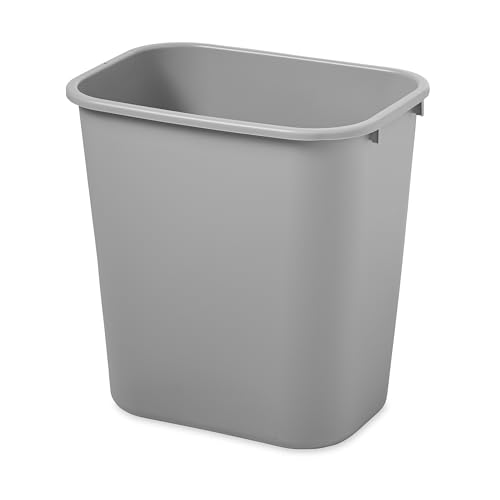
For offices, classrooms, or shared spaces, larger capacity can reduce emptying frequency. The Rubbermaid Commercial 10.25-gallon model is the largest selected bin and is positioned for desk-side use. The trade-off is its larger stated footprint. A high-capacity container is useful only if it does not obstruct drawers, walkways, cabinet doors, or chair movement.
Measure narrow spaces carefully
A “slim” label is not a substitute for measurements. The iDesign Mono lists a 7.5-inch width and a tapered form intended for cabinets, desks, and sinks. TOPZEA lists a 6-inch width, making it one of the narrowest options here. The SIDIANBAN lists a 5.5-inch width, although its lid and pedal also need operating clearance.
Check both the top and bottom shape. Tapered bins may offer a wider opening than their base, which helps access but changes how much floor area they occupy. The TOPZEA listing supplies both overall and bottom dimensions, which is useful when fitting it beside furniture. For any model with conflicting or incomplete dimensions, verify the seller’s current dimensional drawing before purchase.
Choose open, lidded, or divided access
Open-top bins are the simplest to use. They suit offices and bedrooms where quick disposal matters and there is little need to hide contents. The Amazon Basics, Sterilite, and Rubbermaid Commercial models use straightforward open or accessible designs. Their lack of a lid also means fewer components to clean or operate.
A lidded wastebasket can provide more visual containment. The SIDIANBAN uses a bamboo lid, soft-close action, and a foot pedal. WDPUCHU uses a push-operated swing lid. These features may be useful in bathrooms, kitchens, or other areas where covered waste is preferred, but they add moving parts and require enough clearance for the mechanism.
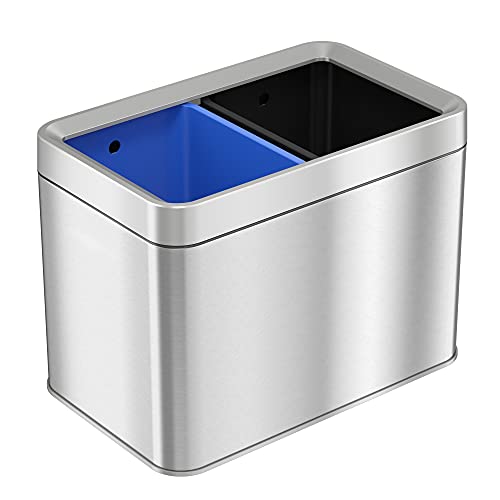
A divided bin addresses a different need. The iTouchless has two 2.65-gallon compartments for trash and recycling. That arrangement can save floor space compared with placing two separate bins side by side. It also means each compartment is smaller than the overall 5.3-gallon capacity, so it may not suit bulky waste.
Compare materials and care
Plastic is a practical choice for routine waste. Sterilite describes a textured easy-clean surface, while the Rubbermaid Commercial listings describe all-plastic construction that will not chip, rust, or dent. Plastic is also generally easier to wipe than porous decorative materials, though the evidence supplied here should not be extended beyond each listing’s claims.
Steel and bamboo change the visual and handling profile. iTouchless uses brushed stainless steel and describes resistance to fingerprints, smudges, and rust. TOPZEA uses bamboo with a black finish and recommends damp-cloth cleaning. The SIDIANBAN combines an iron body with a natural bamboo lid. These materials can coordinate better with a room, but follow the supplied care directions rather than assuming a wooden or metal bin is suitable for soaking.
Look for handling features
TOPZEA and the SIDIANBAN include carry-oriented features, while iTouchless provides removable inner buckets with built-in handles. WDPUCHU adds wheels for repositioning. By contrast, several open plastic models emphasize light construction and simple placement but do not document handles.
Liner management is another practical detail. Always compare the liner guidance with the bin’s actual capacity; an oversized liner may be awkward, while a tight liner can pull away from the rim.
Consider multipacks and placement plans
Multipacks can be useful when several rooms need matching bins. Amazon Basics supplies two 3-gallon containers, and DAJITRE supplies two 3.5-gallon containers. A pair may work for a bathroom and bedroom, two desks, or separate waste locations. It does not automatically mean each bin is larger or more capable, so compare per-bin capacity and dimensions.
For a dorm, RV, or small apartment, prioritize a documented narrow footprint and simple cleanup. For a workplace or shared area, prioritize capacity, durable construction, and fast access. For a bathroom, a covered or pedal-operated design may better suit the setting. These distinctions make the top rectangular wastebaskets useful for different jobs rather than interchangeable.
Final recommendation
iTouchless 5.3-Gallon Dual-Compartment Wastebasket ranks first overall in this specification-based comparison under the published weighted criteria.
The final choice among the best rectangular wastebaskets depends on the documented features that match your intended use.
Buyers needing more capacity should consider the Sterilite 5.5-Gallon or Rubbermaid Commercial 10.25-Gallon models. For a narrow decorative setting, iDesign Mono and TOPZEA are stronger fits; for covered bathroom use, SIDIANBAN is the more feature-focused option. The top rectangular wastebaskets differ mainly in capacity, clearance, access, and cleanup, so confirm measurements before selecting one.
Frequently Asked Questions
Among the best rectangular wastebaskets, what size rectangular wastebasket is suitable for a bathroom?
A compact model such as the 1.3-gallon SIDIANBAN or 2.5-gallon iDesign Mono can suit light bathroom waste, especially where floor space is limited. A 3.5-gallon Rubbermaid Commercial or DAJITRE bin may be more convenient when the room produces more daily waste. Measure around the toilet, vanity, and door swing before choosing.
Are open-top or lidded wastebaskets better?
Open-top models are faster to use and have fewer parts, which suits offices and bedrooms. Lidded options such as SIDIANBAN and WDPUCHU provide more visual containment and may fit bathrooms or kitchens better. A lid requires clearance and adds a mechanism, so consider whether the added containment is worth that trade-off.
Which selected bin is best for recycling?
The iTouchless is the clearest fit because its listing documents two separate 2.65-gallon compartments for trash and recycling. It keeps both streams in one rectangular unit, although each compartment has less capacity than a single large bin.
Are wooden wastebaskets practical?
TOPZEA is documented with bamboo construction, a finished surface, handles, and damp-cloth care. It can work well where appearance matters, but it should be maintained according to those instructions. A plastic model may be more convenient when the container is likely to encounter wet residue or require frequent rinsing.
What should I verify before ordering?
This is especially important for models whose supplied listing data contains inconsistent or incomplete dimensions. Also check whether a removable bucket, wheels, pedal, or lid is necessary for your intended placement.