Buying Guide
Choosing among the best living room wastebaskets is mainly a matter of matching the bin to the room’s traffic, furniture arrangement, and decorating style. The products above are not hands-on tested. They are ranked from the supplied listing specifications and feature descriptions, with no customer-opinion or marketplace-popularity claims used in the editorial scores.
Start with the waste volume
Capacity affects how often a bin needs to be emptied. The Cesun provides a documented 5-gallon size, while the Yuyetuyo is approximately 4.5 gallons. These are sensible directions for a busy family room, a media room, or a space where paper, packaging, and snack waste accumulate throughout the day. The smusei and Ciao Stilista options go larger, at 9.5 gallons and 9 gallons respectively, but their larger footprints need more open floor area.
Compact bins make sense when the living room primarily collects tissues, receipts, wrappers, and other light waste. The Tidita and Sholramo are both listed at 2 gallons, while the Scakbyer lists 10 liters. A smaller capacity can be easier to position beside a chair or under a desk, but it may require more frequent emptying. Capacity claims are taken from the supplied listings and should be treated as approximate where the source uses approximate wording.
Measure the placement area
Measure the available width, depth, and height rather than relying on a product’s room label. Narrow openings are especially useful beside sofas, consoles, and desks. Cesun lists a 6.9-inch width, LILXIU lists a 6-inch width, and Tidita lists a 6.75-inch width. The Sholramo and iEGrow listings also describe compact forms suitable for tight spaces.
Height changes how noticeable a wastebasket feels. The Yuyetuyo, smusei, and Ciao Stilista designs are taller or more substantial, which can improve capacity but may draw attention beside low furniture. The Coeusy is also tall according to its supplied specifications, despite its narrow listed width. Check the complete height and footprint against baseboards, cabinet doors, and walkways.
Match the construction to the decor
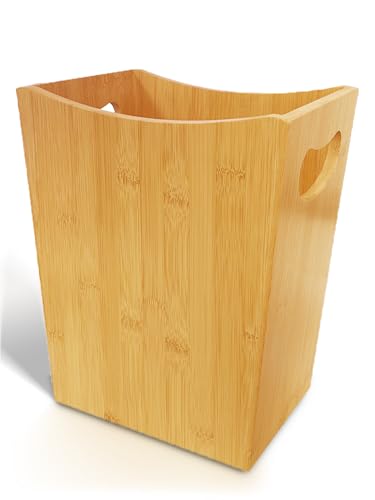
Wood bins suit farmhouse, rustic, country, and warm contemporary interiors. Selected examples include solid pine LILXIU bins, acacia Tidita construction, paulownia smusei construction, and the wood-and-mesh Yuyetuyo design. Wood grain and distressed or walnut-colored finishes make these options look more like furnishings than purely utilitarian containers. However, the sources do not establish that any wood finish is waterproof unless a particular listing says so, so spills should be handled according to the manufacturer’s care information.
Wicker and water hyacinth provide visible texture. The iEGrow and Coeusy products document woven water-hyacinth construction, with Coeusy adding a reinforced iron frame and a removable liner. These styles can complement woven baskets, natural fibers, and boho decor. Wicker texture may be less convenient to wipe than a smooth plastic or metal surface, so consider where drinks, wet waste, or messy materials are likely to appear.
The Scakbyer is different from the wood and wicker choices. Its PU, grey-board, and internal non-woven construction creates a printed decorative accent. It may work well when the wastebasket needs to contribute visibly to the room’s theme rather than blend into it.
Decide whether waste should be concealed
Open-top bins are quick to use and easy to empty. Tidita, Sholramo, iEGrow, and most of the wood designs use an open or wide-access format. This is convenient for paper waste and avoids touching a lid, but the contents remain visible and odors are not enclosed by a lid.
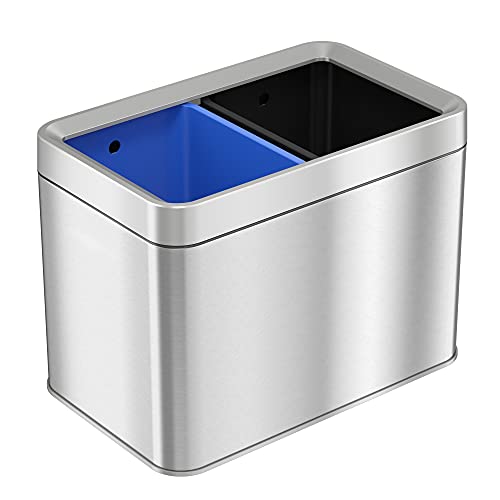
Lidded choices provide more visual separation. Coeusy documents an integrated lid and removable liner, while Cesun specifies a sealed automatic lid. These features are more relevant when the bin is near seating, pets, children, or food service. The Cesun listing also documents a bag-fixing ring, which can help keep the bag edge from hanging outside the bin. The source does not support a universal claim that any selected bin eliminates odors; only the supplied containment features should guide that decision.
Consider handling and cleanup
Side handles and cutouts are useful when the bin must be carried to another room. Cesun has an inner fix ring rather than a traditional external handle, while Ciao Stilista, smusei, Sholramo, Tidita, Yuyetuyo, and LILXIU document handles or handle cutouts. The LILXIU set adds removable plastic liners, and Coeusy also specifies a removable liner. Those designs offer a clearer separation between the decorative exterior and the waste compartment.
Automatic operation is a specialized convenience rather than a requirement. Cesun uses infrared opening and needs batteries. Mechanical simplicity may be preferable if you want no battery-dependent feature.
How this comparison was scored
The editorial criteria reflect this category: capacity and daily-use practicality, space fit, construction and decorative finish, handling and disposal access, and containment and maintenance. Each product received a 0.0-to-10.0 score on every criterion, with the published weights totaling 100. The ranking uses only the supplied product features and specifications. Exact prices, ratings, current listing information, sales activity, and marketplace labels were not used as public evidence or scoring criteria.
Final Recommendation
Cesun 5 Gallon Automatic Bathroom Trash Can ranks first overall in this specification-based comparison under the published weighted criteria.
Cesun is the highest-scoring returned product and the first overall specification-based choice among these best living room wastebaskets. Its documented 5-gallon capacity, slim width, automatic opening, sealed lid, and bag-fixing ring give it the most complete functional specification for a busy living room. Choose Coeusy instead if woven texture, a lid, and a removable liner are more important than electronic operation.
For larger waste loads, Yuyetuyo, smusei, and Ciao Stilista provide more capacity, with different footprint and assembly considerations. For compact decorative placement, Tidita and Sholramo are easier starting points. LILXIU and iEGrow are useful when matching pairs matter. In short, the top living room wastebaskets are not identical: the best choice depends on whether you prioritize concealed waste, large capacity, narrow placement, or visible decorative character.
Frequently Asked Questions
Among the best living room wastebaskets, what size wastebasket works well in a living room?
A 2- to 5-gallon bin is a practical starting range for ordinary paper and light household waste. Tidita and Sholramo are listed at 2 gallons, while Coeusy is listed at 3 gallons, Yuyetuyo at approximately 4.5 gallons, and Cesun at 5 gallons. Larger 9- to 9.5-gallon wood bins may suit high-volume rooms but need more floor space.
Are open-top or lidded wastebaskets better for a living room?
Open-top models are faster to use and simpler to empty, making them suitable for dry paper waste. Lidded designs such as Coeusy and Cesun provide more visual concealment. Cesun additionally documents a sealed lid, while Coeusy specifies a removable liner. The right choice depends on whether quick access or concealed contents matters more.
Which selected wastebaskets fit narrow spaces?
The supplied dimensions identify several compact options. LILXIU lists a 6-inch width, Tidita lists 6.75 inches, Cesun lists 6.9 inches, and Coeusy lists 7.9 inches in its specifications. Always compare the full height and depth with the intended location, especially beside furniture or inside a narrow passage.
Are wooden wastebaskets practical for everyday use?
Wooden wastebaskets can provide a furniture-like appearance and are represented here by Tidita, Sholramo, Yuyetuyo, LILXIU, smusei, and Ciao Stilista. Their listings describe different wood types, finishes, handles, or liners. Because care details vary and not every listing documents a liner or water resistance, use them primarily for appropriate dry waste unless the product instructions state otherwise.
What should I look for if I want easier cleanup?
Prioritize a removable liner, smooth wipeable surfaces, or a bag-fixing feature. Coeusy and LILXIU document removable liners, while Cesun specifies a removable inner fix ring. Wicker, wood, and fabric-like materials may require more careful cleaning than smooth plastic or metal, so the material and interior design should be considered together.