Buying Guide
Choosing the best clarinet reeds starts with understanding how reed design influences your playing. The ten picks in this guide span natural cane and synthetic construction, traditional and modern cuts, and a wide range of strengths, so you can match the reed to your mouthpiece, embouchure, and musical goals.
Understanding Reed Materials
Natural cane remains the most common material for the best clarinet reeds, and it is used in every Vandoren, D’Addario Royal, Rico, and Mitchell Lurie entry in this comparison. Cane provides a familiar warmth and tonal character that many clarinetists prefer, but it can respond to changes in humidity and playing temperature. Synthetic designs from Légère address this by offering a plastic or composite construction that is unaffected by humidity and requires no pre-soaking, making them a practical choice for students, marching bands, and frequent travelers.
Cut Profile and Response
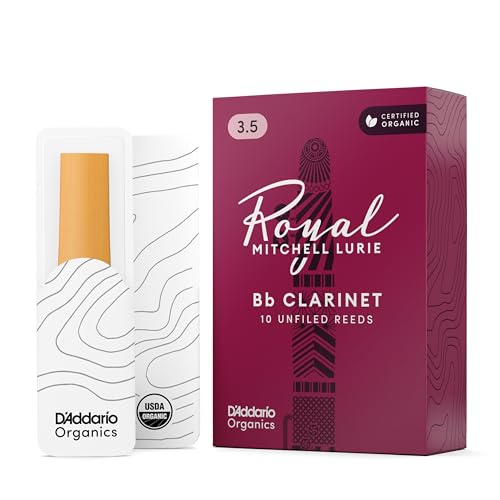
The cut of a reed, including its tip thickness, spine strength, and whether it is filed or unfiled, shapes how a reed responds. The Vandoren CR103 Traditional and the Vandoren 56 Rue Lepic use a thicker cane with a German-style heel taper for traditional and orchestral profiles, while the D’Addario Royal line uses a thinner profile and stronger spine for clarity and ease of response. The D’Addario Mitchell Lurie reeds pair a thinner tip with a medium spine and unfiled cut for a deep, dark tone that supports warmth across registers.
Synthetic Cuts for Consistency
For players who want predictable performance, the Légère Classic and Signature options each target a distinct response. The Classic is built for effortless projection and a darker tone, and the Signature uses a thinner cut for a focused sound requiring less effort. Each synthetic reed is documented as ready to play without pre-soaking and unaffected by humidity.
Strength Range and Matching to Your Embouchure
Reed strength controls how much resistance you feel when you blow. Lower strengths feel easier to play and suit beginners and developing embouchures, while higher strengths offer more resistance and tonal body for advanced players. The Rico Organic comes in 2.5 for students, while the D’Addario Royal is available in 2.5 and 3.5, and the D’Addario Mitchell Lurie is offered in 3.0 and 3.5 within this comparison. The La Voz range adds Soft through Hard for finer selection, and the Vandoren 56 Rue Lepic uses finer graduations such as 3.5+ for very specific embouchure matching.
Consistency Features in Manufacturing
Consistency between reeds in a box matters for both students and professionals. The Vandoren CR103 and 56 Rue Lepic reeds are individually sealed in Flow Pack wrappers to preserve freshness. The Légère reeds use synthetic construction that removes the variability of natural cane, so each reed of the same cut and strength is designed to match the last.
Climate and Moisture Resilience
If you play in humid climates, outdoors, or during long travel days, climate resilience is a key factor. The Légère synthetic reeds are unaffected by environmental conditions. Natural cane reeds such as the Vandoren CR103 and the D’Addario Royal and Mitchell Lurie lines may still respond to humidity, so players who travel frequently may want to keep a synthetic option on hand.
Packaging and Reed Rotation
Multi-pack cane reeds come in 10-packs for the Rico Organic, D’Addario Royal, La Voz, and Mitchell Lurie lines, which supports regular rotation. Synthetic reeds from Légère are sold as single reeds, which is standard for the synthetic category and matches the durability of the material. Students typically rotate through reeds every one to two weeks, so a 10-pack usually covers a school semester.
Matching Reed to Playing Level
Beginner students may benefit most from the Rico Organic 2.5, the D’Addario Royal 2.5, or the Légère Classic 2.50. Intermediate classical players can explore the Vandoren CR103 Traditional 3, the D’Addario Mitchell Lurie 3.0, or the D’Addario La Voz Medium. Advanced orchestral clarinetists may gravitate toward the Vandoren 56 Rue Lepic 3.5+, the D’Addario Mitchell Lurie 3.5, or the D’Addario Royal 3.5. Doublers and marching players may prefer a Légère synthetic reed for climate resilience.
Final Recommendation
Vandoren CR103 Bb Clarinet Traditional Reeds Strength 3; Box of 10 ranks first overall in this specification-based comparison under the published weighted criteria.
The final choice among the best clarinet reeds depends on the documented features that match your intended use.
The Vandoren CR103 Bb Clarinet Traditional Reeds Strength 3 stands as the first overall specification-based choice in this comparison for its documented balance of response across registers, traditional cut that suits a wide range of advancing players, and Flow Pack sealing that supports freshness. It is joined by the Vandoren 56 Rue Lepic as the top clarinet reeds option for advanced orchestral tone, and the Légère Classic 2.50 as the top clarinet reeds option for players who need durable, climate-resistant reeds. Together, these three cover the most common needs on the Bb clarinet, and the rest of the list offers targeted alternatives for specific strengths, cuts, and playing situations.
Frequently Asked Questions
What strengths are best for beginner clarinet players?
Lower strengths are generally easier to play, so beginners often start at 2 or 2.5. The Rico Organic 2.5 and the D’Addario Royal 2.5 are designed for ease of response, and the Légère Classic 2.50 offers a synthetic alternative that plays immediately without pre-soaking. Choosing one of these helps new players build a stable embouchure without fighting too much resistance.
Are the best clarinet reeds always natural cane?
Not always. The best clarinet reeds come from both natural cane and synthetic materials. Natural cane offers the traditional warmth and tonal character, while synthetic reeds from Légère provide durability, climate resistance, and consistent strength from reed to reed. Many players keep both options available so they can switch based on venue and weather.
How often should I rotate my reeds?
Rotating every one to two weeks helps reeds dry evenly and last longer, especially for natural cane. A 10-pack such as the D’Addario Royal or D’Addario Mitchell Lurie provides a full semester of rotation for a student. Synthetic reeds last much longer and do not require rotation in the same way.
What cut should I choose for classical playing?
Classical and orchestral players often prefer a traditional or French cut with a darker tone. The Vandoren CR103 Traditional and the Vandoren 56 Rue Lepic both document characteristics aimed at classical and orchestral repertoire. Players seeking a darker, more centered sound can start with one of these and adjust strength to match their embouchure.
Do higher strength reeds improve sound quality?
Higher strength does not automatically improve sound quality; it mainly increases resistance. The right strength depends on your mouthpiece, embouchure, and air support. The D’Addario Mitchell Lurie 3.0 and 3.5 and the D’Addario Royal 3.5 give you room to experiment, while the Vandoren 56 Rue Lepic offers finer strength graduations for precise matching.