Buying Guide
The best satin door knockers are easier to compare when the finish is treated as only one part of the decision. A satin-nickel appearance can coordinate with other entry hardware, but construction, mounting dimensions, door thickness, and the presence of a viewer determine whether a particular model is appropriate for the installation. The products ranked here were selected from public listing information. They were not physically tested, and this guide does not infer durability or ease of use beyond the supplied specifications.
Start with the door thickness and mounting layout
Before ordering, measure the door and identify the existing holes, if any. QCAA’s viewer and non-viewer models document adjustment for doors from 1.4 to 2.1 inches thick. Those details are useful when replacing hardware, but they should be compared with the actual door before purchase.
Other listings provide different kinds of fit information. Taymor identifies wood, metal, and fiberglass entry doors as suitable surfaces, while Richelieu supplies length, width, and projection measurements. Warwick lists 4-7/8-inch screw spacing. A model with no stated door-thickness range may still be suitable, but the missing information makes a direct fit check more important.
Choose solid brass when the specification matters most
Several of the best satin door knockers in this comparison specify solid brass. QCAA describes its brass construction as supporting corrosion resistance, and both Hillman listings identify solid brass. Schlage also lists durable solid brass and added gauge thickness. These statements describe the supplied construction claims; they are not independent laboratory findings.
Richelieu identifies its product simply as metal, Franklin Brass describes durable metal, and Taymor specifies solid metal. Those options may appeal when dimensions, shape, or coordination are more important than a specifically documented brass body.
Decide whether you need a door viewer
A viewer changes the function of the hardware. QCAA’s two viewer models and Hillman’s viewer-equipped model combine a knocker with a stated 160-degree viewing angle. That can be useful for an entry where the occupant wants to see a visitor before opening the door. The viewer is integrated into the knocker assembly, so installation requirements matter: QCAA specifies a 0.47-inch hole for the viewer.
A viewer-free design may be preferable when an existing door already has separate viewing hardware or when the goal is a simpler exterior feature. The standard QCAA, Hillman 852724, Schlage, Richelieu, Franklin Brass, Taymor, and Warwick models are presented as knockers without an integrated viewer in the supplied evidence. Do not assume that a viewer is included merely because a model has a large face or decorative shape.
Match the visual scale to the entry
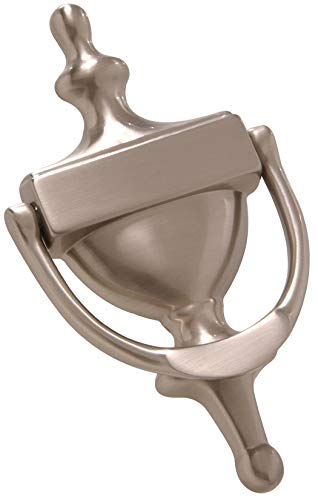
Measure the available area around the door panel, trim, and other hardware. Warwick’s nine-inch design is the largest documented option in this group and is intended for a prominent traditional look. The 7-3/8-inch Victorian QCAA and seven-inch QCAA and Hillman models occupy a middle-to-large visual scale. Richelieu’s 6-1/4-inch body has a stated 11/16-inch projection, which may suit a more restrained installation.
Franklin Brass and Taymor provide smaller, more compact forms. Franklin Brass lists dimensions of about 3.5 by 3.3 inches, while Taymor lists a ring measuring 3-5/8 by 3-7/8 inches. Compact dimensions can help on a narrow panel, but the screw locations and strike plate still need to align with the door surface. Scale is therefore a design and planning consideration, not a guarantee of fit.
Check what comes in the package
Included hardware varies in detail. Most selected products list mounting hardware, and several provide installation instructions. QCAA’s viewer models include long screws and an extension stud for thicker doors. Hillman’s viewer model lists two screws, two screw extensions, and two trim rings. Taymor includes a strike plate, mounting hardware, and instructions, while Franklin Brass lists mounting hardware and a limited lifetime warranty.
Those details can reduce uncertainty, but they do not replace a measurement. Prime the installation plan around the stated screw spacing, hole size, door thickness, and surface type. If the listing does not provide one of those specifications, verify it with the seller or compare the product diagram before drilling.
Compare finish terminology carefully
Most selected listings use satin nickel directly, while Hillman describes a brushed satin-nickel finish. Satin chrome appears in other available listings, but this ranking focuses on the candidates with the clearest satin-nickel evidence and the most useful supporting specifications. Finish names can look different under indoor and outdoor lighting, so coordinate against the actual handle, lock, mail slot, or house numbers rather than relying only on a product title.
Final recommendation
QCAA Victorian Rope Knocker with 160° Viewer ranks first overall in this specification-based comparison under the published weighted criteria.
The final choice among the best satin door knockers depends on the documented features that match your intended use.
QCAA 7-Inch Brass Knocker with 160° Viewer is the highest-scoring returned product and the first overall specification-based choice. It combines solid brass, a satin-nickel finish, a 160-degree viewer, a stated 1.4- to 2.1-inch door range, and hardware for thicker doors. The Hillman 7-Inch Brass Knocker with 160° Viewer is a close alternative for buyers who value its detailed package contents. For a viewer-free design, the QCAA 7-Inch Solid Brass Satin-Nickel Knocker offers strong fit information, while the Richelieu Onward is a sensible compact option. These are among the top satin door knockers here because their documented features address different installation priorities rather than relying on popularity signals.
Frequently Asked Questions
What should I measure before buying the best satin door knockers?
Measure the door thickness, existing hole diameter, screw-center spacing, and the clear area around the intended mounting position. Also check whether the door is wood, metal, or fiberglass. QCAA provides a 1.4- to 2.1-inch adjustment range on several models, while Taymor identifies compatible door surfaces. Those specifications are useful starting points, but the actual door measurements should control the final selection.
Do satin door knockers include a viewer?
Only some do. The QCAA viewer models and Hillman’s viewer model explicitly combine a knocker with a 160-degree viewer. The other selected designs are presented as knockers without an integrated viewer, and Warwick specifically states that its eye viewer is not included. Check the individual listing rather than assuming that every satin finish model has visitor-viewing functionality.
Is solid brass necessary for an exterior knocker?
Not necessarily. Solid brass is clearly documented for QCAA, Hillman, and Schlage, with QCAA also describing corrosion resistance. Richelieu, Franklin Brass, and Taymor identify metal construction without specifying solid brass. The appropriate choice depends on the desired construction evidence, design, dimensions, and compatibility. A metal specification alone should not be rewritten as a solid-brass claim.
Which satin-nickel knocker is best for a compact entry?
Richelieu’s Onward model provides a 6-1/4-inch length and 11/16-inch projection, while Franklin Brass and Taymor list smaller overall forms. Compare those dimensions with the available door-panel space and mounting layout. A compact body does not by itself confirm that existing holes will align.
Are mounting instructions always included?
No. Many selected listings mention mounting hardware, and Taymor and Hillman provide more detailed package information. The supplied evidence does not give identical installation documentation for every model. Confirm the included parts, required hole size, and any need for a drill before starting the installation.